
Branded vs. Non-Branded Search: What It Really Tells You About Your Electrical Company's Growth
The split between branded and non-branded search shows whether your electrical company is growing its market or just catching people who already know your name.
Think of branded search like the customer who already has your card in their glovebox. They type your company name into Google because they already decided to call you and just need the number. Non-branded search is the opposite. Someone types "electrician near me" or "whole house surge protector install" without knowing your name exists. They found you cold.
Both look the same in your analytics. They are not the same, and the ratio between them tells you more about your company's future than almost any other number you can pull.
What Branded and Non-Branded Search Actually Mean
A branded search contains your company name or a variation of it. "Ramos Electric," "Ramos Electric reviews," "Ramos Electric phone number." A non-branded search does not. "Electrician near me," "EV charger installation cost," "why does my breaker keep tripping."
The difference is intent before the click. Branded searchers already know you. Non-branded searchers are still deciding who to hire, and that is where new customers actually come from.
Why the Split Is a Growth Report, Not Just a Chart
Open Search Console and pull your last 90 days. Look at how many clicks came from queries that contain your business name versus queries that describe the job.
If almost all of your traffic is branded, your website is working as a phone book for people who would have found you anyway. That feels good because the conversion rate on branded traffic is high. It hides a problem. You are not adding new customers. You are just not losing the ones who already picked you.
Non-branded clicks are the growth signal. Every non-branded click is a homeowner or a general contractor who did not know your name five seconds ago and now has you on the list. That is how a company goes from the third truck to the fifth truck.
Why a Branded-Heavy Profile Feels Like Winning and Is Not
The trap is real. Branded searches convert because the decision is already made, so the dashboard looks efficient. You see a low bounce rate and a strong phone call rate and assume the marketing is working.
Here is what the number is actually telling you. A branded-heavy split means your reputation and word of mouth are doing the work, but your online visibility to new buyers is thin. That is a fragile position. If a competitor starts outspending you on the non-branded terms, they quietly intercept the next wave of homeowners while your branded clicks keep looking healthy.
This is what our contractor SEO guide calls demand capture versus demand creation. Branded search captures demand you already earned. Non-branded search creates demand for you in the first place.
The Demand Gap: How to Read the Split Like a Contractor
Think of it like a job site. Branded search is the repeat client who calls because you did good work last year. Non-branded search is the cold lead from the yard sign or the truck wrap.
A healthy electrical company in a competitive metro wants the majority of its new opportunities to come from non-branded terms. A useful benchmark to watch is the direction of the trend, not one snapshot. If non-branded clicks are flat for six straight months while your branded clicks keep climbing, your growth is coming from word of mouth, not from the market. That is fine in the short term and dangerous in the long term, because word of mouth has a ceiling and a competitor with a search strategy does not.
Google reports that roughly 15 percent of the queries it sees every day are searches it has never seen before. Demand keeps shifting. If you are not building pages for the new ways people describe electrical work, someone else is.
How to Build Non-Branded Visibility for an Electrical Company
You do not rank for "electrician near me" by accident. You earn it with a small number of deliberate moves.
Own the services you actually sell. Every service on your menu, from panel upgrades to EV charger installs to whole-house rewires, needs a dedicated page with its own title, its own copy, and its own local intent. A single "services" page cannot rank for all of them. Our guide to how SEO works for home service businesses walks through why one page per service is the foundation.
Claim every city and neighborhood in your radius. Homeowners search for "electrician in [town]" constantly. A page for each area you actually serve, written honestly about the work you do there, is how you show up when they do. This is the number one gap we see in electrical sites that lean branded, and our thin location coverage guide shows how to fix it.
Make your Google Business Profile do the heavy lifting for near-me searches. The map pack sits above the organic results for almost every local electrician query. A complete, verified profile with real reviews is the fastest non-branded win available. Our Google Business Profile optimization guide covers the fields that move the needle.
Answer the questions people type before they are ready to buy. "How much does a panel upgrade cost" and "do I need a permit to add an outlet" are non-branded searches from homeowners still doing research. Answering them earns the click today and the booking in a few weeks. If you want the framework for turning questions into pages, our guide to how electricians build their first keyword list shows the exact process.
A 90-Day Plan to Shift the Split
You cannot flip the ratio overnight, and you should not try. You can bend it.
Month 1: Measure the baseline. Pull 90 days of Search Console data and write down your branded to non-branded ratio. Note which five non-branded queries already send clicks. That is your starting foundation.
Month 2: Build the pages that are missing. Publish the service pages and area pages that do not exist yet. Map each one to a real query people already search. Do not write ten thin pages. Write five strong ones.
Month 3: Reinforce with links and reviews. Get listed in local directories, ask every completed job for a review, and make sure each new page links to the next relevant one. Google rewards sites that look like a real, connected business, and our breakdown of Google ranking factors explains which signals matter most for local results.
By the end of the quarter you want to see one thing: non-branded clicks rising while branded clicks stay level or grow. That is the difference between a company that gets found and a company that gets recognized. One you control. The other you are just enjoying while it lasts.
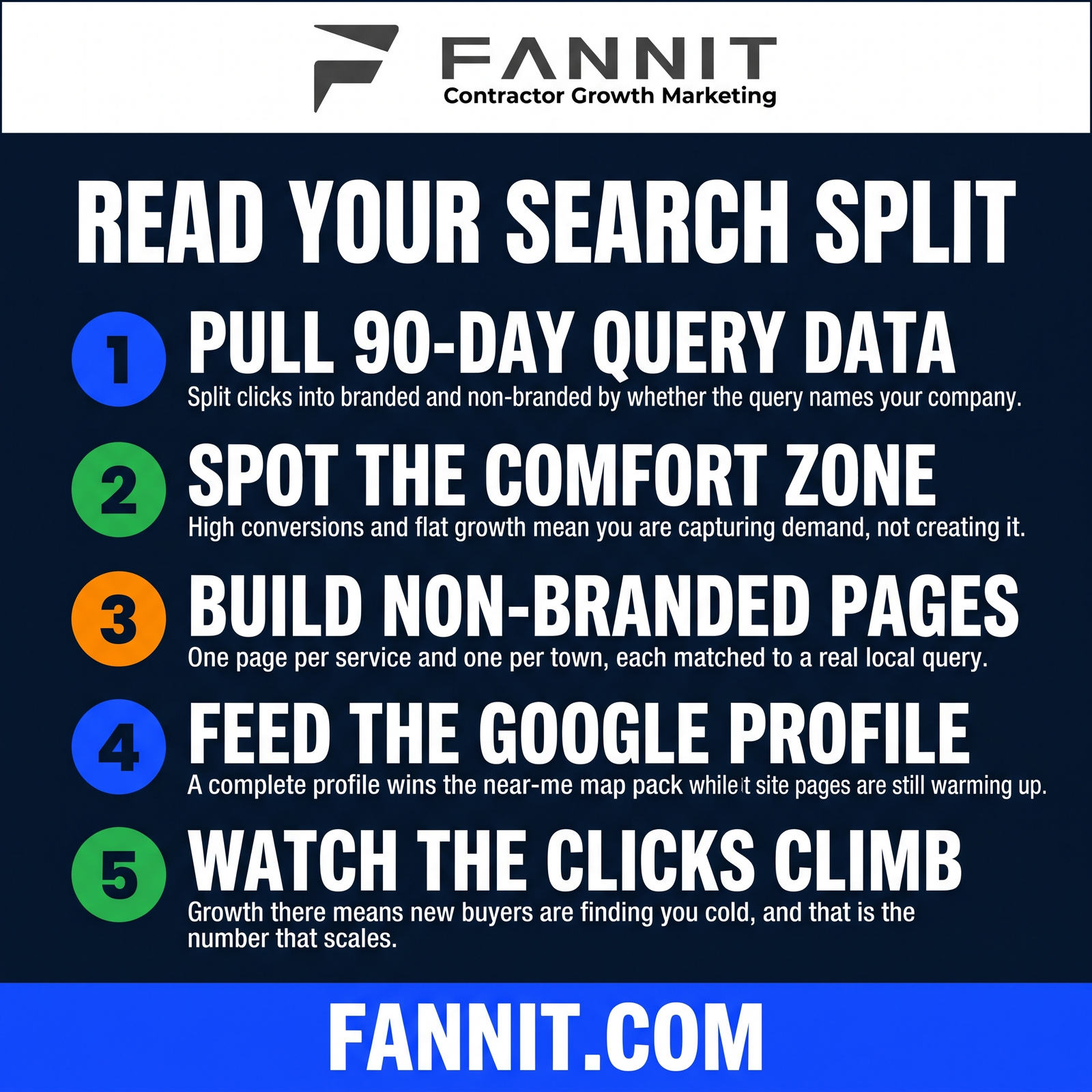
<a href="https://www.fannit.com/blog/branded-vs-non-branded-search-electrical-company/" title="Branded vs Non-Branded Search — Electrical Company Growth Guide"><img src="https://www.fannit.com/images/blog/infographic-branded-vs-non-branded-search-electrical-company-1920x1080.png" alt="Branded vs Non-Branded Search — Electrical Company Growth Guide [Infographic]" width="800" /></a><br /><small><a href="https://www.fannit.com/blog/branded-vs-non-branded-search-electrical-company/">Branded vs Non-Branded Search — Electrical Company Growth Guide</a> via <a href="https://www.fannit.com">Fannit | Contractor Growth Marketing</a></small>

Keith Eneix is the Co-Founder and President of Fannit, a digital marketing agency built exclusively for home service contractors. He still owns and operates a multi-seven-figure contracting business in the Pacific Northwest. Since 2010, Fannit has helped 200+ contractors generate $100M+ in documented revenue.
Full Bio