
Commercial vs. Residential Electrical Ads: Why They Need Separate Google Ads Campaigns
A general contractor searching for a bid and a homeowner searching for a fix are not the same buyer. Here is why commercial and residential electrical ads need their own campaigns.
A general contractor searching for a bid on a ten-thousand-square-foot tenant buildout and a homeowner searching for someone to fix a tripped breaker are both "electrical leads." That is where the similarity ends. They use different words, want different things, spend different amounts, and buy on different timelines.
Running them in the same Google Ads campaign is like bidding a commercial job with residential pricing. The numbers come out wrong and you cannot see why.
Two Buyers, Two Searches, Two Timelines
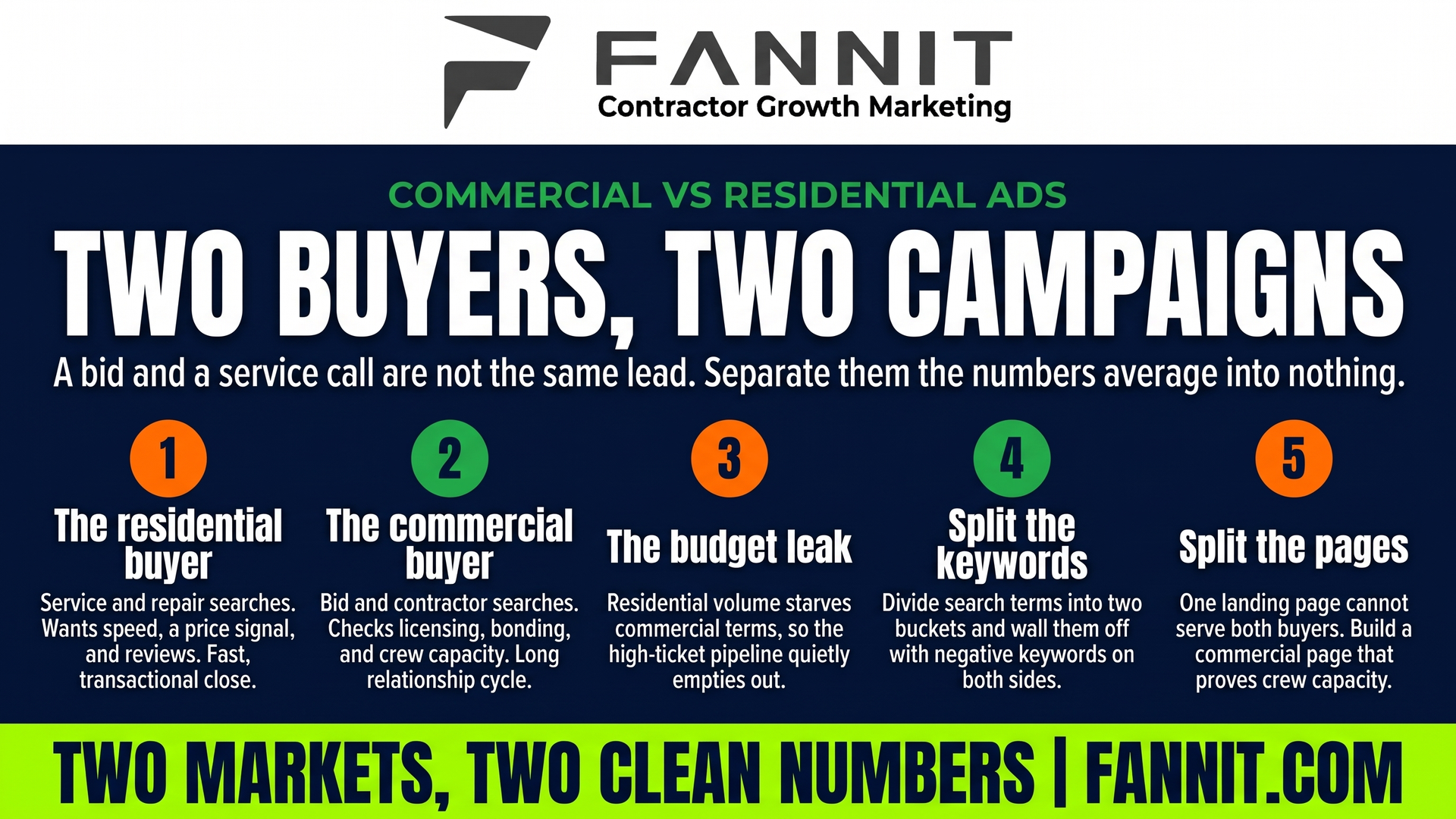
The residential buyer is searching "electrician near me" or "outlet not working." They want someone today or this week, the job is usually under a few thousand dollars, and the decision is fast. Volume is high, the close is quick, and the sale is transactional.
The commercial buyer is searching "licensed commercial electrician" or "electrical contractor for tenant improvement." They are comparing bids, checking licenses and insurance, and the job might run for weeks at five or ten times the ticket. Volume is low, the cycle is long, and the sale is a relationship.
When both land in the same campaign, your cost per lead averages the two together and tells you nothing. A $400 commercial lead and a $60 residential lead average to $230, and you cannot tell which one is actually earning its keep. Our guide to running Google Ads as a contractor covers why clean separation is the whole game. Google Ads account structure guidance recommends aligning each campaign to a single goal, which is exactly the split you are making.
Why One Campaign Fails Both Buyers
The keywords fight each other. Commercial and residential terms trigger the same ads, so a homeowner sees an ad written for a facility manager and skips it, while a general contractor sees an ad written for a homeowner and assumes you are too small for the job.
The budget goes to whoever shouts loudest. Residential terms have far more search volume, so they consume the daily budget and starve the commercial terms that carry the real margin. Your high-ticket pipeline quietly empties while the small jobs fill the schedule.
The landing pages cannot do two jobs. A commercial buyer needs proof of licensing, bonding, crew capacity, and past commercial work. A residential buyer needs a phone number, a price signal, and reviews. One page cannot serve both without failing both.
What Separation Actually Looks Like
Split into two campaigns, each with its own keywords, ad copy, landing pages, and budget.
The residential campaign targets service and repair terms, leads with speed and reviews, sends clicks to residential service pages, and gets a budget sized for volume and fast closes.
The commercial campaign targets commercial and contractor terms, leads with licensing, insurance, and project capacity, sends clicks to a commercial capabilities page, and gets its own budget that is protected from being eaten by residential volume.
Each campaign reports its own cost per lead, close rate, and cost per booked job. That is the only way the numbers mean anything. Our Google Ads cost guide shows how to set budgets so neither side cannibalizes the other. And our electrician CPC guide shows how commercial and residential clicks price out differently.
How to Split Without Wrecking Your Account
You do not need a complicated rebuild. Start with the split that matters most.
Separate the keywords first. Pull your search terms and divide them into residential and commercial buckets. Put a hard wall between them with negative keywords so neither campaign bleeds into the other. The small-budget structure guide shows how the three-intent split keeps a lean account clean.
Write the ad copy for each buyer. A residential ad says "Same-Day Electrician. Call Now." A commercial ad says "Licensed, Bonded Electrical Contractor. Get a Bid." Same trade, different promise.
Build one commercial landing page. Even if it starts simple, give commercial clicks a page that proves you can handle the job. Our guide to getting electrician leads shows how the page and the follow-up work together. Then run the cost per conversion math to see whether each campaign is earning its keep.
Commercial and residential electrical work both make money, but they make it differently. The company that treats them as one market averages its results into confusion. The company that separates them reads two clean numbers and knows exactly where to put the next dollar.
<a href="https://www.fannit.com/blog/commercial-vs-residential-electrical-ads/" title="Commercial vs Residential Electrical Ads — Electrician Google Ads Guide"><img src="https://www.fannit.com/images/blog/infographic-commercial-vs-residential-electrical-ads-1920x1080.png" alt="Commercial vs Residential Electrical Ads — Electrician Google Ads Guide [Infographic]" width="800" /></a><br /><small><a href="https://www.fannit.com/blog/commercial-vs-residential-electrical-ads/">Commercial vs Residential Electrical Ads — Electrician Google Ads Guide</a> via <a href="https://www.fannit.com">Fannit | Contractor Growth Marketing</a></small>

Keith Eneix is the Co-Founder and President of Fannit, a digital marketing agency built exclusively for home service contractors. He still owns and operates a multi-seven-figure contracting business in the Pacific Northwest. Since 2010, Fannit has helped 200+ contractors generate $100M+ in documented revenue.
Full Bio