Custom vs. Template Electrician Website: Which One Actually Books Jobs
A template gets you online. A custom site gets you found and booked. The difference is not how it looks, it is how the site is structured to rank and convert.
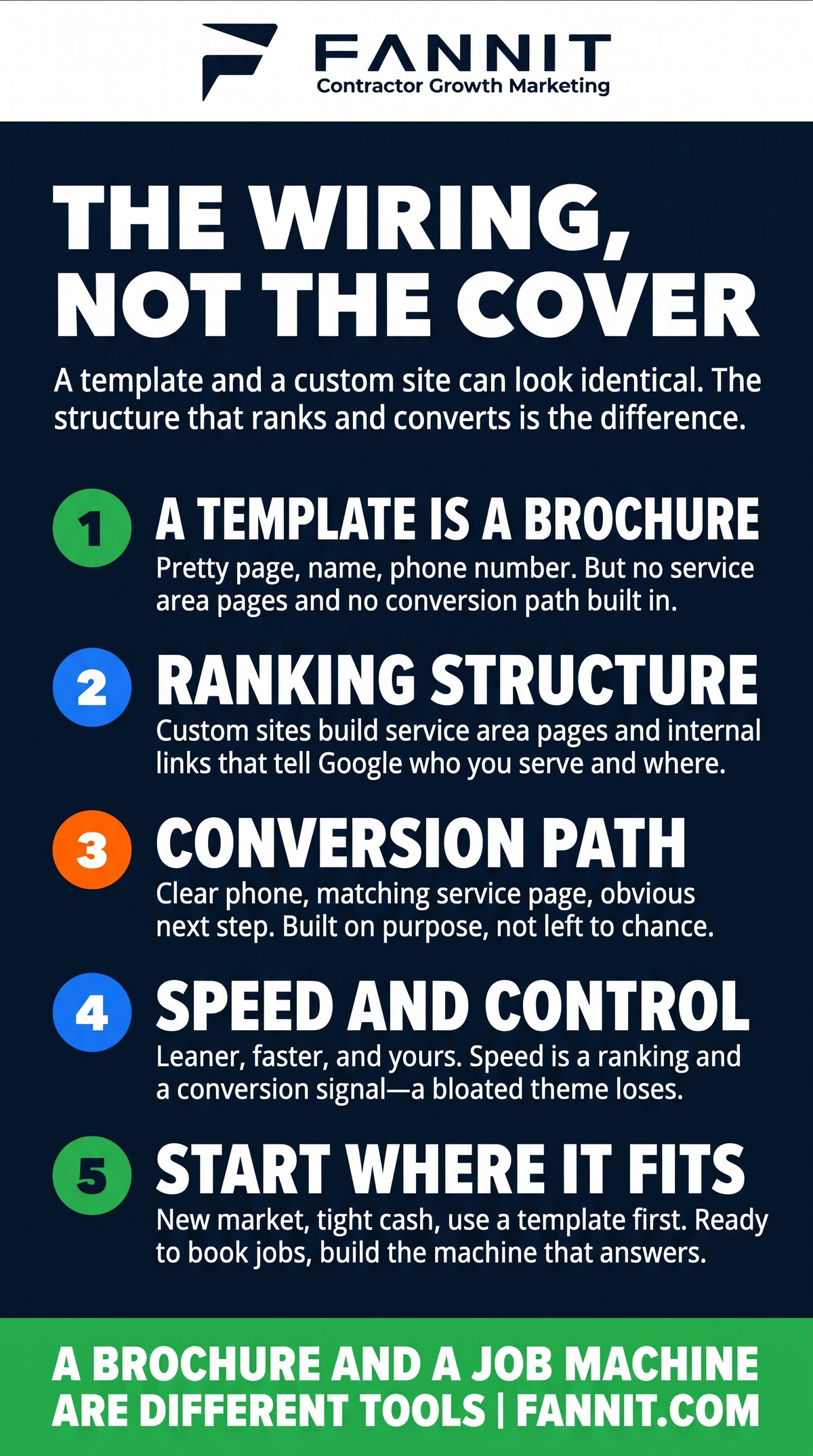
A website is like a panel. The cover looks the same whether the wiring behind it is clean or a rat's nest. A template and a custom site can look nearly identical to the owner, but the wiring, the structure that Google reads and the structure that converts a visitor, is where the jobs are won or lost.
The question is not which one looks better. It is which one gets found and gets called.
What a Template Actually Gives You
A template gets you online fast and cheap, and for a brand-new electrical company that is a real thing. You need a page with your name, your phone number, and proof you exist.
That is also about where a template stops. It gives you a pretty page, but it does not give you the structure that ranks for "electrician in [your city]" or turns a visitor into a service call. A template is a brochure. Most electrical owners need a machine that books jobs, and those are different tools.
The Three Jobs a Custom Site Does Better
A custom electrician website earns its cost in three places a template cannot reach.
Ranking structure. Google reads your site's structure, not just its words. A template flattens everything into a handful of generic pages, while a custom site builds the service area pages, service pages, and internal links that tell Google exactly who you serve and where. Our guide to electrician service area pages shows the structure that actually ranks, and the contractor SEO guide at Fannit covers the fundamentals underneath it.
Conversion path. A visitor lands, decides in seconds, and either calls or leaves. A custom site builds the path on purpose: a clear phone number, a service page that matches the ad or search that brought them, and a next step that feels obvious. A template leaves that to chance. For a shop serving several towns, our guide to thin location coverage for electricians shows how the site can still rank in each one.
Speed and control. Custom sites are leaner, faster, and yours to change without fighting a theme's assumptions. Speed is a ranking signal and a conversion signal, and Google's page experience guidance makes both part of how a site is judged.
When a Template Is the Right Call
There is a window where a template is the correct move, and pretending otherwise is bad advice.
Brand new and testing the market. If you have not proven there is demand for your service in your area, a template keeps the risk low while you learn. No one should drop five figures on a custom build before the phone rings.
Tight cash and a short runway. A template plus a strong Google Business Profile and reviews can book early jobs while you build the war chest for a real site later.
The mistake is staying on the template too long and treating it as the final answer. It is a placeholder, not a strategy. Our guide to the cost of a roofing website shows the same math in a related trade: cheap today, expensive in missed jobs later.
How to Decide Without Getting Sold
The decision comes down to one question: what does the site need to do for you right now?
If the answer is "exist," start with a template. Put your name, number, service area, and a way to call out there this week.
If the answer is "book jobs," build custom. Rank for your service area, match every page to a search, and build the conversion path on purpose. Our guide to getting electrician leads shows how the site and the follow-up work as one system. Before you price it out, our digital marketing cost guide for electrical contractors maps what the whole build should run.
Most electrical owners do not need a website. They need a machine that answers the phone with booked work. A template starts the conversation. A custom site closes it.
<a href="https://www.fannit.com/blog/custom-vs-template-electrician-website/" title="Custom vs Template Electrician Website — Web Design Guide"><img src="https://www.fannit.com/images/blog/infographic-custom-vs-template-electrician-website-1920x1080.png" alt="Custom vs Template Electrician Website — Web Design Guide [Infographic]" width="800" /></a><br /><small><a href="https://www.fannit.com/blog/custom-vs-template-electrician-website/">Custom vs Template Electrician Website — Web Design Guide</a> via <a href="https://www.fannit.com">Fannit | Contractor Growth Marketing</a></small>

Keith Eneix is the Co-Founder and President of Fannit, a digital marketing agency built exclusively for home service contractors. He still owns and operates a multi-seven-figure contracting business in the Pacific Northwest. Since 2010, Fannit has helped 200+ contractors generate $100M+ in documented revenue.
Full Bio