
From Word-of-Mouth to SEO: How Electricians Should Build Their First Keyword List
Ranking for a keyword nobody types is a dead circuit. Here is how to build your first electrician keyword list from your own call log, reviews, and referral map, not a keyword tool.
The Vanity Trap
Every trade has a version of this mistake. You spend weeks wiring a circuit that feeds nothing, because nobody ever flips that breaker on. Ranking number one for a keyword nobody types is the same dead circuit. It looks like progress on a report, and it produces zero booked jobs.
A lot of electricians arrive at SEO after a decade of word of mouth. The referrals slowed, or they want a second stream, or a competitor's name keeps showing up where theirs should. The instinct is to open a keyword tool and grab the biggest numbers. That instinct is where most local SEO money goes to die.
The fix is not a bigger list. It is a different starting point.
Start With Your Call Log, Not a Tool
Before you touch a keyword tool, open your own call log. Go back six months. Write down the exact words customers use when they call or text. Not the words you would use to describe the job. The words they actually say.
You will see patterns fast. "My breaker keeps tripping." "I need a panel upgrade." "How much to install an EV charger." "The outlets in my kitchen stopped working." "Half the house has no power." Those sentences are a better keyword list than any software will hand you, because they are the language of a real buyer standing in front of a real problem, credit card in hand.
Notice what is missing from that list. Nobody calls and says "residential electrical services" or "licensed electrician." Those are phrases the trade invented. Customers talk in symptoms and jobs, not categories. The call log gives you the symptoms. Your job later is to pair each symptom with the service you actually sold to fix it, and that pairing is where the real keyword list lives.
Call this "The Call Log Method." It is the difference between optimizing for the way search behaves and optimizing for the way customers talk. The two are not the same, and the customer's version is the one that books. The contractor SEO guide at Fannit explains why matching real customer language is the whole game, and the method starts with your own phone history, which costs nothing to pull.
One warning. Pull the log before you look at a tool, not after. Once you see a tool's suggestions, you start writing in the tool's language instead of the customer's, and the whole advantage is gone.
Port Your Reputation First
A word of mouth business holds an asset most new competitors would pay for and cannot buy: trust. The mistake is treating SEO as a fresh start and leaving that trust behind. Port it over first, because most of it transfers almost for free.
Your reviews are the highest leverage piece. They already sit on Google, and Google weighs them heavily for a trade like electrical, where a homeowner is letting a stranger into their walls to touch live wires. Reviews that name the specific job do more than a five star count. A review that says "panel upgrade, on time, walked us through the permit" tells Google exactly what you do, and tells the next caller exactly why to choose you. So ask for that. When the job is done and the panel is labeled, hand the customer the review link and ask them to name the specific work in their own words. It costs a minute and feeds the exact phrases you are about to rank for.
The same logic applies to referral relationships. Every contractor, realtor, and property manager who already sends you work is a local citation and a link waiting to happen. Word of mouth built a map of who trusts you. SEO just needs that map written down somewhere Google can read it. Turn each long term referral partner into a directory listing, a supplier page, or a partner link, and you convert reputation into ranking signal without a single cold outreach email.
The numbers back the instinct. Nielsen found that 92 percent of consumers trust recommendations from people they know over every other form of advertising. You already earned that trust the slow way. The Google Business Profile optimization guide at Fannit shows how to make it visible on the listing where local searchers actually decide.
Build the List on Three Axes
A useful keyword list is not a pile of phrases. It is a grid with three axes, and every phrase you keep has to land on all three.
Service. The jobs you actually book and want more of. Panel upgrades, EV charger installs, rewiring, emergency repairs, generator hookups. Not "how to become an electrician" or "what does an electrician do," which pull in students and the merely curious. Every service on the list has to be one your crew can show up for next week, not one you might expand into someday.
Service area. The towns and neighborhoods you actually serve. A suburb name plus a service phrase is worth ten generic national phrases, because the person typing it is close enough to hire you today.
Intent. What the caller is trying to do right now. "Electrician near me now" is an emergency. "EV charger installation cost" is a buyer pricing out a job. "Breaker keeps tripping" is a diagnosis that becomes a service call. Each one maps to a different page and a different next step.
Put the three together and you get phrases like "panel upgrade [your city]," "EV charger installation [your suburb]," "emergency electrician [your town]." Call this "The Service Grid." It is the skeleton every later page hangs on, and it keeps you from chasing a keyword that fails on any one axis.
Sort by Intent, Not Volume
Here is where the tool finally earns its keep, and where most owners use it wrong. Do not sort the list by search volume. Sort it by intent.
A phrase with two hundred searches a month and a caller standing in a dark house beats a phrase with two thousand searches and nobody who will ever hire you. Volume tells you how many people type it. Intent tells you whether any of them book a job. You want the second number, even when it is smaller.
Take a real example. "Electrician salary" might carry serious volume, but the people typing it want a job, not a quote. "Panel upgrade cost" is smaller, and every single search is a homeowner close to spending thousands. A shop that ranks for the second one and ignores the first one books more work with a fraction of the traffic.
The trap is choosing "electrician salary" or "electrician near me free estimate" because they look big and you are afraid of a short list. A short list of real buyers is a strategy. A long list of browsers is a hobby. The common SEO mistakes guide at Fannit walks through the same volume over intent mistake and how it burns a whole quarter.
Use the Tool Last, Not First
The keyword tool still has a job. You just use it at the end, not the beginning.
Once the call log has given you the phrases, run them through the tool for two things only. First, confirm the search volume is not zero, so you know real people type it. Second, pull the related phrases and map them back to jobs you already book. If the tool surfaces "whole house surge protector" and you install those, it goes on the list. If it surfaces a phrase you do not actually sell, it does not matter how big the number is.
Used this way the tool validates and expands your list instead of inventing it. Used first, it drowns you in phrases that sound like search and not like a customer. The home service SEO guide at Fannit shows the full sequence, and the order matters: customer language first, tool second.
Where This Fits Your Other Channels
This keyword list is not just for your website. It is the input for everything else you run.
Your Google Business Profile gets categorized around the same services, so the jobs you name are the jobs Google shows you for. Your ad campaigns pull their ad groups from the same Service Grid, and the Bing Ads guide for electricians at Fannit shows how the same phrases transfer to a cheaper lane with almost no rework. Your technicians learn to ask for reviews that name the exact job, feeding the same keywords back into the loop.
One list, every channel. That is the whole point. When SEO, ads, and reviews all point at the same ten or fifteen phrases, Google stops guessing what you do and starts treating you as the obvious answer for it.
The 90 Day Keyword Plan
You can build this without hiring anyone and without waiting on a designer.
Month 1: Pull the raw material. Export six months of your call log. Write down the exact phrases customers used. Match each phrase to a service you actually book, and cut everything that is a student question or a DIY search. Pull your top twenty reviews and note the words they repeat. The guide on getting electrician leads at Fannit covers the same raw material workflow for a new shop.
Month 2: Build the Service Grid. Combine service, service area, and intent into a clean list of ten to fifteen phrases. Assign each phrase to a page: a service page for the big jobs, a city or suburb page for the local variants. Update your Google Business Profile so its categories and services match the list exactly.
Month 3: Publish and measure. Write the first pages in the customer's own words, using the phrases you pulled from the call log, not the ones the tool suggested. Then watch which pages get calls, not which pages get clicks. A keyword that produces calls is a keeper. One that produces traffic and silence gets cut.
The goal is not a longer list. It is a shorter list that matches the jobs you already know how to book. That is the version of SEO a word of mouth business was built for.
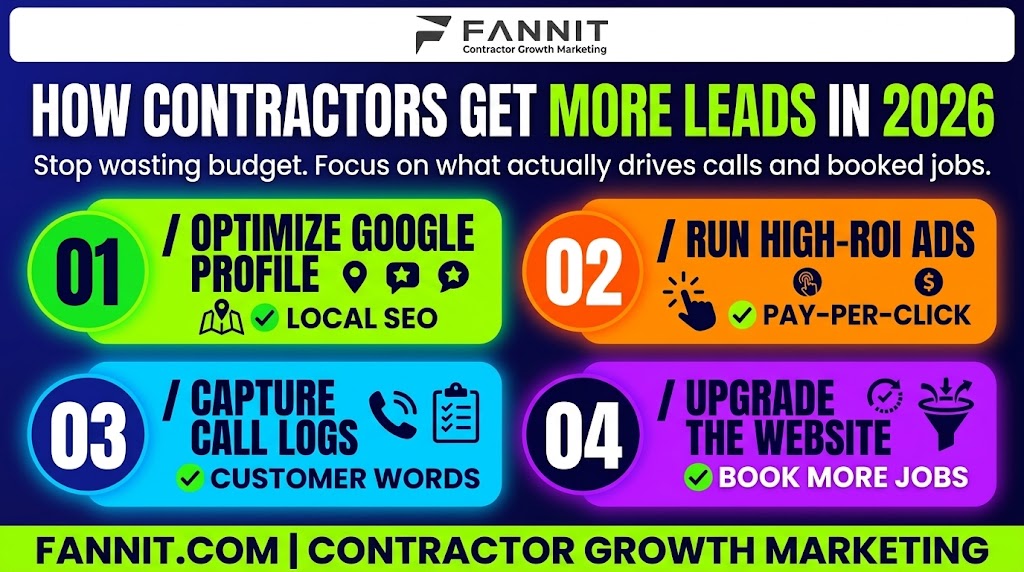
<a href="https://www.fannit.com/blog/how-electricians-build-their-first-keyword-list/" title="How Electricians Build Their First Keyword List — Electrician SEO Guide"><img src="https://www.fannit.com/images/blog/infographic-how-electricians-build-their-first-keyword-list.jpg" alt="How Electricians Build Their First Keyword List — Electrician SEO Guide [Infographic]" width="800" /></a><br /><small><a href="https://www.fannit.com/blog/how-electricians-build-their-first-keyword-list/">How Electricians Build Their First Keyword List — Electrician SEO Guide</a> via <a href="https://www.fannit.com">Fannit | Contractor Growth Marketing</a></small>

Keith Eneix is the Co-Founder and President of Fannit, a digital marketing agency built exclusively for home service contractors. He still owns and operates a multi-seven-figure contracting business in the Pacific Northwest. Since 2010, Fannit has helped 200+ contractors generate $100M+ in documented revenue.
Full Bio

