The HVAC Shoulder Season Playbook: How to Fill Your Calendar in Spring and Fall
Spring and fall are when most HVAC companies go quiet. The ones that grow to $3M and beyond treat shoulder season as their biggest opportunity of the year. Here is how they do it.
The HVAC Shoulder Season Playbook: How to Fill Your Calendar in Spring and Fall
Every HVAC company knows the pattern. Summer is chaos. Phones ring constantly, technicians are booked out two weeks, and you are turning down work you could have taken if you had more capacity. Winter is the same. Then April arrives, or October, and the phone goes quiet.
Shoulder season is the period between peak heating and peak cooling demand. For most HVAC companies, it represents 30 to 40 percent of the calendar year. The companies that treat it as dead time stay stuck at the same revenue level year after year. The companies that treat it as an opportunity use it to build the recurring revenue base, the brand awareness, and the operational capacity that makes the next peak season dramatically more profitable.
This playbook covers the specific strategies that HVAC companies at the $2M to $5M level use to fill their calendars in spring and fall, and how to build a marketing system that turns shoulder season from a liability into an asset.
Why Shoulder Season Is Actually Your Best Marketing Window
The counterintuitive truth about shoulder season is that it is the best time to market your HVAC company, not the worst. Here is why.
During peak season, every HVAC company in your market is running ads, sending mailers, and competing for the same emergency replacement leads. Cost per click on Google Ads goes up. Homeowners are stressed and price-shopping. Your technicians are stretched thin, which means customer experience suffers. The leads you close during peak season are often the most expensive to acquire and the least likely to become long-term customers.
During shoulder season, most of your competitors go quiet. Ad costs drop. Homeowners are not in emergency mode, which means they are more receptive to proactive outreach. Your technicians have time to do thorough work, which means customer experience improves. The customers you acquire during shoulder season through maintenance agreements, system tune-ups, and proactive outreach are more likely to call you first when their system fails during peak season.
The HVAC companies that grow consistently are the ones that invest in marketing during shoulder season and harvest the results during peak season.
The Maintenance Agreement as a Shoulder Season Engine
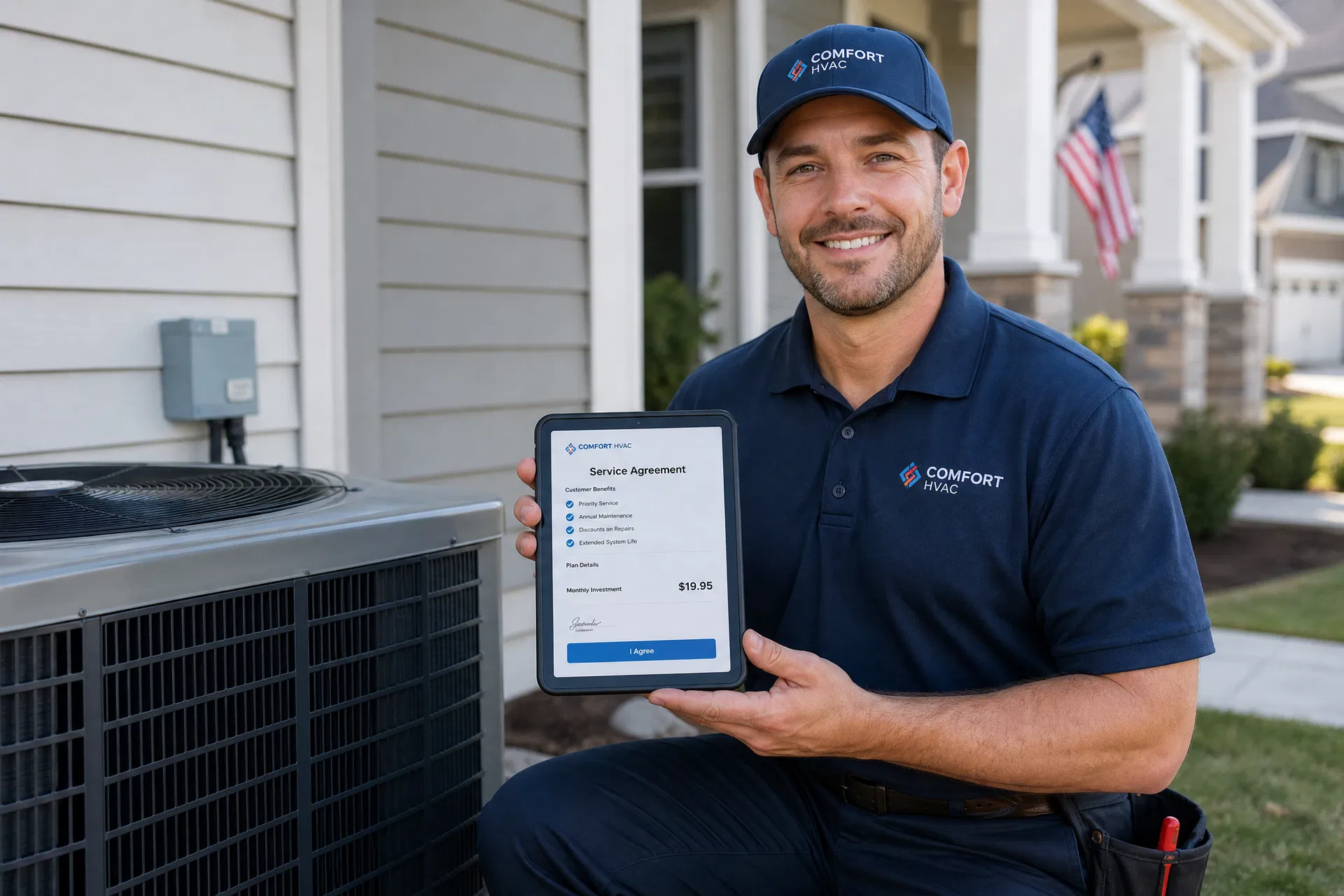
If there is one strategy that separates HVAC companies doing $1M from those doing $3M, it is the maintenance agreement program. A well-run maintenance agreement program does three things: it fills the shoulder season calendar with scheduled work, it generates recurring revenue that smooths out the seasonal cash flow problem, and it creates a base of customers who call you first when they need a replacement.
The math is straightforward. If you have 500 active maintenance agreements at $200 per year, that is $100,000 in predictable annual revenue before you book a single repair or replacement. If 15 percent of those customers replace their system in a given year, that is 75 replacement jobs from customers who already trust you. At an average ticket of $8,000, that is $600,000 in replacement revenue from your maintenance base alone.
The spring tune-up and fall tune-up that are part of every maintenance agreement also fill the shoulder season calendar with scheduled appointments. This keeps your technicians busy, keeps your revenue consistent, and gives you regular touchpoints with customers before they are in emergency mode.
Building a maintenance agreement program from scratch requires a clear offer, a consistent sales process, and a follow-up system that converts one-time customers into agreement holders. The HVAC maintenance agreement marketing guide covers the offer structure, the technician sales script, and the renewal sequence in detail. The offer should be simple: two tune-ups per year, priority scheduling during peak season, and a discount on repairs. The sales process should happen at the end of every service call, not as a separate sales visit. The follow-up system should automatically reach out to customers who did not convert during the service call.
Spring Marketing: Positioning Before the Heat Arrives
The spring shoulder season runs roughly from mid-March through May in most markets. Homeowners are thinking about their air conditioning systems for the first time since last summer. They remember the system that struggled, the utility bill that was higher than expected, or the technician who mentioned that the system was aging. They are not in emergency mode yet, but they are open to a conversation.
Spring is the best time to market AC tune-ups, system efficiency assessments, and new system consultations. The homeowner who books a spring tune-up and discovers their 14-year-old system is running at 60 percent efficiency is a much easier replacement conversation than the homeowner whose system fails on the hottest day of July.
Your spring marketing should start in late February or early March, before the weather turns. The channels that work best for spring HVAC marketing are email to your existing customer base, Google Ads targeting "AC tune-up" and "air conditioning maintenance" terms, and direct mail to neighborhoods with older housing stock where systems are more likely to be aging.
The messaging should be proactive and specific. "Is your AC ready for summer?" is generic. "Most AC systems over 10 years old lose 20 to 30 percent of their efficiency without annual maintenance. A $99 tune-up now can prevent a $8,000 emergency replacement in July." That is specific, it creates urgency without being manipulative, and it speaks to the economic reality that your ICP cares about.
Fall Marketing: The Heating Season Setup
The fall shoulder season runs from September through November in most markets. Homeowners are thinking about their heating systems for the first time since last winter. The same dynamics apply as spring, but the urgency is slightly higher because a heating failure in January is more immediately dangerous than an AC failure in September.
Fall is the best time to market furnace tune-ups, heat pump maintenance, and heating system replacements. The homeowner who discovers in October that their 18-year-old furnace has a cracked heat exchanger has time to make a thoughtful decision about replacement. The homeowner who discovers it in January during a cold snap is making a panic decision.
Your fall marketing should start in late August, before the first cold snap. The channels are the same as spring: email to your existing base, Google Ads targeting heating-specific terms, and direct mail. The messaging should emphasize the risk of waiting: "The average furnace lasts 15 to 20 years. If yours is approaching that range, a fall inspection can tell you whether to repair or replace before you need it most."
One tactic that works particularly well in fall is the "free heating safety inspection" offer. Framing the tune-up as a safety inspection rather than a maintenance visit changes the conversation. Homeowners who would not pay for maintenance will often accept a free safety inspection, and a thorough inspection that identifies real issues converts to paid work at a high rate.
Google Ads Strategy for Shoulder Season
Most HVAC companies run Google Ads during peak season and pause them during shoulder season. This is backwards. The cost per click during shoulder season is significantly lower because fewer competitors are bidding. The conversion rate is lower because homeowners are not in emergency mode, but the cost per acquisition can actually be lower than during peak season because the reduced competition more than compensates for the lower conversion rate.
During shoulder season, your Google Ads strategy should shift from emergency replacement terms to maintenance and tune-up terms. Instead of bidding on "AC repair" and "furnace repair," bid on "AC tune-up," "furnace tune-up," "HVAC maintenance," and "heating system inspection." These terms have lower search volume but also lower competition, and they attract exactly the customer profile you want: proactive homeowners who are thinking about their system before it fails.
Your landing page for shoulder season campaigns should be different from your peak season landing page. During peak season, the homeowner wants to know you can come today. During shoulder season, they want to know what the tune-up includes, how long it takes, and what happens if the technician finds a problem. A landing page that answers these questions and makes the booking process simple will convert significantly better than a generic "contact us" page.
Email Marketing to Your Existing Customer Base
Your existing customer base is your most valuable shoulder season asset. These are people who have already trusted you with their home, who have your phone number, and who are far more likely to call you than to search for a new contractor. Yet most HVAC companies do almost no email marketing to their existing customers.
A simple shoulder season email sequence looks like this. In late February, send an email to every customer who had AC service in the past two years with a spring tune-up offer. In late August, send an email to every customer who had heating service in the past two years with a fall tune-up offer. In both cases, include a specific offer, a clear call to action, and a deadline.
This sequence, done consistently, will generate a meaningful number of bookings from customers who would not have called otherwise. It also keeps your company top of mind so that when their system does fail during peak season, you are the first call they make.
The companies that do this well also segment their email list by system age and service history. A customer with a 12-year-old system gets a different message than a customer with a 3-year-old system. The 12-year-old system customer gets messaging about efficiency and the cost of an aging system. The 3-year-old system customer gets messaging about protecting their investment with regular maintenance.
Reputation Management During Shoulder Season
Shoulder season is the best time to invest in your online reputation because you have more bandwidth to do it well. During peak season, your team is stretched and customer experience can suffer. During shoulder season, your technicians have time to be thorough, your office staff has time to follow up, and you have the capacity to deliver the kind of experience that generates five-star reviews.
A deliberate review generation process during shoulder season can significantly improve your review profile before peak season. The mechanics are simple: after every completed service call, send a text message to the customer with a direct link to your Google review page and a brief, personal request. This message, sent within an hour of the service call, converts at a significantly higher rate than a generic follow-up email.
The goal is to enter peak season with a review profile that is visibly better than your competitors. A fully optimized Google Business Profile amplifies this effect - the HVAC GBP optimization guide covers the profile completeness and post cadence that Google rewards with higher local pack rankings. When a homeowner searches for an HVAC company in July and sees one company with 200 reviews at 4.9 stars and another with 40 reviews at 4.2 stars, the choice is made before they read a single review.
The Long-Term Compounding Effect
The HVAC companies that grow from $1M to $3M and beyond do not do it by capturing more emergency replacement leads during peak season. They do it by building a recurring revenue base through maintenance agreements, a referral network through exceptional customer experience, and a brand that homeowners recognize before they need it.
Shoulder season is where all three of those things are built. The maintenance agreement customer acquired in April becomes a replacement customer in July. This is not just anecdotal - the Air Conditioning Contractors of America tracks seasonal demand patterns across markets, and the data consistently shows that the companies with the strongest shoulder season programs have the most stable year-round revenue. The homeowner who gets a thorough fall tune-up and a follow-up call in November refers their neighbor in February. The brand that runs consistent marketing in spring and fall is the one homeowners think of first when their system fails.
The compounding effect of consistent shoulder season marketing takes two to three years to become fully visible. The HVAC companies that commit to it in year one are the ones that look back in year three and wonder why they waited so long. Fannit's HVAC seasonal marketing program is built specifically for the spring and fall demand windows - the pre-season campaign structure, the maintenance agreement offer, and the review velocity system that makes peak season more profitable. If you want to see what it looks like for your market, schedule a free strategy call.
Seasonal HVAC marketing is a specialty, not a default. The best HVAC marketing agencies for shoulder season are the ones who have built the campaign infrastructure for both the spring and fall windows - and who track calendar fill rate, not just lead volume.

Keith Eneix is the Co-Founder and President of Fannit, a digital marketing agency built exclusively for home service contractors. He still owns and operates a multi-seven-figure contracting business in the Pacific Northwest. Since 2010, Fannit has helped 200+ contractors generate $100M+ in documented revenue.
Full Bio