Online Presence for Contractors: Why You're Invisible and How to Fix It
92% of customers search online before hiring. Learn why your contracting business may be invisible to local homeowners and get a simple step-by-step plan to fix it.
The Real Reasons Contractors Skip Building an Online Presence
Walk onto any job site and ask why the owner does not have a website. You will hear variations of the same few answers. They are understandable, but each one hides a costly blind spot.
The most common refrain is, "I get enough work from referrals." Referrals are the lifeblood of the trades, and they always will be. But treating referrals as a complete strategy is dangerous. Referrals are unpredictable. A slow month from your network can mean a slow month for your crew. More importantly, even referred customers now verify you online before they call. A 2026 study found that 71 percent of commercial buyers begin their research online, and 86 percent of consumers use Google Maps to find local businesses. When a referred customer searches your company name and finds nothing, a seed of doubt gets planted. That doubt does not exist for the competitor with a polished profile and fifty five-star reviews.
Another common barrier is fear of technology and the perceived time commitment. Many contractors assume a website requires constant maintenance, coding skills, or a five-figure investment. That was true a decade ago. Today, modern contractor website design tools and managed services have stripped away the complexity. You can have a professional, mobile-friendly site that you rarely need to touch, or you can pay a specialist a few hundred dollars a month to handle everything. The time excuse is understandable, but it is no longer accurate.
Then there is the contractor who got burned. They signed a contract with a slick marketing agency that promised a flood of leads and delivered a trickle of junk. The skepticism is justified. Plenty of agencies overpromise and underdeliver. But letting a bad experience keep you offline entirely is like refusing to buy a new truck because you once got a lemon. The basics of online presence are things you can control yourself, with no agency required.
The most dangerous trap is the "I will get to it later" mindset. When you are booked solid with jobs, marketing feels like a luxury. But the data is unforgiving: 62 percent of customers will completely ignore a business that has no web presence. Later is not a strategy. Later is how you wake up one month to an empty pipeline and no way to fill it quickly.
Finally, many contractors simply do not know where to start. The options are overwhelming: websites, social media, Google, directories, reviews, ads. This paralysis is real, and it is exactly what this article is designed to solve. You need an order of operations, not a firehose of tactics.
What "Online Presence" Actually Means for a Contractor (Beyond Just a Website)
Ask ten contractors what "online presence" means, and nine will say "a website." That narrow definition is part of the problem. A contractor online presence is an ecosystem. It is every digital touchpoint where a potential customer encounters your business before they ever pick up the phone.
Think of it in three pillars. The first is your digital identity, what people see when they search your business name. This includes your Google Business Profile, your reviews, your directory listings, and any social media profiles. The second is your website, your digital storefront where customers go to verify your credibility, see your work, and decide whether to call. The third is your local footprint, how you appear in map results and local searches for your services.
A common debate among contractors is the "contractor website vs Google Business Profile" question. Which matters more? The answer is that the question itself is flawed. You need both, because they serve different functions. Your Google Business Profile gets you found. It is what populates the map pack, the top three results that appear with a map when someone searches "roofer near me." Your website gets you hired. It is where a customer goes after they click your profile to confirm you are legitimate, browse your past projects, and read your story.
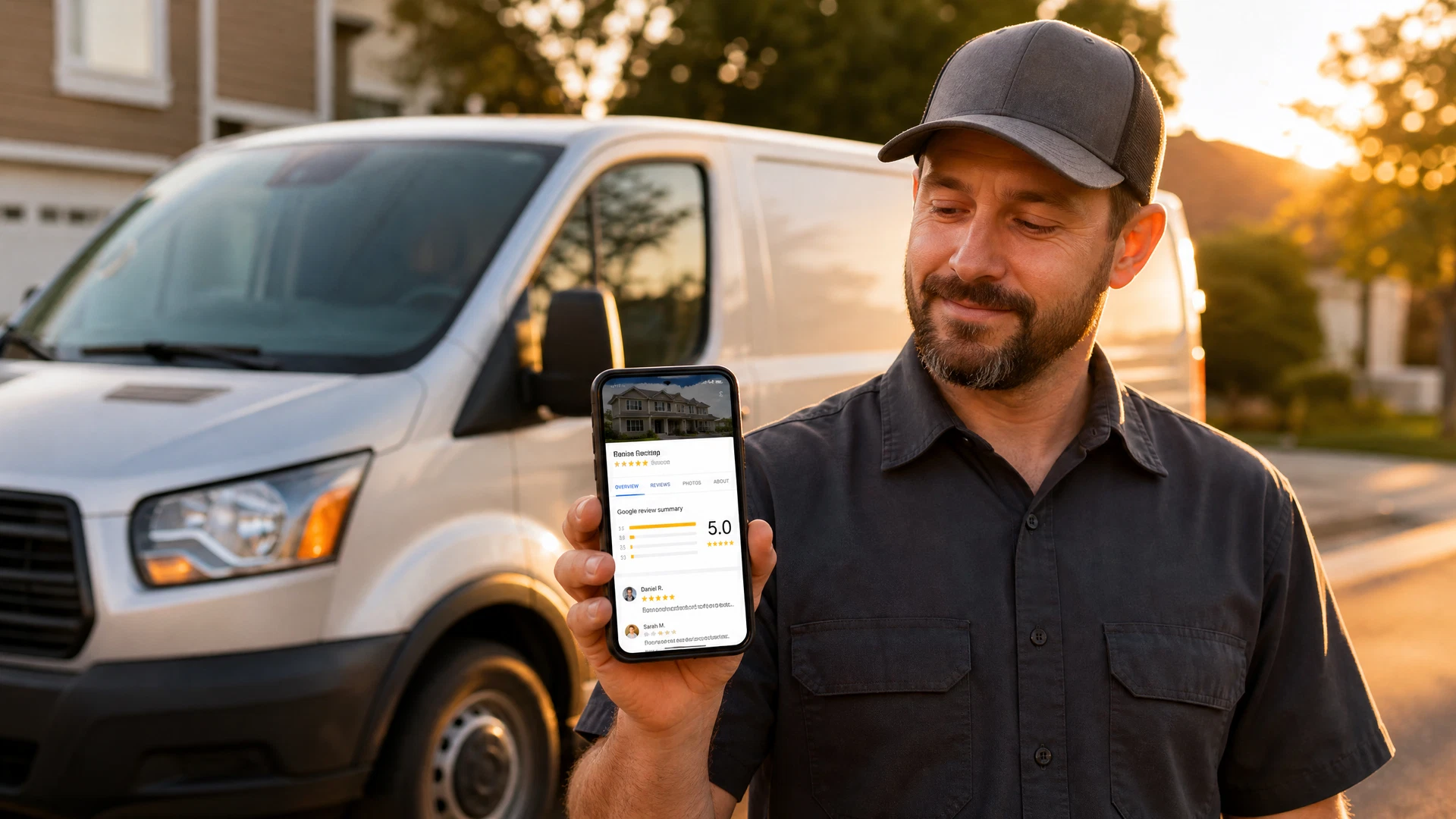
Social proof is the glue that holds this ecosystem together. Reviews are the new word-of-mouth. When 86 percent of customers use Google Maps to find local businesses, the ones with a 4.5-star rating or higher and a steady stream of recent reviews win the click. A single negative review left unanswered can undo months of reputation building.
Here is what you do not need. You do not need a massive social media following. You do not need to blog every day. You do not need to be on TikTok, LinkedIn, and every other platform that demands content. You need to be visible and credible in the places where your customers actually look when they have a leak, a broken AC, or a renovation deadline. For most service contractors, that means Google, a handful of key directories, and a simple, professional website.
The Google Business Profile: Your Highest-Impact, Lowest-Cost First Step
If you do nothing else from this article, do this one thing. Your Google Business Profile, formerly called Google My Business, is free, takes roughly thirty minutes to set up, and is the single most powerful factor in your contractor Google Maps ranking. It is the reason some contractors show up at the top of local searches while others remain buried.
Setting up and optimizing your profile follows a clear sequence. First, claim and verify your profile if you have not already. Google needs to confirm you are a real business at a real address. Second, ensure your NAP information, Name, Address, Phone number, is accurate and consistent with every other place your business appears online. A mismatched phone number or a slightly different business name confuses Google and hurts your ranking.
Category selection matters more than most contractors realize. Choose the most specific category available. If you are a roofing contractor, select "Roofing Contractor," not just "Contractor" or "Home Builder." This tells Google exactly which searches you should appear for.
Photos are non-negotiable. Profiles with high-quality images receive significantly more clicks and calls. Before-and-after shots of your work perform best. A photo of a water-damaged ceiling next to a clean, repaired one tells a story in two seconds. Add photos of your team, your truck, and your completed projects regularly.
Your service description should clearly state what you do, where you do it, and what makes you different. Include your primary service area and your specialties. This is not the place for keyword stuffing; it is the place for a clear, honest summary that a homeowner can read in ten seconds and understand.
The review engine is where your profile becomes a lead-generation machine. Make asking for reviews a standard step in your job completion process. Send every satisfied customer a direct link to leave a Google review via text or email. Respond to every review, positive and negative, professionally and promptly. A thoughtful response to a negative review can actually build more trust than a page full of five-star ratings with no replies.
Use Google Posts to share project photos, announce seasonal promotions, or answer common questions. This signals to Google that your profile is active and maintained, which can improve your ranking. Avoid common mistakes like using a PO box instead of a physical address, claiming a service area that spans three states when you only serve one county, or ignoring negative reviews, which looks worse than the review itself.
Your Contractor Website: The Cornerstone of Credibility
Your Google Business Profile is your storefront sign. Your website is the store itself. A profile alone cannot close the deal. When a homeowner clicks through to your site, they are looking for confirmation that you are a real, professional, trustworthy business. A missing or poorly built website raises immediate red flags. If you need one built for the trades, see Fannit's contractor website design services.
The essentials of contractor website best practices start with mobile-first design. The majority of local searches happen on a phone, often in a moment of urgency. If your site does not load quickly and display cleanly on a small screen, the visitor will hit the back button and call the next contractor on the list. Your phone number must be visible in the header on every page, and it must be click-to-call. Do not make a stressed homeowner copy and paste a number.
Your site needs dedicated service pages for each major trade or service you offer. A single generic "Services" page is a missed opportunity. A page titled "Emergency AC Repair in Phoenix" tells both Google and the visitor exactly what you do and where you do it. A gallery or portfolio page with real project photos, not stock images, builds instant credibility. An "About" page that tells your story, how long you have been in business, who owns the company, and what you stand for, humanizes your operation and builds trust.
Every contractor website needs a lead capture mechanism. A simple form with a compelling offer, a free estimate, a discount on a first job, or a seasonal inspection special, gives visitors a reason to act. The form should be short. Name, phone number, and a brief description of the problem. Every additional field reduces the likelihood of completion.
Contractor website SEO does not need to be complicated. Each service page should target a specific keyword phrase that real people search for. "Emergency electrician in Austin" is better than "electrician." Include your city and service area naturally in page titles, headings, and body copy. Do not overthink it. Write clearly about what you do and where you do it.
Speed and simplicity are not optional. A slow, cluttered website with auto-playing videos and pop-ups will drive visitors away before they read a single word. Keep the design clean, the navigation simple, and the focus on a single goal: getting the visitor to call or submit a form.
The budget question is real, and the answer is more accessible than most contractors assume. You do not need a ten-thousand-dollar custom build. Options range from DIY platforms to specialized contractor website design services that charge between one hundred and three hundred dollars per month. If your site captures even one extra job per month, the return on investment is immediate and substantial.
Local SEO for Contractors: Getting Found When It Matters
Local SEO for contractors sounds technical, but the concept is straightforward. It is the practice of making your business visible when someone in your service area searches for the work you do. The goal is to appear in the map pack, the top three results with a map, and in the organic results below them.
Three factors determine your local ranking. Relevance is whether your profile categories, website content, and service pages match what the searcher is looking for. If you are a plumber and someone searches "plumber near me," relevance is on your side. Distance is how close your business address is to the searcher. Google prioritizes proximity, which is why your service area settings matter. Prominence is your overall online reputation, measured by reviews, backlinks from other websites, and the consistency of your business information across the web.
On-page SEO tactics are simple enough to implement today. Put your city and service area in your page titles, meta descriptions, and main headings. If you serve multiple cities or neighborhoods, create a dedicated page for each one with unique content about the work you have done there. A page titled "Kitchen Remodeling in Scottsdale" with photos of actual Scottsdale projects is far more effective than a generic "Remodeling" page.
Citations are mentions of your business name, address, and phone number on other websites. Consistency is critical. If your business is listed as "Smith & Sons HVAC" on Google, "Smith and Sons Heating and Cooling" on Yelp, and "Smith HVAC" on Angi, Google sees three different businesses. This inconsistency hurts your ranking. Audit your listings on key directories and correct any discrepancies.
The question "why my contracting business isn't showing up on Google" is one of the most common searches among contractors. The answer is almost always one of three issues: an unclaimed or unverified Google Business Profile, inconsistent NAP data across the web, or a complete lack of reviews. All three are fixable, and none requires technical expertise.
Beyond the Basics: Contractor Digital Marketing That Actually Generates Leads
If you want the full picture, read our digital marketing guide for contractors — it covers every channel with budget benchmarks.
Most advice for contractor digital marketing stops at organic tactics: your profile, your website, your reviews. Those are the foundation, but there are additional channels that can accelerate your lead flow, and they are rarely discussed in the content your competitors are reading.
Google Local Services Ads are the most underutilized tool in contractor marketing. These are the ads that appear at the very top of search results with a green "Google Guaranteed" badge. Unlike traditional pay-per-click ads, you pay only when someone calls or messages you directly through the ad. For service contractors in competitive markets, this can be a reliable, measurable source of leads that does not require ongoing content creation or SEO expertise.
Social media has a role, but it is not what most agencies will tell you. Facebook and Instagram are portfolio tools, not lead generators for most contractors. Post project photos, before-and-after shots, and short video walkthroughs of completed jobs. Consistency matters more than frequency. One post per week showing excellent work is far better than daily posts of filler content. The goal is not to go viral. The goal is to have a current, professional-looking feed that a curious homeowner can scroll through and think, "These people do good work."
NextDoor is a hyper-local platform where homeowners constantly ask for contractor recommendations. A simple, complete profile and a few genuine, helpful responses to neighbor questions can generate surprising referral traffic. Do not spam the platform with ads. Just be present and helpful. When someone asks, "Does anyone know a good electrician?" and your name appears in the comments from multiple neighbors, that is trust you cannot buy.
Email and follow-up hygiene is a small detail with outsized impact. Use a professional email address, estimates@yourcompany.com, not a personal Gmail account. Respond to inquiries within hours, not days. Speed-to-lead is one of the biggest differentiators in contractor marketing. The contractor who calls back first often wins the job, regardless of price.
Track everything. Ask every new customer a simple question: "How did you find us?" Keep a spreadsheet. Over time, patterns emerge. You will see which channels actually produce work and which are just noise. This data is more valuable than any analytics dashboard because it ties directly to revenue.
Measuring Your Progress: What to Track and When to Adjust
Before you track anything, you need a plan. See how to build a contractor marketing strategy for the framework.
You cannot improve what you do not measure. Before you implement any of the steps in this article, establish a baseline. Note your current monthly lead volume, your Google Business Profile views if you have them, and any website traffic you are currently getting. Without a starting point, you will never know if your efforts are working.
The metrics that matter for a local contracting business are straightforward. Monitor your Google Business Profile insights monthly: how many people viewed your profile, how many called, how many requested directions, how many clicked to your website. Track your website traffic and its sources. Are visitors coming from Google search, from your profile, or from social media? Count your calls and form submissions. Track your review count and average rating over time.
Attribution, knowing which channel produced which lead, is simpler than most marketers make it sound. The spreadsheet method works. Ask every caller how they heard about you. Note the answer. Over ninety days, the data will tell you clearly what is working.
If you are getting traffic but no calls, your website or your offer is the problem. The site may be confusing, slow, or missing a clear call to action. If you are getting no traffic at all, your local SEO or Google Business Profile needs attention. Diagnose the bottleneck before you spend more money or time.
Give any strategy at least ninety days before judging it. Local SEO and review building are compounding efforts. They build momentum slowly and then sustain it. Do not abandon a working plan because the results are not instant. Patience and consistency are the unfair advantages that most of your competitors will never have.
Conclusion: Your 30-Day Action Plan for Building an Online Presence
If you want expert help, see our roundup of the best contractor marketing agencies to find the right fit.
The gap between having no online presence and being the contractor who dominates local search is not as wide as it feels. It is a series of small, manageable steps executed in the right order.
Week one, claim and fully optimize your Google Business Profile. Add real photos, write a clear description, set your service area, and select the right categories. This is free, fast, and immediately impactful.
Week two, build your review generation system. Make asking for reviews a non-negotiable part of your job completion checklist. Send the link. Respond to every existing review, good or bad, with professionalism.
Week three, launch a simple, mobile-friendly website. It needs a homepage, a services page, a portfolio, and a contact form. It does not need to be elaborate. It needs to be fast, clear, and credible.
Week four, get listed in three to five key directories with consistent NAP information. Yelp, Angi, Houzz, the Better Business Bureau, and your local Chamber of Commerce are solid starting points.
The contractor who shows up online is the contractor who gets hired. You have already done the hard part, running a quality business that delivers excellent work. Now make sure the people searching for exactly what you do can find you when they are ready to hire. If the full plan feels overwhelming, start with just the Google Business Profile. It is free, it takes half an hour, and it is the single highest-impact thing you can do this week to start showing up where your customers are looking.

Keith Eneix is the Co-Founder and President of Fannit, a digital marketing agency built exclusively for home service contractors. He still owns and operates a multi-seven-figure contracting business in the Pacific Northwest. Since 2010, Fannit has helped 200+ contractors generate $100M+ in documented revenue.
Full Bio

