Residential Plumbing Marketing: Why One Page Per Service Per City Wins
Most plumbing sites are invisible for one reason: a single page trying to rank for every service and every town at once. Split it into one page per service per city.
Think of your plumbing website like a van that tried to carry every tool, every part, and every drain snake you own at once. It would sag, it would be slow, and it would be useless at the one job you actually needed it for. That is exactly what one generic plumbing page is doing to your search rankings, and it is the most common reason a residential plumbing company stays invisible while smaller competitors book all the local calls.
Here is the part nobody tells you until the audit: the problem is almost never the website builder. It is the architecture underneath it.
The One-Page Trap (Why Your Site Can't Rank for Anything)
Open up most residential plumbing websites and you will find the same mistake hiding in plain sight. One page. A single "Plumbing Services" page trying to rank for "plumber," "drain cleaning," "water heater repair," "sewer line replacement," and five different towns, all at the same time.
That page is doing the SEO equivalent of a tech showing up to a job with no idea which fixture they were called for. Google has to answer one question when a homeowner searches "water heater repair in Mesa": which page on the internet is the single most relevant answer? A page that covers every service in every town is relevant to none of them, because it never commits to any one of them.
The mechanics are unforgiving, and they are spelled out plainly in Google's own SEO Starter Guide. Google matches a search to a page, not to a website. A homeowner searching "drain cleaning in Mesa" wants a page about drain cleaning in Mesa. If your site's only plumbing page is a catch-all, it will lose to the competitor who built a page titled exactly for that service and that town, even if your reviews are better and your trucks are closer. Relevance beats reputation in the first round.
The telltale sign is a ranking graph where everything sits on page two. You rank okay for nothing, everywhere, instead of ranking great for a few things, locally. Our plumbing SEO vs PPC guide explains why that slow, compounding channel only works when the pages underneath it are built to match real searches.
The Fix: One Service x One City = One Page
The highest-leverage fix in any plumbing SEO audit, before anyone even mentions backlinks, is to split that one page into a grid. One service, times one city, equals one dedicated page. "Drain cleaning in Mesa" is one page. "Water heater repair in Mesa" is another. "Drain cleaning in Gilbert" is a third. Each page exists to answer one search, and one search only.
This is not a redesign. It is a reorganization. The page builder is fine. The copy is mostly fine. What changes is that each service and each town you serve gets its own URL, its own heading, its own title tag, and its own local proof, instead of fighting for space on one crowded page.
The result is a site that Google can actually understand. When a homeowner searches "sewer line replacement in Chandler," Google finds a page whose title tag says exactly that, whose heading says exactly that, and whose content proves you actually do that work in Chandler. The relevance problem disappears, and with it goes the reason you were stuck on page two.
Building the grid also hands you something a catch-all page can never give you: a clean internal link structure. Each service page links to the town pages it belongs to, and each town page links back to its services, so Google can crawl the whole thing in one pass and understand exactly what you do and where. That structure is the plumbing of your site, and it matters as much as the words on any one page.
The plumbing marketing guide walks through how this page architecture fits into the wider system of getting residential plumbing calls.
The Anatomy of a Page That Actually Ranks
So what makes one of these pages work? Three things, and every one of them is specific enough that a homeowner, and Google, can tell it is real.
A title tag that names the job and the town. The title tag is the line that shows up in the search result, and it is the single strongest signal you can give Google about what a page is for. "Drain Cleaning in Mesa, AZ | Your Company" tells Google exactly what to rank it for. "Plumbing Services" tells Google nothing. The same rule applies to the heading at the top of the page, which should say the same thing a homeowner typed.
A heading and body that stay on one topic. The page should open with the service and the city, then answer the questions a homeowner in that town actually asks: what it costs, how fast you can get there, what neighborhoods you serve, and whether you are licensed for that work. No drifting into water heaters when the page is about drain cleaning, because every off-topic sentence dilutes the one signal you are trying to send.
Local proof points that are specific to the town. Reviews from customers in that city, a line about how many jobs you have completed nearby, the neighborhoods you cover, and a map or directions. This is the part that tells a homeowner, and Google, that you are not just claiming to serve Mesa. You actually work there.
Links that connect the grid together. Each service-area page should link to the sibling pages for the same town and the same service, so Google can crawl the whole grid and see the relationship. It also gives a homeowner who landed on drain cleaning a one-click path to your water heater page instead of a dead end.
The Google Business Profile optimization guide covers how that same local proof compounds when it also lives on your profile, where homeowners look first.
Local Proof Points: Reviews and Jobs Completed Nearby
The difference between a page that ranks and a page that just sits there is rarely the copy. It is the proof. Google has gotten very good at reading whether a page is genuinely tied to a place, and two proof points carry most of the weight: reviews and completed jobs.
A review from a homeowner in Mesa, dropped on the Mesa drain cleaning page, is worth more than a generic testimonial because it is geographically specific. It tells Google that real customers in that town had a real experience with your company. The same goes for the jobs-completed line. "We have completed 400 drain cleaning jobs in the East Valley" is proof. "We are a full-service plumbing company" is a slogan.
Sprinkle that proof through every service-area page, and you are not just building pages. You are building a case, page by page, that you are the plumber for that service in that town. That case is what Google ranks, and it is also what convinces the homeowner who clicks through to actually call.
Getting that proof is easier than it sounds. Ask every tech to remind the homeowner for a review at the close of the job, and tag each review with the town it came from in your system. The jobs-completed number comes from the same place your dispatch software already tracks. You are not creating new data. You are pointing data you already have at the page that needs it.
Why This Fix Beats Building Backlinks
Here is the counterintuitive part, and it is why this is the first thing a real audit fixes. Most plumbing companies think the ranking problem is backlinks. They assume the competitor on page one must have more links, or better links, or some secret off-page trick. They are usually wrong.
The competitor on page one has, more often than not, a clean page architecture. They built a dedicated page for each service and each town, and your catch-all page is trying to outrank forty pages with one. You cannot win that fight with backlinks, because backlinks cannot fix a relevance problem. A link does not tell Google that your "Plumbing Services" page is the best answer for "water heater repair in Mesa." Only a page built for that exact search does.
That is why the single highest-leverage fix in a plumbing SEO audit happens before anyone talks about backlinks. Fix the architecture first, and the links you already have start working harder. The how to vet a plumbing SEO agency guide shows how to tell whether an agency wants to build you pages or just sell you a backlink package.
Put it in plumbing terms. A backlink is a referral from a neighbor. A service-area page is your truck parked outside the house with the tools already out. You can collect referrals all day, but if you never actually show up in the neighborhood with a page that says what you do, the referrals do not convert into rankings, and the rankings do not convert into calls.
How to Build the Grid (A Practical Order)
You do not need forty pages on day one. You need a system, and a priority order. Here is how to build the grid without boiling the ocean.
List every service and every town you actually serve. Put services down one side, towns across the top. Every box you actually work is a page. Do not build pages for towns you cannot reach in a reasonable drive, because an unserved town is a lead you cannot book.
Rank the boxes by money. Start with the services that carry the highest average ticket and the towns where you already get the most calls. Water heater replacement in your home city comes before drain cleaning in a town you visit twice a year.
Build the money pages first. For each of the top boxes, write the title tag, the heading, the body, and the local proof points. Ten strong pages will beat forty thin ones, so do not stretch yourself into a hundred half-empty pages.
Keep the proof fresh. Add the newest reviews from each town as they come in, and update the jobs-completed numbers every quarter. A page that stays current keeps ranking, and a page that goes stale stops.
The how to get plumbing leads guide connects this page architecture to the lead flow, so the pages you build are the pages that actually answer a buying search.
The Only Number That Matters
A plumbing company with one catch-all page does not look broken. It looks normal. The website is up, the phone number is on it, and the photos look fine. Only the calls are missing, and it is easy to blame the market or the season when the real answer is sitting in a page architecture that never committed to a single search.
Split the page into a grid of one service per city, give each one its own title tag and a couple of local proof points, and the same website starts winning searches it was invisible for yesterday. The goal is not more pages. It is pages that match, one by one, the exact searches a homeowner is typing right now.
If you would rather hand the whole thing to a team that builds the service-area page grid and keeps the local proof fresh, Fannit's plumbing marketing program does exactly that.
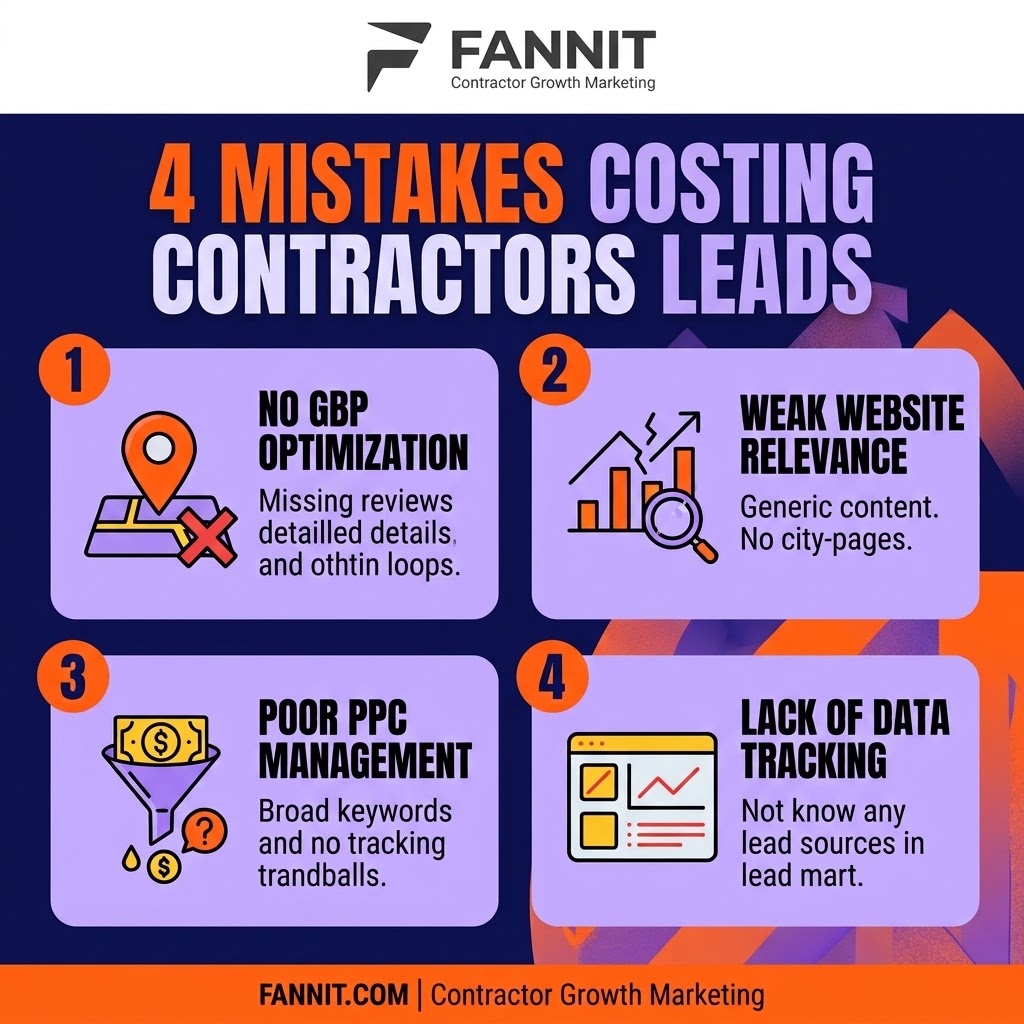
<a href="https://www.fannit.com/blog/residential-plumbing-marketing-service-area-pages/" title="Plumbing Service Area Pages Guide — Plumbing Marketing Ideas"><img src="https://www.fannit.com/images/blog/infographic-plumbing-service-area-pages.jpg" alt="Plumbing Service Area Pages Guide — Plumbing Marketing Ideas [Infographic]" width="800" /></a><br /><small><a href="https://www.fannit.com/blog/residential-plumbing-marketing-service-area-pages/">Plumbing Service Area Pages Guide — Plumbing Marketing Ideas</a> via <a href="https://www.fannit.com">Fannit | Contractor Growth Marketing</a></small>

Keith Eneix is the Co-Founder and President of Fannit, a digital marketing agency built exclusively for home service contractors. He still owns and operates a multi-seven-figure contracting business in the Pacific Northwest. Since 2010, Fannit has helped 200+ contractors generate $100M+ in documented revenue.
Full Bio