How Roofing Companies Generate 50+ Google Reviews a Year (Without Begging or Buying Them)
Most roofing companies do great work and still have fewer than 30 Google reviews. The difference is not quality. It is the system. This post covers how to build a repeatable review generation process that runs automatically.
How Roofing Companies Generate 50+ Google Reviews a Year (Without Begging or Buying Them)
Most roofing companies have the same review problem: they do great work, their customers are happy, and they still have fewer than 30 Google reviews. Meanwhile, a competitor down the road with a smaller operation somehow has 200 reviews and a 4.9 rating.
The difference is not the quality of the work. It is the system.
Review generation is a process, not a hope. Companies that consistently generate 50, 100, or 200 reviews a year have built a repeatable workflow that makes asking for reviews a standard part of every job close, not an afterthought. This post covers exactly how to build that system.
Why Reviews Matter More for Roofing Than Almost Any Other Trade
Roofing is a high-stakes, high-ticket purchase. Homeowners are spending $10,000 to $30,000 or more, they cannot easily evaluate quality before the work is done, and they are trusting a contractor with the most important asset they own. In that context, reviews are not just a nice-to-have. They are the primary trust signal that converts a searcher into a lead.
Google's local ranking algorithm weights review count and recency heavily. A roofing company with 150 reviews and a 4.8 rating will consistently outrank a company with 20 reviews and a 5.0 rating in the local pack. More reviews also means more content for Google to index, more keyword-rich phrases from real customers, and more social proof on your Google Business Profile that converts clicks into calls.
The math is simple: every review you generate is a compounding asset. It improves your ranking, increases your conversion rate, and stays on your profile indefinitely.
The Four Moments When Customers Are Most Likely to Leave a Review
Timing is everything in review generation. Ask at the wrong moment and you get ignored. Ask at the right moment and you get a five-star review with a detailed paragraph that mentions your crew by name.
The four highest-conversion moments in the roofing customer journey are:
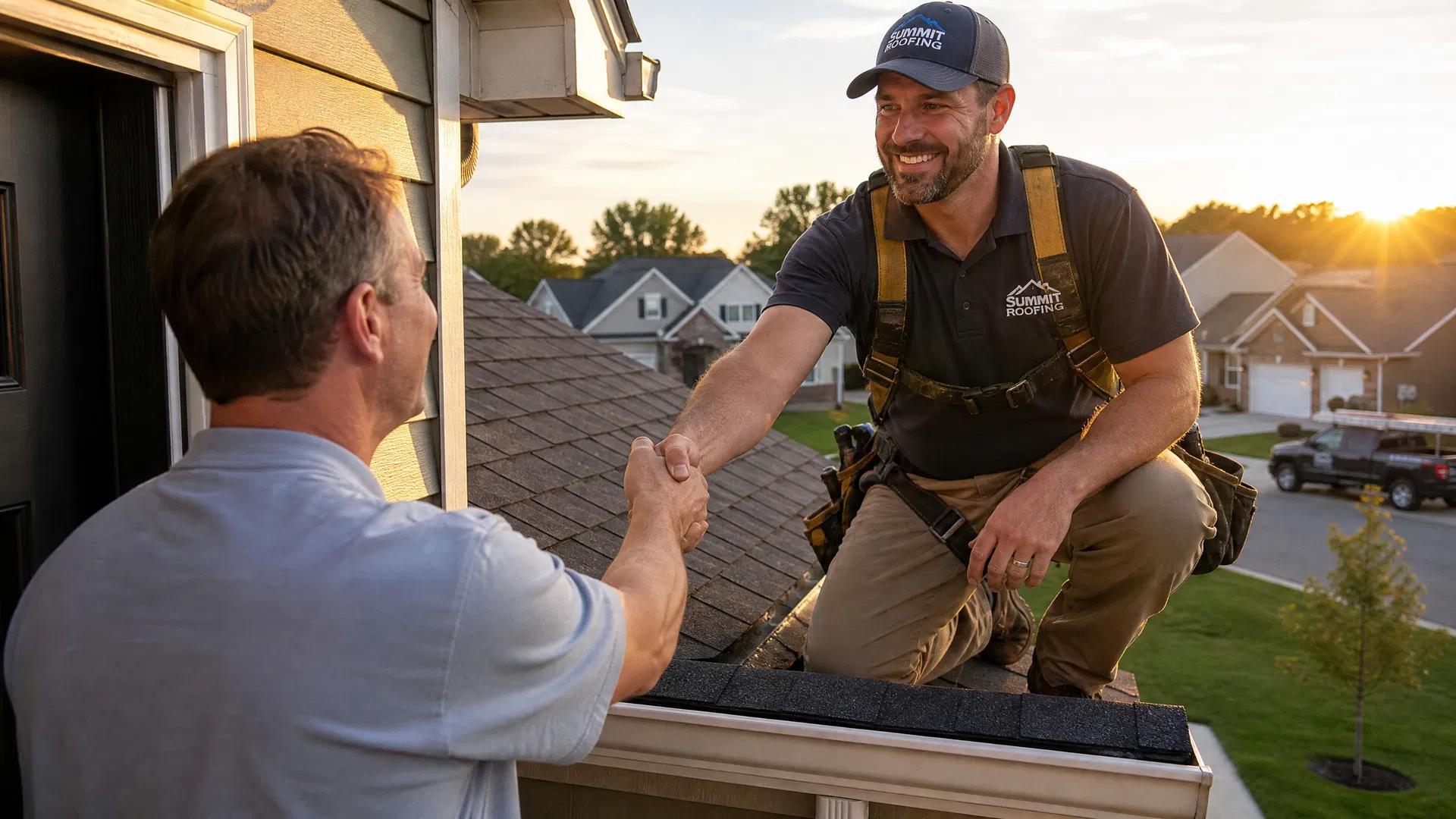
Immediately after final walkthrough. When your project manager or crew lead does the final walkthrough with the homeowner and they express satisfaction, that is the moment. Pull out your phone, open the Google review link, and hand it to them. The emotional high of a completed project is the single best time to ask. Conversion rates at this moment are typically 40 to 60 percent.
The day after project completion. Send a text message the following morning. Something like: "Hi [Name], this is [Your Name] from [Company]. We hope you're loving your new roof. If you have a minute, a Google review would mean the world to our team. Here's the direct link: [link]." Keep it personal, keep it short, and include the direct link. Do not make them search for your profile.
At the 30-day follow-up. Call or text at 30 days to check in on the project. Ask if there are any questions or concerns. If the customer is happy, ask again for the review. This follow-up also generates referrals, which is a secondary benefit of the same call.
After resolving a warranty or service call. When a customer has a concern and you address it quickly and professionally, they often feel more positive about your company than they did before the issue arose. This is a counterintuitive but highly effective moment to ask for a review.
Insurance restoration jobs have their own timing dynamic - the homeowner has been through a stressful claims process, and the relief of a completed job is particularly strong. The insurance claim marketing guide covers how to build the post-job follow-up sequence specifically for that customer experience.
Building the Review Request System
The companies that generate the most reviews do not rely on individual employees to remember to ask. They build the ask into the process so it happens automatically regardless of who is closing the job.
Step 1: Create a short review link. Go to your Google Business Profile, find the "Get more reviews" section, and copy your review link. Use a URL shortener to create a clean, memorable link (something like bit.ly/yourcompanyreviews). Save this link in every employee's phone contacts and in your CRM.
Step 2: Train every customer-facing employee. Every project manager, crew lead, and office staff member who interacts with customers should know how to ask for a review and when. Role-play the ask in your next team meeting. The ask should feel natural, not scripted. Something like: "We really appreciate your business. If you're happy with how everything turned out, a Google review helps us a lot. I can send you the link right now if you'd like."
Step 3: Automate the follow-up text. Set up an automated text message in your CRM or use a tool like GoHighLevel to send the review request text 24 hours after job completion. The message should be personalized with the customer's name and include the direct link. Automated texts that feel personal convert at 25 to 35 percent.
Step 4: Add the review link to every invoice and receipt. Include a QR code and the review link on your final invoice, your completion certificate, and any post-job documentation you send. Some customers prefer to leave reviews from their computer rather than their phone. Make it easy for them.
Step 5: Track your review velocity. Set a goal for reviews per month and track it. If you complete 20 jobs a month and you are only getting 2 reviews, your system is broken somewhere. A healthy review generation rate is 15 to 25 percent of completed jobs.
What to Do When You Get a Negative Review
Negative reviews are inevitable. How you respond to them matters as much as the review itself, because potential customers read your responses. A professional, empathetic response to a negative review often converts skeptical readers into leads.
The response formula is simple: acknowledge the concern, apologize for the experience without admitting fault if the complaint is inaccurate, and offer to resolve it offline. Something like: "We're sorry to hear your experience didn't meet your expectations. We take every project seriously and would like to make this right. Please call us at [number] so we can discuss this directly."
Never argue with a negative review in your response. Never call the reviewer dishonest. Never be defensive. The audience for your response is not the person who left the review. It is every future customer who reads it.
If the review is factually inaccurate or from someone who was never a customer, you can flag it to Google for removal. This process takes time and is not guaranteed, but it is worth attempting for reviews that are clearly fraudulent.
Responding to Positive Reviews
Most roofing companies ignore their positive reviews. This is a missed opportunity. Responding to positive reviews signals to Google that your profile is active and engaged, which has a small but real impact on local rankings. More importantly, it shows potential customers that you value your clients and pay attention.
Keep positive review responses brief and genuine. Mention the customer's name if they used it. Reference the specific project type if they mentioned it. Something like: "Thank you, [Name]! We loved working on your [project type] in [neighborhood]. Our crew takes a lot of pride in their work and it means a lot to hear this. We're here if you ever need anything."
The Review Velocity Problem: Why Recency Matters
Google's algorithm weights recent reviews more heavily than old ones - the Google Business Profile Help Center addresses this directly in its guidance on how reviews affect local ranking. A company with 200 reviews but none in the past six months will rank below a company with 80 reviews and 10 in the past 30 days.
This means review generation is not a one-time project. It is an ongoing system. You need to be generating reviews consistently, every month, for the life of your business. Companies that run a review campaign, get 50 reviews, and then stop will watch their ranking advantage erode within 12 to 18 months.
Set a monthly review goal. Track it in your weekly team meeting. Celebrate when you hit it. Make it part of your company culture.
Platforms Beyond Google
Google reviews are the highest priority for local search ranking, but they are not the only platform that matters. Homeowners also check Yelp, Angi, HomeAdvisor, the Better Business Bureau, and Houzz when evaluating roofing contractors. A strong presence across multiple platforms builds trust and captures customers who start their research on platforms other than Google.
The priority order for roofing contractors is: Google first, then Yelp, then the BBB, then Angi or HomeAdvisor if you use those platforms for lead generation. The platform mix shifts when you are targeting commercial buyers rather than residential homeowners - the commercial versus residential roofing marketing guide covers how review strategy and platform selection differ between the two segments. Do not try to build all platforms simultaneously. Dominate Google first, then expand.
How Reviews Connect to Your Overall Marketing System
Reviews do not exist in isolation. They are one component of a broader reputation and local search system that includes your Google Business Profile optimization, your website's review schema markup, your response strategy, and your internal referral program.
The review workflow described in this guide is the same one Fannit builds into every roofing reputation and lead generation program - because we have seen what happens when roofing companies treat reviews as an afterthought versus when they treat them as a system. The cost of generating a review is near zero. The value of a review, in terms of improved ranking and increased conversion rate, compounds over time.
If you want to talk through what a review generation system looks like for your company and market, schedule a free strategy call.
Reputation is not a soft metric. The best roofing marketing agencies track review velocity the same way they track cost per lead - because the data shows that review count and recency are among the strongest predictors of local pack ranking.
Frequently Asked Questions
Can I ask customers to leave reviews via email?
Yes, and you should. Email review requests convert at 15 to 25 percent when the message is personalized and includes a direct link. Automated email sequences triggered by job completion are a standard part of any well-built review generation system.
Is it against Google's terms of service to incentivize reviews?
Yes. Offering discounts, gift cards, or any other incentive in exchange for reviews violates Google's policies and can result in reviews being removed or your profile being penalized. The ask should always be genuine and unconditional.
How many reviews do I need to rank in the local pack?
There is no magic number, and it varies by market. In competitive markets like Seattle or Dallas, you may need 150 or more reviews to consistently rank in the top three. In smaller markets, 50 to 75 reviews may be sufficient. The key is to have more recent reviews than your direct competitors.
What if my crew is uncomfortable asking for reviews?
Train them. Role-play the ask. Make it part of the job close checklist so it is a standard step, not an optional one. Most discomfort comes from not knowing what to say. Give them a script and practice it until it feels natural.

Keith Eneix is the Co-Founder and President of Fannit, a digital marketing agency built exclusively for home service contractors. He still owns and operates a multi-seven-figure contracting business in the Pacific Northwest. Since 2010, Fannit has helped 200+ contractors generate $100M+ in documented revenue.
Full Bio