Showroom vs. In-Home Estimate: A Clearer Sales Process for Window and Door Companies
A practical framework for turning showroom visits and in-home estimates into clearer homeowner decisions, stronger follow-up, and better sales handoffs.
A showroom visit and an in-home estimate are not the same sales moment. The showroom visit is usually a chance to help a homeowner make sense of options and earn the next appointment. The in-home estimate is the moment to understand the home, clarify the scope, and make the proposal easy to evaluate.
When a company treats both moments as a brochure handoff or a price presentation, it leaves the homeowner to do the hard work of comparing products, installers, and proposals alone. A better process gives the homeowner a clear next decision at each stage.
Give Each Moment One Job
Set a clear outcome before you train the team.
| Moment | Primary job | What the homeowner should leave with | What your team should capture |
|---|---|---|---|
| Showroom visit | Earn the right to a relevant next conversation | A clearer way to compare options and a reason to book an estimate | Project goals, product interest, service area, and permission to follow up |
| In-home estimate | Help the homeowner evaluate a specific solution | A scope, proof, timing, and next step they can understand | Project details, decision criteria, stakeholders, and follow-up date |
This distinction prevents a common mistake: trying to close a full project before the homeowner has enough information, or leaving an estimate without an agreed next step.
Turn the Showroom Into a Useful Discovery Visit
A good showroom experience does not start with, "Let me know if you have questions." It starts with a simple conversation about the home and the project.
Use a short intake card or CRM form that records:
- What prompted the visit
- Window, door, or whole-home scope
- The concern that matters most, such as comfort, noise, operation, appearance, or maintenance
- Whether an estimate is already scheduled with another company
- The preferred follow-up method and timing
Then show only the relevant options. Walking every visitor through every line of product makes the visit harder, not better. If a homeowner is focused on a drafty bedroom, start with how they should compare performance and installation for that problem. If they are focused on curb appeal, begin with the door or window design choices that affect the front of the home.
The National Fenestration Rating Council labels help homeowners compare product performance across categories such as U-factor and solar heat gain coefficient.1 ENERGY STAR also recommends selecting products for the applicable climate zone.2 Your team does not need to turn the showroom into a classroom. It should be able to explain which questions are worth asking and how those answers relate to the customer's stated goal.
End every showroom visit with one clear next step: book the in-home estimate, send the requested product information, or schedule a follow-up call. Do not rely on a stack of brochures to do the follow-up for you.
Prepare the In-Home Estimate Before You Arrive
The estimate is better when the rep already knows why the homeowner reached out. Pass the showroom notes, paid-campaign form details, call notes, and relevant project examples into the appointment record.
Before the visit, the rep should know:
- What the homeowner wants to change.
- What problem they want the project to solve.
- Who will be involved in the decision.
- Whether product education, timing, financing information, or installation proof is likely to matter.
- Which finished projects are most relevant to show.
That preparation lets the rep ask better questions instead of repeating the first conversation. It also helps the homeowner feel that the company is organized.
Structure the Estimate Around the Homeowner's Decision
A clear estimate conversation has five parts:
- Confirm the goal. Restate what the homeowner said they want to solve and ask what would make the project feel successful.
- Inspect and explain. Show what you see in the opening, the condition of the existing units, and the practical constraints that affect scope.
- Present the appropriate options. Explain tradeoffs in plain language. Do not force a product upgrade that does not match the homeowner's goal.
- Show proof. Use completed projects, installation photos, reviews, and process documentation that are relevant to the project.
- Agree on the next decision. That could be accepting a proposal, reviewing an option with another decision-maker, checking financing terms, or scheduling a defined follow-up.
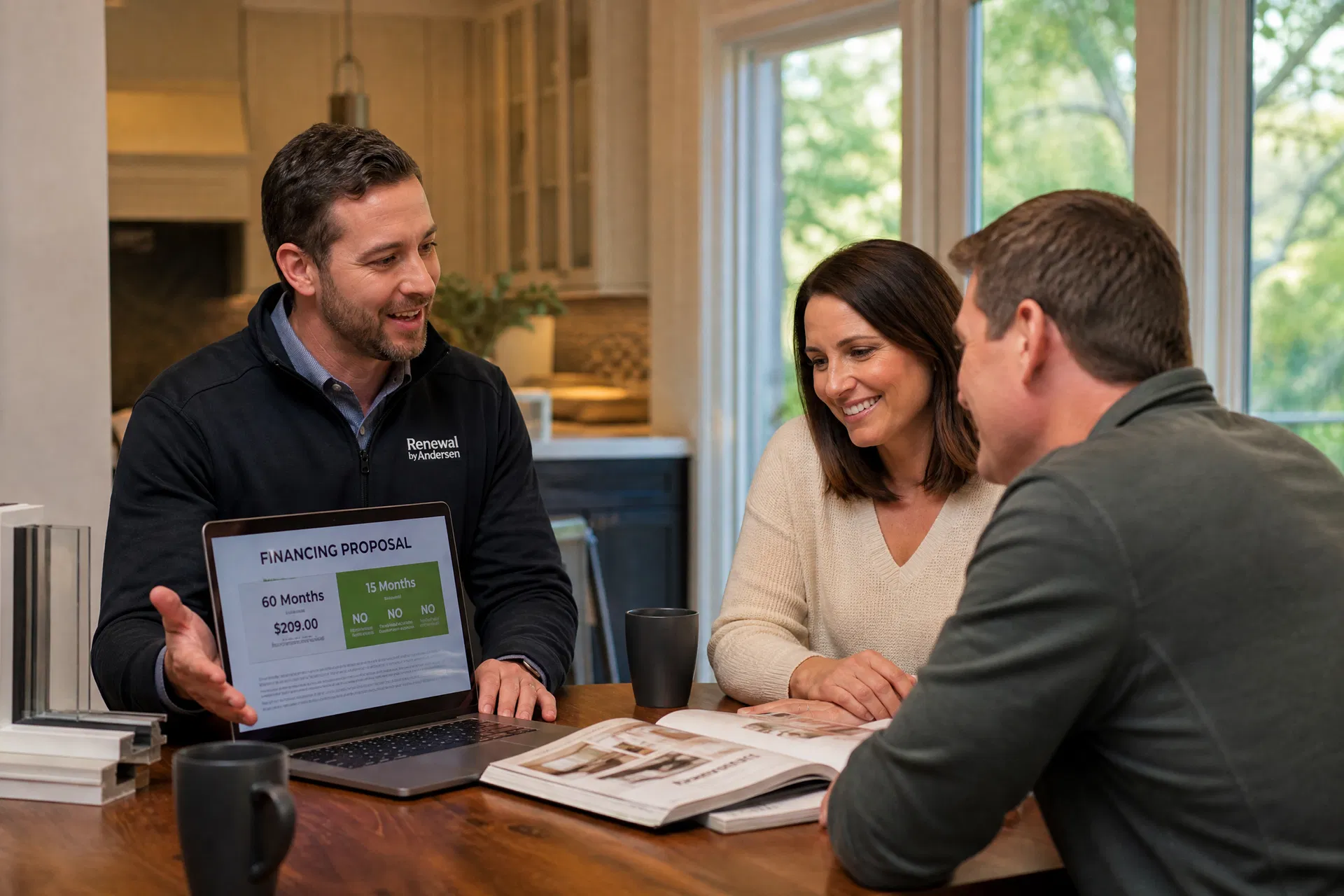
The right proposal makes it easy to compare what is included. State the product, scope, installation details, timing assumptions, warranty information, exclusions, and next step. If you offer financing, use the lender-approved details and make sure the homeowner understands the actual terms. The window and door financing guide covers the marketing and process side of that conversation.
Use Proof With Context, Not a Generic Portfolio
A gallery is useful when a homeowner can see themselves in it. Organize photos and case examples by project type, home style, neighborhood when appropriate, and the original concern.
For example:
- A homeowner concerned about comfort should see a project that explains the comfort problem and the installation approach.
- A homeowner replacing an entry door should see examples of entry-door design, security, and finishing details.
- A homeowner comparing full-home replacement should see how your team protects the home, sequences the installation, and communicates during the work.
Do not make up savings or comfort outcomes that the homeowner did not report and you did not measure. The proof is stronger when it stays specific.
Follow Up Like a Professional, Not a Reminder Bot
Every estimate should leave with a documented next step. If the homeowner is comparing proposals, send a concise recap that answers the questions they raised. If they need another decision-maker involved, make it easy to schedule a short review call. If the timing is later in the season, set the follow-up date with permission rather than sending repeated generic messages.
Your CRM should make it possible to see: appointment held, proposal sent, next step, reason not decided, and final outcome. Review those notes monthly. They show where the sales process needs better proof, better training, or better qualification.
The research content that brings homeowners in should match this process. Our research-phase marketing plan is about creating that education and proof before a visitor becomes an appointment. After an installation, a simple, well-timed ask can create the beginning of a trackable window and door referral program.
A window and door marketing for in-home sales program connects the marketing promise to the appointment handoff, project proof, and follow-up system. If you are deciding whether to bring in an agency, compare the operating model, tracking, and industry understanding, not just the presentation. Our guide to comparing window and door marketing agencies gives you a practical starting point.
Frequently Asked Questions
Should every showroom visitor be asked for contact information?
Ask for only what you need to provide relevant follow-up, and make the value clear. If you are sending product information or scheduling an estimate, explain why you are asking and honor the homeowner's communication preference.
What should an estimator bring to the appointment?
Bring relevant product samples, a clear scope process, finished-project proof, installation documentation, the ability to record notes, and the right information for any financing option you offer. The goal is clarity, not a larger stack of materials.
How should we use a homeowner's questions after an estimate?
Add recurring questions to a shared list. The best questions become sales enablement, FAQ content, product pages, and follow-up templates. That turns sales friction into marketing intelligence.
Sources

Keith Eneix is the Co-Founder and President of Fannit, a digital marketing agency built exclusively for home service contractors. He still owns and operates a multi-seven-figure contracting business in the Pacific Northwest. Since 2010, Fannit has helped 200+ contractors generate $100M+ in documented revenue.
Full Bio