
How Home Service Businesses Get Found in AI Search
AI search is not a trick. This contractor guide shows how accurate business data, service pages, reviews, and third-party proof make your company easier to find and trust.
The homeowner who needs a new roof, an urgent drain repair, or an HVAC replacement can now ask a full question instead of typing three words into Google. They may ask ChatGPT for a short list, use Perplexity to compare options, read a Google AI Overview, and then check reviews before they call.
That does not mean you need a different marketing system for every AI tool. It means the business information, proof, and service expertise you already put online need to agree, stay current, and give a homeowner a clear reason to trust you.
The opportunity is real. BrightLocal reports that 45% of consumers use ChatGPT or another generative AI tool for local business recommendations. [1] The wrong response is to chase a shortcut. The right response is to make your company easy to verify wherever an AI system looks.
What AI Search Changes for Home Service Businesses
AI search changes the way a homeowner narrows a list. Traditional local search often begins with a short phrase such as "plumber near me." AI tools invite a longer conversation: who handles a specific job, what should it cost, which company has experience with a certain system, or what should the homeowner ask before hiring.
That creates more places where your business can be discovered, but it also raises the bar. A useful recommendation needs evidence. The AI system has to find accurate business details, understand the services you offer, see proof that real customers trust you, and connect all of it to the city or service area the homeowner named.
| What a homeowner is trying to confirm | What your online presence needs to show |
|---|---|
| Can this company handle my specific job? | A dedicated, detailed page for the service, with process, limits, photos, and practical answers. |
| Do they work where I live? | Accurate service area information that matches your website, Google Business Profile, and major listings. |
| Are they legitimate and dependable? | Recent, specific reviews, clear ownership and contact information, licenses or credentials where relevant, and real project proof. |
| Why should I call them instead of the next company? | A plain-language explanation of your approach, the jobs you do best, and what the customer can expect next. |
Google's own guidance is direct: visibility in its generative features still depends on foundational SEO, helpful original content, crawlable pages, and complete local business details. [2] Put differently, AI search is not a separate universe. It is another place where strong local marketing can compound.
Build a Business That Is Easy to Verify
The goal is not to teach a model a slogan. The goal is to make the facts about your company consistent enough that a search engine, an AI assistant, a homeowner, or a referral partner reaches the same conclusion.
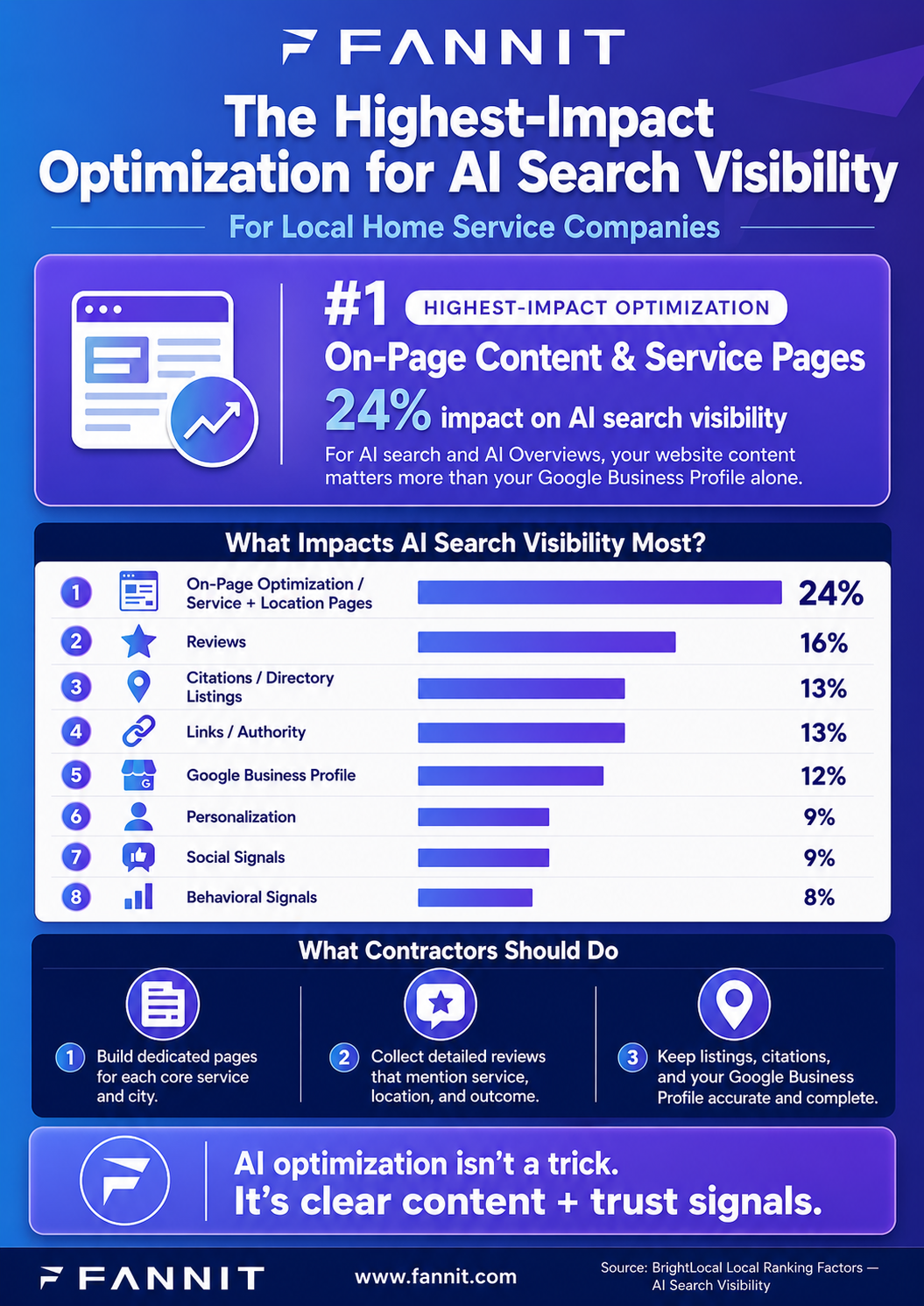
For local AI visibility, BrightLocal's 2026 expert survey put on-page factors first at 24%, followed by reviews at 16%, citations and links at 13% each, and Google Business Profile signals at 12%. [3] The survey is not a formula used by Google, ChatGPT, or Perplexity. It is a useful prioritization tool because it points back to the work that has always made a local business credible.
Start With Dedicated Service Pages
One generic services page leaves too much for a search engine or a homeowner to infer. Build a page for each core job you want to be known for, such as heat-pump installation, slab-leak repair, roof replacement, electrical-panel upgrades, or commercial kitchen hood cleaning.
Each page should answer the questions your office hears every week. Explain the symptoms, the process, likely options, what affects the job, the area you serve, and what happens after the customer calls. Use project photos and examples you can stand behind. Do not make ten thin city pages that repeat the same copy with a different place name. Google explicitly warns against producing a high volume of pages only to manipulate AI or search results. [2]
This is the core of a local SEO program for home service contractors. Your service pages are not there to please a bot. They give a homeowner and an AI system the specific information needed to decide whether you are a real fit for the job.
Make Your Business Facts Match Everywhere
Your name, phone number, website, hours, categories, and service area should match across your website, Google Business Profile, and the listings that matter in your market. Incomplete or inaccurate information creates a trust problem before the customer reaches your team.
Google says complete and accurate Business Profile information makes a company more likely to appear in relevant local results. It also lists relevance, distance, and prominence as the core local factors. [4] Work through the details in our Google Business Profile optimization guide, then clean up the directories that reinforce those details with this local citation management checklist.
Turn Reviews Into Useful Evidence
AI tools are looking for proof, and reviews are the clearest public record of whether people trust your company. The useful review is not a scripted five-star sentence. It explains the type of work, the area, the crew's communication, and the result in the customer's own words.
Build a simple job-closeout system: ask when the work is finished, make the review link easy to use, and respond like a business owner who expects future customers to read every reply. Never write reviews for customers, buy reviews, or pressure a customer to change honest feedback. That is not a growth system. It is a liability.
Publish First-Hand Answers, Not Generic AI Filler
The pages most likely to earn trust are the ones a real competitor cannot copy. A roofing company can explain how it documents storm damage in its market. An HVAC company can show how it decides whether a system needs repair or replacement. A plumbing company can walk through the conditions that change the scope of a repipe.
Google calls this non-commodity content: information shaped by direct experience and useful expertise, not a generic summary anyone could produce. [2] Good topics come from the questions that slow your sales team down, the job-site mistakes your crews see, and the decisions homeowners get wrong before they call.
If you want the full terminology behind SEO, GEO, AI Overviews, answer engines, and search experience, read our contractor guide to the five search signals. The practical point here is simpler: publish information that makes your company more believable after a homeowner sees your name.
Use Structure to Make the Page Easier to Understand
Clear headings, concise answers, descriptive page titles, fast mobile pages, image alt text, and sensible internal links make the site easier for people and systems to understand. Schema markup can help search engines interpret business and service details, and it remains worth maintaining as part of normal SEO.
It is not a magic AI switch. Google says no special AI markup, llms.txt file, or content "chunking" method is required to appear in its AI features. [2] Use structured data correctly because it supports your overall search presentation, not because someone sold it to you as a guaranteed ChatGPT ranking.
<a href="https://www.fannit.com/blog/ai-search-optimization-home-service-contractors/" title="AI Search Optimization for Home Service Contractors | Contractor Local SEO Guide"><img src="https://www.fannit.com/manus-storage/infographic-ai-search-home-service-contractors_df0fb7cc.png" alt="AI Search Optimization for Home Service Contractors | Contractor Local SEO Guide [Infographic]" width="800" /></a><br /><small><a href="https://www.fannit.com/blog/ai-search-optimization-home-service-contractors/">AI Search Optimization for Home Service Contractors | Contractor Local SEO Guide</a> via <a href="https://www.fannit.com">Fannit | Contractor Growth Marketing</a></small>
Build Authority Beyond Your Own Website
Your website is the source you control. AI search also looks for corroboration. That is why accurate listings, respected local directories, trade associations, local press coverage, supplier relationships, community involvement, and credible third-party reviews matter.
Do not buy a pile of low-quality links or publish fake mentions. Earn the kind of third-party signals that would still be valuable if AI search did not exist. A local Chamber profile, a real project feature in a trade publication, a supplier case study, or a neighborhood sponsorship can reinforce that your business is real and active in the places you claim to serve.
When you evaluate an agency, do not settle for an "AI package" that cannot explain the work. Use this comparison of best contractor marketing agencies to ask a more useful question: who is responsible for the pages, reputation, citations, technical health, and reporting that make your business easier to verify?
A 90-Day AI Search Visibility Plan
The work is manageable when you put it in the right order. Start with the pages and facts that a homeowner needs today. Then expand your proof and measure what changes.
| Timeframe | Focus | What completion looks like |
|---|---|---|
| Days 1 to 30 | Get the facts right | Your Google Business Profile, website contact details, core directories, categories, hours, and service area match. You have a baseline of current reviews, organic visibility, and AI answers for your brand name. |
| Days 31 to 60 | Strengthen service proof | Your most important services have clear, detailed pages with real job context, photos, helpful FAQs, and a direct next step. Your team has a consistent review request and response process. |
| Days 61 to 90 | Build external confidence | You correct remaining citation gaps, pursue a few credible local or industry mentions, refresh priority pages, and compare how AI tools describe your business with the sources they cite. |
For tracking, run a small set of repeatable searches every month. Search your brand name, each core service plus city, and the questions homeowners ask before they call. Record whether the answer is accurate, which sources appear, whether those sources are up to date, and whether the customer has a clear path to contact you. Google also recommends using Search Console's generative AI reporting to understand how people discover content in its AI features. 2
What Not to Spend Money On
Skip any vendor that promises a guaranteed placement in ChatGPT, a secret prompt that makes an AI recommend you, thousands of automatic city pages, or artificial mentions on sites no real customer would read. Those tactics either create a temporary illusion or make your site less useful.
The work that holds up is less exciting but more valuable: accurate facts, strong service pages, earned proof, current reviews, technical health, and a trackable process. The same system helps you show up in regular search, map results, referral research, and AI-assisted discovery.
Frequently Asked Questions
Can a contractor rank number one in ChatGPT or Perplexity?
There is no stable universal ranking position to buy or guarantee. These systems can change their sources and answers based on the question, location, and context. Focus on making your business accurate, well-documented, and easy to verify across the sources a homeowner can inspect.
Do I need an llms.txt file for AI search?
Not for Google's generative search features. Google says llms.txt and similar AI-specific files do not help or hurt visibility in Google Search. 2 Keep your energy on accessible pages, accurate business data, useful content, and sound technical SEO.
Is Google Business Profile still important if people use AI tools?
Yes. Google lists complete, accurate profile information, reviews, photos, and local prominence signals as important for local visibility. 4 Keep the profile current, then make sure your website and important directories tell the same story.
How do I know whether AI search is helping my business?
Track the answers and cited sources for a repeatable set of service and location questions. Pair that review with Search Console data, branded-search demand, called-in lead notes, and the simple question every office should ask: "How did you find us?" You are looking for accurate visibility that turns into qualified conversations and booked jobs, not a vanity mention.
Sources

Keith Eneix is the Co-Founder and President of Fannit, a digital marketing agency built exclusively for home service contractors. He still owns and operates a multi-seven-figure contracting business in the Pacific Northwest. Since 2010, Fannit has helped 200+ contractors generate $100M+ in documented revenue.
Full Bio