SEO, GEO, AIO, AEO, SXO: The 5 Search Signals Every Contractor Needs to Understand in 2026
Search has changed. Google is no longer the only place homeowners look for a roofer or an HVAC company. Here is a plain-language breakdown of the five signals that determine whether your contracting business gets found or gets ignored.
SEO, GEO, AIO, AEO, SXO: The 5 Search Signals Every Contractor Needs to Understand in 2026
If you have been running a contracting business for more than a few years, you have watched the rules of getting found online change completely. The playbook that worked in 2018 barely works today. And the playbook that works today will look different by 2027.
The reason is simple: search itself has changed. Google is no longer the only place people look for a roofer or an HVAC company. They ask ChatGPT. They use Perplexity. They talk to Siri. They read the AI overview at the top of the Google results page before they ever click a link.
That shift has created five distinct search signals that determine whether your contracting business gets found or gets ignored. Understanding all five, and how they work together, is the difference between a phone that rings and a phone that sits quiet.
This guide breaks down each one in plain language, explains what it means specifically for home service contractors, and shows you how Fannit builds all five into a single integrated strategy.
The 5 Search Signals: A Quick Overview
Before we go deep on each one, here is the short version:
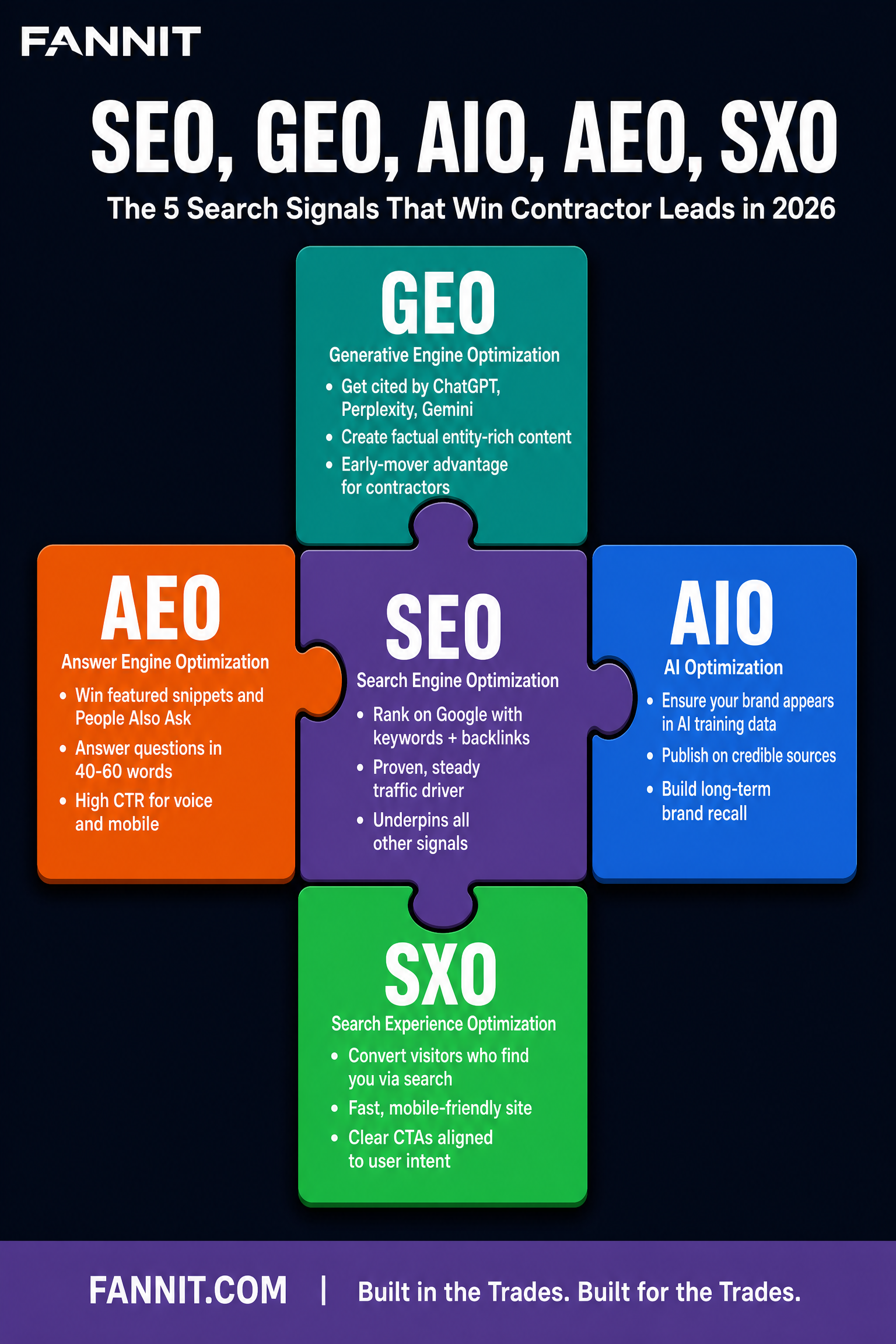
| Signal | Full Name | What It Does |
|---|---|---|
| SEO | Search Engine Optimization | Gets you ranked on Google through keywords, backlinks, and technical quality |
| GEO | Generative Engine Optimization | Gets your business cited by ChatGPT, Perplexity, and Google Gemini |
| AIO | AI Optimization | Ensures your brand is represented accurately in AI training data |
| AEO | Answer Engine Optimization | Wins featured snippets, People Also Ask boxes, and voice search results |
| SXO | Search Experience Optimization | Converts visitors into leads once they land on your site |
None of these five signals works in isolation. SEO drives traffic. GEO and AIO build brand authority in AI systems. AEO captures zero-click visibility. SXO turns all of that traffic into booked jobs. A weakness in any one of them creates a leak in your lead pipeline.
SEO: The Foundation That Still Matters Most
Search Engine Optimization is the oldest of the five signals and still the most important. When a homeowner in your service area types "roofing company near me" or "HVAC repair [city]" into Google, SEO is what determines whether your business appears on the first page or the fifth.
For contractors, SEO has three core components.
Local SEO is the most critical. This means your Google Business Profile is fully optimized, your business is listed consistently across directories, you have a steady flow of reviews, and your website has dedicated pages for each service area you cover. When Google shows the map pack (the three businesses with a map at the top of local search results), local SEO is what gets you there.
On-page SEO means your website pages are built around the specific keywords your customers use. A roofing company needs pages optimized for terms like "roof replacement [city]," "storm damage roof repair," and "commercial roofing contractor." Each page needs a clear title, a well-structured body, proper header tags, and internal links to related pages.
Technical SEO means your website loads fast, works perfectly on mobile, has no crawl errors, and uses structured data (schema markup) to help Google understand what your business does and where you operate.
SEO is the foundation because every other signal depends on it. You cannot win GEO or AEO without content that is already well-structured and authoritative. You cannot win SXO without a website that is fast and technically sound.
If you are not investing in SEO, you are invisible to the majority of homeowners who search for your services. The contractors who dominate local search results are not there by accident. They have been building their SEO foundation consistently for years.
Learn more about Fannit's contractor SEO services.
GEO: The New Frontier for Contractor Visibility
Generative Engine Optimization is the newest of the five signals and the one with the most upside for contractors right now. GEO is the practice of optimizing your content so that AI-powered search tools like ChatGPT, Perplexity, Google Gemini, and Microsoft Copilot cite your business or your content when answering questions.
Here is a concrete example. When a homeowner asks ChatGPT "what should I look for when hiring a roofing contractor in Seattle," the AI generates an answer. That answer is built from content it has indexed from across the web. If your website has a well-structured, factual, entity-rich page that answers that question, there is a real chance your business gets mentioned in the response.
This is not theoretical. It is happening right now, and most contractors have no idea it is a channel they can influence.
GEO is built on three principles. First, your content needs to be factual and entity-rich. AI systems are trained to surface authoritative information, which means your pages need to clearly state who you are, what you do, where you operate, and what makes you credible. Named entities (your business name, your city, your specific services, your years in business) help AI systems identify you as a real, trustworthy source.
Second, your content needs to follow E-E-A-T principles (Experience, Expertise, Authoritativeness, Trustworthiness). This means writing from genuine expertise, citing real results, and having your content linked to and referenced by other credible sources.
Third, your website structure needs to be clear and crawlable. AI systems favor content that uses clear headings, tables, FAQs, and structured formatting because it is easier to parse and summarize.
Right now, very few contractors are thinking about GEO. The ones who start building GEO-optimized content today will have a significant advantage as AI search continues to grow. This is the same opportunity that existed with local SEO in 2012. The contractors who built their Google Business Profiles early dominated their markets for years.
Learn more about Fannit's GEO services for contractors.
AIO: Making Sure AI Knows Who You Are
AI Optimization is closely related to GEO but focuses on a different goal. Where GEO is about getting cited in AI-generated answers, AIO is about ensuring your brand is represented accurately and positively in the AI training data that powers those systems.
Think of it this way: AI systems like ChatGPT and Gemini were trained on enormous datasets of web content. The way your business is described across the web, in reviews, in directory listings, in news articles, in your own content, shapes how AI systems understand and represent your brand.
If your business has inconsistent information across the web (different phone numbers, different addresses, different descriptions of what you do), AI systems will reflect that inconsistency. If your business has no presence on credible platforms, AI systems may not know you exist at all.
AIO is about consistency and credibility at scale. It means your business information is accurate and consistent across every platform where it appears. It means you are publishing content on credible sources beyond your own website, including industry publications, local news sites, and authoritative directories. It means your Google Business Profile, your website, your social profiles, and your directory listings all tell the same story about who you are and what you do.
AIO is also about brand recall. When a homeowner has a positive interaction with an AI assistant that mentions your business, that creates a brand impression even if they never click a link. Over time, those impressions build the kind of brand recognition that drives direct searches and referrals.
AIO is the hardest of the five signals to measure in the short term, but it is one of the most important for long-term brand equity. The contractors who build strong AIO foundations today will be the ones AI systems recommend by name in 2028.
AEO: Winning the Zero-Click Moment
Answer Engine Optimization is the practice of optimizing your content to appear in the zero-click search results that Google and other search engines display before a user ever visits a website. These include featured snippets (the answer box at the top of Google results), People Also Ask boxes, and AI Overviews.
The term "zero-click" refers to the fact that many users get their answer directly from the search results page without clicking through to any website. For contractors, this might sound like a bad thing. If someone gets their answer without visiting your site, how does that help you?
The answer is that AEO builds authority and brand visibility even when no click occurs. When your business is the source of the answer that appears in a featured snippet or an AI Overview, you are positioned as the expert. That positioning influences the homeowner's decision when they are ready to call someone.
The most effective AEO tactic for contractors is answering questions in 40 to 60 words. Google's featured snippet algorithm strongly favors concise, direct answers to specific questions. If a homeowner searches "how long does a roof replacement take," a page that answers that question in a clear, direct paragraph of 40 to 60 words is far more likely to win the featured snippet than a page that buries the answer in a 2,000-word article.
People Also Ask optimization means identifying the questions your target customers ask and building dedicated FAQ sections that answer each one directly. These sections should use proper FAQ schema markup so that Google can easily identify and display them.
Voice search optimization is a subset of AEO. When someone asks their phone "who is the best HVAC company in [city]," the voice assistant reads a single answer aloud. That answer almost always comes from a featured snippet or a Google Business Profile. Optimizing for AEO directly improves your voice search visibility.
Every service page on your website should have a FAQ section that answers the most common questions your customers ask. Every blog post should be structured to answer a specific question clearly and concisely. These are not just good content practices. They are the specific signals that win AEO placement.
SXO: Turning Search Traffic into Booked Jobs
Search Experience Optimization is the bridge between getting found and getting hired. SXO is the practice of optimizing the on-site experience so that visitors who arrive from any search channel (Google, AI tools, voice search, featured snippets) convert into leads and booked jobs.
SXO is where many contractors lose the leads they worked hard to earn. A homeowner finds your business through a Google search, clicks your link, and lands on a slow website with a confusing layout and no clear way to request a quote. They leave. All of that SEO, GEO, and AEO work produced a visit that turned into nothing.
Speed and mobile performance are the foundation. More than 70 percent of contractor website traffic comes from mobile devices. If your site takes more than three seconds to load on a phone, you are losing a significant percentage of your visitors before they see a single word of your content. Core Web Vitals measure load speed, interactivity, and visual stability. Poor scores hurt both your SEO rankings and your conversion rates.
Intent alignment means your landing pages match what the visitor was looking for. If someone searches "emergency roof repair" and lands on your generic homepage, there is a disconnect. SXO means building dedicated pages for each high-intent search query, with content that immediately confirms you can solve the visitor's specific problem.
Clear calls to action mean every page has an obvious next step. For contractors, this is almost always a phone number (prominently displayed, click-to-call on mobile), a contact form, or a quote request button. The CTA should be visible without scrolling, repeated throughout the page, and framed around the visitor's urgency.
Trust signals are the elements that tell a new visitor you are a legitimate, credible business. These include real customer reviews displayed on the page, photos of your actual work, years in business, licenses and certifications, and any awards or recognitions. For home service contractors, trust signals are especially important because you are asking homeowners to invite you into their homes.
You can have the best SEO in your market, but if your website does not convert visitors into leads, you are leaving money on the table. SXO is the final mile of your search strategy.
Learn more about Fannit's website design services for contractors.
How the Five Signals Work Together
The power of this framework is not in any single signal. It is in how they reinforce each other.
SEO builds the foundation of organic visibility on Google. GEO and AIO extend that visibility into AI-powered search channels, ensuring your brand is present wherever homeowners are looking for answers. AEO captures the zero-click moments that build authority and brand recognition even when no visit occurs. SXO converts all of that traffic and visibility into actual leads and booked jobs.
A contractor who invests only in SEO will see diminishing returns as AI search continues to grow. A contractor who invests in GEO without a strong SEO foundation will struggle to build the content authority that AI systems require. A contractor who wins on all five signals will have a compounding advantage that is very difficult for competitors to replicate.
Here is how the signals connect in a real customer journey. A homeowner's HVAC system stops working on a hot July afternoon. They ask Google "HVAC repair near me" and see your business in the map pack (SEO). They also see an AI Overview that mentions your company as a trusted local HVAC contractor (GEO + AIO). They click your listing, land on a fast, mobile-friendly page with a clear "Request Emergency Service" button (SXO), and call you within 30 seconds. That is what an integrated five-signal strategy looks like in practice.
What Fannit Does Differently
Fannit was founded to save our father's contracting business. We have been in the trades since 2010, and we have watched every major shift in how homeowners find contractors online. We built our service model around all five of these signals because we know from experience that a weakness in any one of them creates a gap that competitors will fill.
Our SEO program covers local optimization, on-page content, technical audits, and link building. Our GEO and AIO work focuses on building entity-rich content and consistent brand presence across the platforms that AI systems trust. Our AEO work includes FAQ schema, featured snippet optimization, and People Also Ask targeting. Our website design and SXO work ensures that every visitor who arrives on your site has a clear path to becoming a lead.
If you want to understand where your business stands across all five signals, start with a free strategy call. We will audit your current visibility, identify the gaps, and show you exactly what it would take to dominate your local market.
Get a free strategy call with a Fannit contractor marketing specialist.
Frequently Asked Questions
What is the difference between SEO and GEO?
SEO (Search Engine Optimization) focuses on ranking in Google's traditional blue-link results through keywords, backlinks, and technical quality. GEO (Generative Engine Optimization) focuses on getting your business cited in AI-generated answers from tools like ChatGPT, Perplexity, and Google Gemini. The two are complementary: a strong SEO foundation supports GEO performance, but GEO requires additional work on entity richness and structured data that traditional SEO does not address.
Do I need to do all five signals at once?
No. The recommended starting point is SEO, because it is the foundation that every other signal builds on. Once your SEO foundation is solid, GEO and AEO are the next highest-priority investments for most contractors. SXO improvements can and should happen in parallel with SEO, because a faster, better-converting website improves both your rankings and your lead volume. AIO is an ongoing practice that happens as part of your broader content and brand consistency work.
How do I know which signals are weakest for my business?
The fastest way to find out is a free strategy audit with a Fannit specialist. We test your current visibility across all five channels, identify the specific gaps, and prioritize the improvements that will have the highest impact on your lead volume. Schedule a free strategy call here.
Is GEO worth investing in if my SEO is not strong yet?
No. GEO requires a strong content foundation, and that foundation is built through SEO. Entity-rich content, schema markup, E-E-A-T signals, and consistent brand information are all SEO fundamentals that GEO builds on. Fix your SEO first, then layer in GEO optimization.
How long does it take to see results from these strategies?
SEO results for local rankings typically appear within 60 to 90 days. Organic keyword rankings for competitive terms take 3 to 6 months. GEO and AIO results are harder to measure in the short term but support long-term brand authority. AEO improvements (featured snippets, People Also Ask) can appear within 30 to 60 days of implementing the right content changes. SXO improvements to conversion rates are often visible within days of implementing them.

Keith Eneix is the Co-Founder and President of Fannit, a digital marketing agency built exclusively for home service contractors. He still owns and operates a multi-seven-figure contracting business in the Pacific Northwest. Since 2010, Fannit has helped 200+ contractors generate $100M+ in documented revenue.
Full Bio