
Do Contractors Need Marketing in 2026? The Honest Answer
You built your business on referrals. The phone rang because people knew your name. That model still works, but it has a ceiling. Here is the honest answer to whether contractors actually need marketing in 2026, and what the data says.
If you run a service contracting business, you have probably had this exact thought: "I don't need marketing. My phone rings because people know my name and my work." That belief is not wrong. It is incomplete. A referral is a powerful thing. It means someone trusted you enough to put their reputation on the line. But in 2026, a referral is no longer the finish line. It is the starting pistol. The homeowner who gets your name from a neighbor will still spend 15 minutes on Google before they ever dial your number. And if what they find is a thin online presence, a handful of stale reviews, and a competitor who looks more polished and more present, that referral evaporates. This article is not here to tell you that word-of-mouth is dead. It is here to show you that contractor marketing is the difference between a referral that converts and a referral that quietly moves on.
The Golden Age of Referrals Is Over (Here’s Why)
For decades, the model worked beautifully. Do good work, shake a hand, get a referral, repeat. Many service contractors built six- and seven-figure businesses on that exact loop. The problem in 2026 is not that referrals stopped happening. It is that they stopped being enough to close the deal on their own.
The math of market saturation has shifted. The average homeowner in a mid-sized US city now has three to five service contractors bookmarked or saved in their phone, often without realizing it. They have the plumber their cousin recommended, the electrician their coworker mentioned, and the HVAC company that left a door hanger last spring. When a problem arises, they do not call all three. They search all three. They compare Google Business Profiles, read the most recent reviews, scan photos of completed work, and check response times. A referral gets you onto the shortlist. A professional contractor website and a well-managed online reputation win the job.
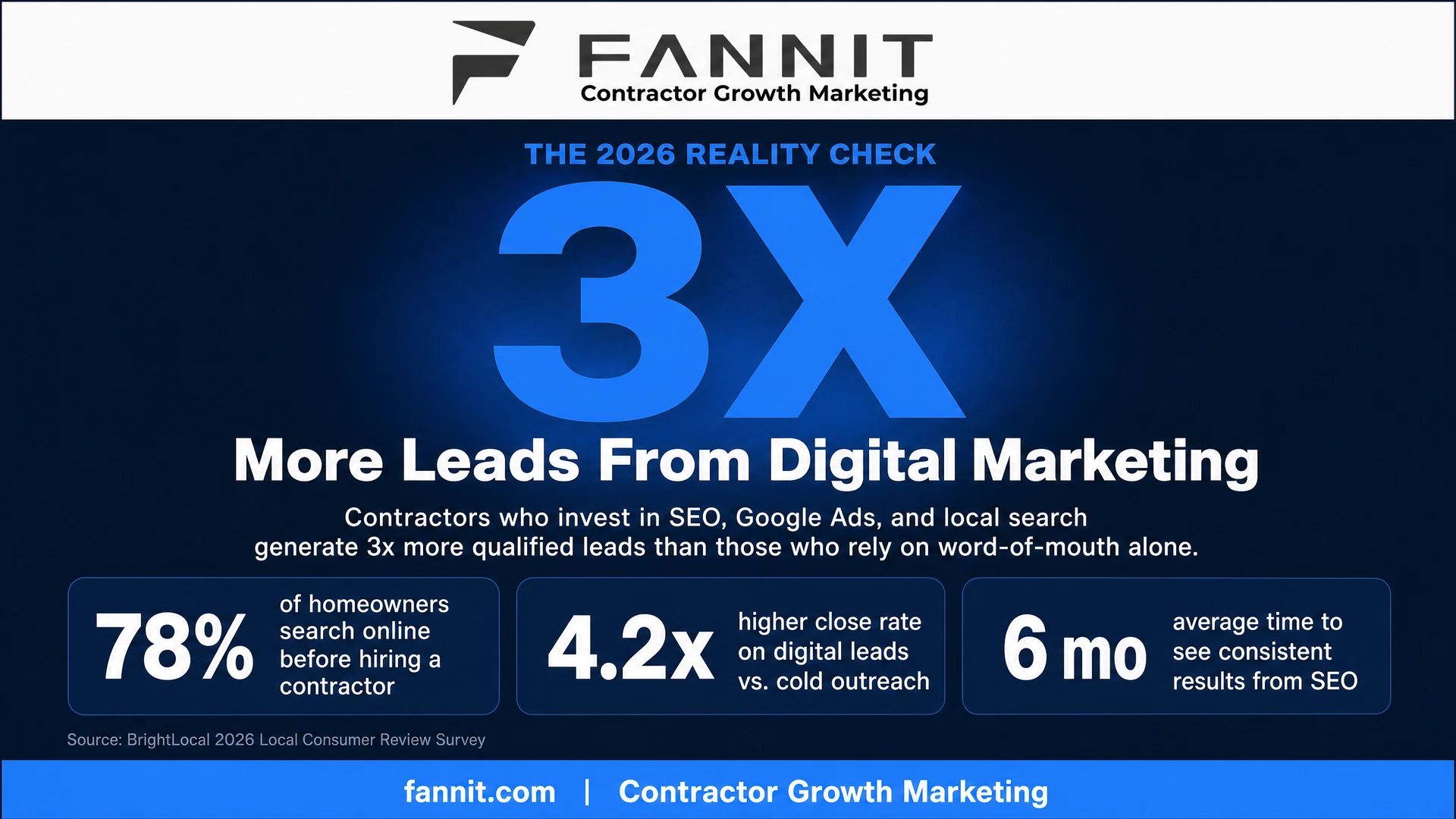
The "Google First" reflex is now nearly universal. Recent consumer behavior data shows that 97 percent of people search online for local services, even after receiving a personal recommendation. They are not searching to find you. They are searching to validate you. If your business does not appear in those search results, or worse, appears with outdated information and a 3.2-star average, the referral that felt like a sure thing suddenly becomes a competitive situation you did not know you were in. Local SEO for contractors — the Bureau of Labor Statistics counts over 900,000 construction firms competing for the same homeowners — is no longer a technical luxury. It is the mechanism that ensures your reputation precedes you when it matters most.
Then there is the referral ceiling, a concept every owner hits eventually. Fannit's contractor marketing program is built to break through it. Word-of-mouth fills a calendar, but it fills it unevenly. You get feast-or-famine cycles. You get jobs clustered in one neighborhood while another service area goes cold. You stay at a size where you and maybe two crews can handle the load, but you cannot confidently hire a third crew because you do not know if the work will be there in February. Contractor business growth requires predictability. Predictability requires proactive lead generation, not reactive scheduling. Referrals are a gift. A marketing system is a plan.
Consider what the data shows when contractors add a deliberate marketing strategy to an already-strong referral base. Blue Corona, a firm that has worked with thousands of home service companies, reported that one client saw a 91 percent increase in phone calls and a 454 percent increase in non-branded organic traffic within 12 months. Those are not numbers from a startup with no reputation. Those are numbers from a contractor who already had word-of-mouth working and layered marketing on top. Marketing does not replace referrals. It amplifies them.
Does Marketing Actually Work for Contractors? (The Data Says Yes)
Skepticism is healthy. Every contractor has been pitched by someone promising to "get you on page one" or "flood your phone with leads." Most of those pitches are noise. The real question, does marketing work for contractors, deserves a real answer rooted in math, not marketing speak.
Working is not about likes, shares, or impressions. A contractor does not pay the mortgage with a viral post. Working means a measurable cost per lead that is lower than the value of the jobs those leads produce. Working means a close rate you can track and a customer lifetime value you can bank on. When you frame contractor marketing strategies as a profit-and-loss equation, the fog clears.
The Blue Corona results mentioned earlier are worth unpacking. A 433 percent increase in online conversions over 12 months is not a fluke, but it is also not instant. That number represents a compounding effect. Month one might produce a handful of extra calls. Month six might produce a steady trickle. Month twelve becomes a stream. Contractor SEO and content marketing behave like compound interest. The early returns feel modest. The later returns change the trajectory of the business.
One of the more surgical contractor marketing strategies to emerge in recent years is permit monitoring. MarketSharp, a software and marketing company serving the trades, identified a tactic that few contractors use: pulling public building permit data to identify homeowners who have filed for renovations, additions, or major repairs. These are people who have already committed to spending money. They have not yet hired a contractor, or they have hired one and may need additional trades. A well-timed, personalized mailer or a door knock with a specific reference to the permitted project converts at a rate that blanket advertising never will. This is contractor advertising at its most precise. It works because it intercepts demand at the exact moment of need.
Paid advertising works too, but it works differently. Google Ads for contractor lead generation can produce calls within hours of launching a campaign. That speed comes at a price. Cost per click in competitive trades like plumbing, HVAC, and roofing can run $30 to $90 in major metro areas. If your close rate is strong and your average ticket is high, those numbers still make sense. But PPC is a faucet you pay to keep open. Turn it off, and the leads stop. Contractor SEO, by contrast, takes six to nine months to mature, but the leads it produces cost nothing per click. The smart play for most established contractors is to run both: PPC for immediate pipeline while SEO builds a long-term asset.
The 5 Pillars of Modern Contractor Marketing (2026 Edition)
Pillar 1: A Contractor Website That Converts (Not Just Looks Pretty)
Most contractor websites are digital brochures. The contractor digital marketing guide covers how to turn a brochure site into a lead machine. They have a logo, a phone number, a list of services, and a gallery of project photos. That is table stakes in 2016. In 2026, it is a liability. A high-performing contractor website must be built to convert a visitor into a lead within seconds, not minutes.
Conversion means removing every possible point of friction. A click-to-call button that is visible without scrolling. Service area pages that tell Google and the visitor exactly where you work. Instant quote forms that ask for three pieces of information, not fifteen. Mobile-first design is non-negotiable. More than 70 percent of local service searches now happen on a phone, often while a homeowner is standing in a flooded basement or looking at a broken AC unit. If your site loads slowly, they bounce. A two-second delay in load time increases bounce rates by 50 percent. For a contractor, that is not a lost visitor. That is a lost job.
One of the most common questions homeowners type into search engines is some variation of "How much does X cost?" Most contractor websites avoid answering it. That is a mistake. A transparent pricing page or an interactive cost calculator tool builds immediate trust. It also filters out prospects who cannot afford your services before they waste your time on a call. Addressing the money question directly is one of the simplest and most underused contractor marketing strategies available.
Pillar 2: Local SEO & Google Business Profile Dominance — covered in depth in the SEO, GEO, AIO, AEO, SXO guide for contractors
When a homeowner searches "plumber near me" or "roofing contractor [city]," Google serves a map with three listings before any organic website links. That map pack is the new Yellow Pages, and local SEO for contractors is the only way to get into it.
Ranking in the map pack requires a fully optimized Google Business Profile. That means selecting the right primary and secondary categories, populating every service field, writing a business description that includes your target keywords naturally, and posting updates weekly. The Q&A section should be pre-loaded with the questions you get on every estimate call. The reviews section must be active, with recent five-star reviews and, critically, responses from the business owner to every review, positive or negative. Google reads those responses as a signal that the business is active and engaged.
The 2026 landscape adds a new layer: voice search and AI assistants. When a homeowner asks Siri for a "roofer near me," Siri pulls data from Yelp. When they ask Google Assistant, it pulls from Google Business Profiles. When they ask Alexa, it pulls from Bing and Yelp. Contractor SEO now means ensuring your business information is accurate, consistent, and complete across all of these platforms. A single incorrect phone number on a Yelp profile you forgot you had can cost you leads from an entire ecosystem of voice search users. This is a unique challenge, and it rewards contractors who treat their online presence as seriously as they treat their truck fleet.
Pillar 3: The Referral Engine (Systematizing Word-of-Mouth)
Contractor referrals are not a strategy. They are the outcome of a strategy. The strategy is a system that asks for, captures, and rewards referrals automatically, without the owner having to remember to do it.
An automated follow-up email sent 48 hours after a job is completed, thanking the customer and including a one-click link to leave a Google review, is the bare minimum. Adding a "Share with a neighbor" card to every paper invoice, with a QR code that pre-fills a referral form, turns every satisfied customer into a passive lead source. A monthly drawing where every reviewer is entered to win a $100 gift card costs $1,200 a year and can generate hundreds of reviews. That is a rounding error compared to the value of one new client.
Partnerships represent an even more powerful referral channel. Real estate agents, mortgage lenders, property managers, and insurance adjusters talk to homeowners at the exact moment they need contractor services. A plumbing company that builds relationships with five local real estate agents will receive a steady stream of contractor lead generation calls for inspection repairs and pre-listing fixes. These are not cold leads. They are warm referrals from a trusted source, and they close at a much higher rate than any other channel.
Pillar 4: Social Proof & Reputation Management
There is a psychological threshold most homeowners apply before they call a contractor: ten reviews. Fewer than ten, and the business feels unproven, regardless of how many years it has been operating. Crossing that threshold is step one. Building a system to generate a steady flow of fresh reviews is step two. Text-to-review links, QR codes on truck doors and estimate sheets, and a simple verbal ask at the end of a successful job all work. The method matters less than the consistency.
Construction marketing thrives on visual proof. Before-and-after photos are the most compelling content a contractor can publish. Instagram and Facebook are not platforms where homeowners go to hire a contractor. They are platforms where homeowners go to see if a contractor is legitimate. A feed full of crisp, well-lit project photos with brief captions about the challenge and the solution tells a story that no advertisement can match.
Negative reviews happen. A 3-star review with a calm, professional, solution-oriented response from the owner is more persuasive to a prospective client than a 5-star review with no response. It shows that the business owns its mistakes and makes them right. That is exactly what a homeowner wants to see before they hand over a deposit.
Pillar 5: Paid Ads (When to Use the Gas Pedal)
Paid contractor advertising is the accelerator. Google Local Services Ads, the ones that appear at the very top of search results with a green "Google Guaranteed" badge, deliver the highest intent leads for emergency and urgent-service trades. Plumbing, HVAC, and electrical contractors see strong ROI from LSAs because the searcher has an active problem and needs someone now.
For high-ticket services like roofing, remodeling, and foundation repair, the buying cycle is longer. Homeowners research for weeks or months before committing. Facebook and Instagram retargeting ads keep a contractor's name in front of those prospects after they visit the website. A homeowner who browses a roofing page, leaves, and then sees a tasteful ad featuring a recent roof replacement in their neighborhood is far more likely to return and convert.
Budget allocation is a gap in most contractor marketing advice, so here is a practical starting point. Established contractors with a steady referral base should consider a 70/20/10 split: 70 percent of budget toward SEO and organic content, 20 percent toward PPC and LSAs, and 10 percent toward social media and traditional methods. Newer contractors who need leads immediately should invert that, running closer to a 50/50 split between paid ads and the SEO foundation they are building for the future.
How Contractors Get Clients in 2026 (A Tactical Breakdown)
The question of how contractors get clients has a different answer in 2026 than it did even five years ago. The channels have multiplied, and the tactics that work vary by trade, season, and market.
One simple framework that helps overwhelmed owners take action is the 3-3-3 rule. Spend three hours a week on marketing, no more and no less. Make three touchpoints per prospect: a phone call, a follow-up email, and a social media connection or retargeting ad impression. Give the system three months before evaluating whether it is working. This rule cuts through the paralysis that stops so many contractors from starting. Three hours a week is manageable. Three touchpoints is memorable without being annoying. Three months is long enough for SEO to show early signals and for paid campaigns to be optimized.
Channel performance varies significantly by trade. Roofing contractors see strong results from Facebook and Nextdoor, where before-and-after photos and neighborhood recommendations carry weight. HVAC contractors win on Google, where emergency intent is highest and Local Services Ads capture demand at the moment of need. Plumbers split the difference, with Google LSAs driving urgent calls and Nextdoor driving planned replacement work. Understanding these dynamics allows a contractor to invest where their specific customers are actually looking.
The decision to handle marketing in-house or hire an agency is one every contractor faces. A practical framework: if your total marketing budget is under $1,000 per month and you have the time and interest to learn, DIY is viable. Start with a well-optimized Google Business Profile, a simple website, and a review generation habit. If your budget exceeds $2,000 per month and your time is better spent running crews and closing estimates, hire an agency. The opportunity cost of a business owner trying to learn technical SEO while also managing operations is almost always higher than the agency fee.
Seasonality is another factor most generic marketing advice ignores. HVAC marketing should pivot from air conditioning repair and replacement content in May through August to furnace tune-up and heating emergency content in September through November. Roofing contractors should monitor weather data and shift ad spend toward storm-affected areas within 48 hours of a hail or wind event. Landscaping contractors should front-load their marketing spend in February and March to book spring cleanups and hardscape installations before the season fills. A static marketing plan is a losing plan. A seasonal plan captures demand when it actually exists.
The Real Cost of Contractor Marketing (Budgeting for Growth)
Pricing transparency is rare in the marketing industry, which is why so many contractors feel like they are walking into a negotiation blind. The question "How much do marketing contractors charge?" deserves a straight answer.
Marketing consultants and freelancers charge between $50 and $500 per hour, depending on their role. At the lower end, $50 to $100 per hour buys execution work: social media posting, basic SEO tasks, review management. At the mid-range, $150 to $300 per hour buys strategy: campaign management, content planning, conversion rate optimization. At the top end, $300 to $500-plus per hour buys a fractional Chief Marketing Officer who can design the entire growth system and manage other vendors. Most service contractors do not need a $500-per-hour strategist. They need a competent team or agency that can execute consistently.
Agency pricing typically follows one of three models. Flat monthly retainers, which might range from $1,500 to $5,000-plus depending on scope, cover a bundle of services like SEO, website management, and content. Percentage of ad spend models are common for PPC management, where the agency charges 10 to 20 percent of the ad budget on top of the media cost. Project-based pricing applies to website redesigns, branding work, or one-time campaigns. The Marketing 360 model, which pairs contractors with a dedicated marketing director as part of a technology and services package, is a done-for-you retainer model. For a contractor spending $3,000 or more per month, that structure is often cheaper than hiring a full-time marketing employee with salary, benefits, and payroll taxes.
ROI benchmarks vary by trade, and knowing these numbers helps set realistic expectations. General contractors doing remodeling and additions can expect a 5:1 return on marketing spend as a healthy baseline. Roofing contractors, with higher average ticket sizes and storm-driven demand, often achieve 8:1 or better. Plumbing and electrical contractors, with lower average tickets but higher repeat visit frequency, should target 3:1 to 4:1, with the understanding that customer lifetime value drives the real return over multiple service calls. These are not guarantees. They are benchmarks that a well-run contractor marketing program can realistically hit.
Is an Agency Worth It? (When to Hire vs. When to DIY)
Any contractor who has spent time reading industry forums knows the skepticism. The best contractor marketing agencies guide covers what the good ones actually do differently. Reddit threads are full of owners who say agencies over-promise and under-deliver, that they charge big retainers and deliver vague reports, that no one cares about your business the way you do. That skepticism is earned. The agency world has plenty of mediocrity.
That does not mean the agency model is broken. It means due diligence is essential. A contractor considering an agency should ask for a 90-day trial with specific, measurable KPIs: number of leads generated, number of phone calls, website traffic growth, map pack ranking improvements. If an agency will not agree to a trial or cannot define what success looks like in numbers, walk away. Some agencies, like Footbridge Media, offer entry-level plans around $249 per month. That is a low-risk way to test the value of professional marketing without committing a significant budget. If the trial produces results, scale up. If it does not, you have learned something for less than the cost of one minor service call.
For contractors who prefer to keep marketing in-house, the DIY toolkit has never been more accessible. A trade-specific CRM like Jobber or Housecall Pro handles scheduling, invoicing, and basic follow-up automation. A review management tool like Birdeye or Podium systematizes review requests and monitors online reputation across platforms. A basic SEO tool like Semrush or Ahrefs provides keyword research and rank tracking without requiring a computer science degree. These tools require time to learn and use, but they put professional-grade marketing capability in the hands of a motivated owner.
The hybrid model is emerging as the smartest approach for 2026. Keep social media and referral generation in-house, where authentic voice and personal relationships matter most. Outsource contractor SEO and paid advertising to a specialist agency that lives and breathes search algorithms and bid strategies. This gives the contractor control over brand and customer experience while leveraging expert traffic generation. It is not an either-or choice between DIY and agency. It is a question of which pieces to own and which to delegate.
Conclusion: The Word-of-Mouth + Marketing Flywheel
The question that opened this article, "Do contractors really need marketing, or is word-of-mouth enough," has a clear answer in 2026. Word-of-mouth is the result of great service. Marketing is the engine that makes it scalable. A contractor who relies on referrals alone is leaving the majority of their potential market untouched and unprotected.
The flywheel works like this: great service produces five-star reviews. Five-star reviews improve Google rankings. Higher Google rankings produce more leads. More leads produce more opportunities to deliver great service. Every turn of the flywheel accelerates the next. Marketing is not a separate activity from doing good work. It is the system that ensures good work gets seen, remembered, and chosen.
If you are a service contractor reading this, take ten minutes today to audit your current state. Pull up your Google Business Profile on your phone. Search for your primary service and your city. Are you in the map pack? Does your contractor website load fast and make it easy to call or request a quote? Are your reviews recent, numerous, and responded to? If the answer to any of those questions is no, you are leaving money on the table. Money that a competitor is happily collecting.
The best contractor marketing in 2026 is not a choice between a great reputation and a predictable lead generation system. It is the deliberate combination of both. Master word-of-mouth. Then build the marketing engine that turns a good reputation into a growing, resilient business.
<a href="https://www.fannit.com/blog/contractor-marketing-2026-reality-check/" title="Do Contractors Need Marketing in 2026 — Contractor Digital Marketing Guide"><img src="https://www.fannit.com/manus-storage/infographic-contractor-marketing-2026-stat_b3d72d47.png" alt="Do Contractors Need Marketing in 2026 — Contractor Digital Marketing Guide [Infographic]" width="800" /></a><br /><small><a href="https://www.fannit.com/blog/contractor-marketing-2026-reality-check/">Do Contractors Need Marketing in 2026 — Contractor Digital Marketing Guide</a> via <a href="https://www.fannit.com">Fannit | Contractor Growth Marketing</a></small>

Keith Eneix is the Co-Founder and President of Fannit, a digital marketing agency built exclusively for home service contractors. He still owns and operates a multi-seven-figure contracting business in the Pacific Northwest. Since 2010, Fannit has helped 200+ contractors generate $100M+ in documented revenue.
Full Bio