
The Right Website Structure for a Local Electrician: Service Pages, Area Pages, and What Not to Nest
Service pages say what you do. Area pages say where you do it. Get the structure wrong and neither one ranks. Here is the hierarchy that actually works.
A job site has a layout for a reason. Framing goes before drywall, and you do not hang drywall on a wall that has no studs. A website is the same. Most electrical sites fail not because the copy is bad but because the structure underneath is wrong. The pages are there, but they are arranged in a way Google cannot follow and a homeowner cannot find.
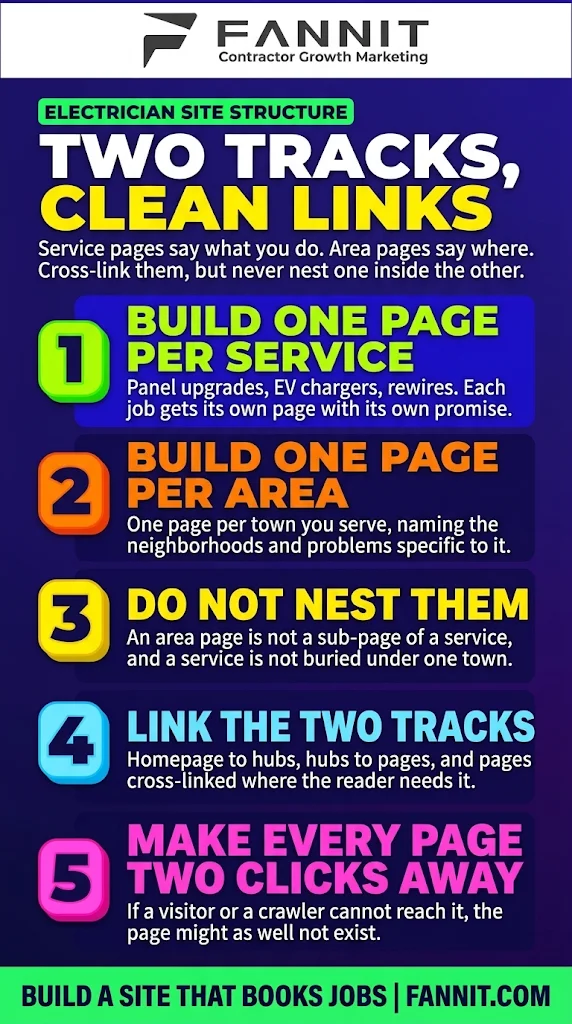
There are two kinds of pages that matter for a local electrician, and they do two different jobs. Service pages say what you do. Area pages say where you do it. Get the relationship between them right and the whole site works harder.
Service Pages: One Page for Every Job You Sell
A service page is a page about one service you actually offer. Panel upgrades, EV charger installation, whole-house rewiring, generator hookups, lighting, service calls. Each one gets its own page.
The reason is simple. When someone searches "EV charger installation cost," they want a page about EV charger installation, not a menu of thirty services where that one is a bullet point. Google rewards the specific page, and so does the reader.
A good service page names the problem, walks through the work, answers the cost and timeline questions, and ends with a clear way to book. It does not try to cover panel upgrades at the same time. One page, one job, one promise. Our guide to how SEO works for home service businesses explains why this one-page-per-service rule is the foundation everything else sits on.
Area Pages: One Page for Every Place You Serve
An area page is a page about one town, city, or neighborhood in your service radius. Northbrook, Oak Park, Naperville. Each one gets its own page.
The page makes the case that you actually work in that specific place. It mentions the neighborhoods, the kinds of homes, the electrical problems common there, and the drive time from your shop. It links to the service pages that matter most for that town.
Area pages answer the second half of every local search. The searcher already knows they need an electrician. What they are really asking is, "who is close to me and actually serves my area." The area page is your answer. If your site has no area pages at all, our thin location coverage guide shows the empty-shelf problem in full.
What Not to Nest
This is where most sites go wrong. They bury the pages instead of connecting them.
Do not nest every area page under one service page. An area page is not a sub-page of panel upgrades. It is a location. If you bury "electrician in Naperville" three clicks under "Services > Panel Upgrades > Areas Served > Naperville," neither Google nor a visitor will ever see it, and you have told Google that Naperville is less important than a single service. It is not.
Do not nest every service page under one area page, either. The same mistake in reverse. Your panel upgrade page should not be buried under "Naperville > Services > Panel Upgrades." The service page needs to be reachable from the whole site, not just from one town.
Do not orphan the pages. A page that nothing links to is a dead end. Google finds it once, crawls it, and then forgets it because the rest of the site does not acknowledge it. Every service page and every area page should be linked from the homepage or from a hub page that Google and visitors both use. This structure is the part of your marketing that compounds, and our contractor marketing cost guide shows where it fits the budget.
The correct structure is two clean tracks that cross-link to each other. The homepage links to a services hub and an areas hub. The services hub links to each service page. The areas hub links to each area page. And the service pages and area pages link across to each other where it makes sense, like an area page pointing to the three services that town buys most. Our guide to building a website for your contracting business walks through this hub-and-spoke layout in more detail. Google's URL structure guidance describes a logical hierarchy, which is exactly what the hub-and-spoke layout delivers.
How the Structure Becomes Bookings
The structure is not just for Google. It is how a homeowner moves from a question to a phone call.
A visitor lands on your panel upgrade page from a search. They like it, but they need to know you serve their town, so they click to your area page for their suburb and see a note about a panel job you did two streets over. Now the doubt is gone. They call.
A visitor lands on your area page first, sees you work their neighborhood, and clicks through to the EV charger page because that is the job they actually need. Now the question is answered. They call.
Every page doing one job and linking to the next job is what turns a website into a lead machine. It is not more pages for the sake of more pages. It is the right pages, in the right shape, pointing at each other. If your current site cannot answer "what do you do" and "where do you do it" in two clicks or less, the structure is costing you bookings, and our look at websites that actually convert shows what to change first. This is also where a template usually fails, and our custom versus template comparison shows why the structure matters more than the design.
<a href="https://www.fannit.com/blog/electrician-website-structure-service-area-pages/" title="Electrician Website Structure — Service Pages vs Area Pages Guide"><img src="https://www.fannit.com/images/blog/infographic-electrician-website-structure-service-area-pages-1920x1080.png" alt="Electrician Website Structure — Service Pages vs Area Pages Guide [Infographic]" width="800" /></a><br /><small><a href="https://www.fannit.com/blog/electrician-website-structure-service-area-pages/">Electrician Website Structure — Service Pages vs Area Pages Guide</a> via <a href="https://www.fannit.com">Fannit | Contractor Growth Marketing</a></small>

Keith Eneix is the Co-Founder and President of Fannit, a digital marketing agency built exclusively for home service contractors. He still owns and operates a multi-seven-figure contracting business in the Pacific Northwest. Since 2010, Fannit has helped 200+ contractors generate $100M+ in documented revenue.
Full Bio

