How Much Should Plumbing PPC Actually Cost? A 2026 Benchmark Guide
What plumbing PPC actually costs comes down to three numbers: cost per click, cost per lead, and cost per booked job. This guide maps the real ranges so you can tell a fair quote from a bad one before you sign.
Ask five plumbing PPC agencies what a campaign costs and you'll get five different answers, usually without much explanation for the gap. One quotes $1,500 a month. Another wants $4,000 plus a $99 per lead guarantee. A third just says "it depends" and never circles back with a number. None of that tells you whether you're about to get a fair deal or get taken for a ride.
There is a real answer to what plumbing PPC should cost, and it isn't a single number. It's a set of ranges tied to your market, your competition, and what you're actually measuring. This guide walks through those ranges so you can look at a quote and know, before you sign anything, whether it's reasonable.
Why There's No Single Answer
Plumbing PPC costs vary for reasons that have nothing to do with how good an agency is. Two plumbing companies in different cities can run identical campaign structures and end up with cost-per-click numbers that are three or four times apart.
Market competition is the biggest driver. A plumber in a mid-size city with a handful of local competitors bidding on "plumber near me" pays a fraction of what a plumber in a major metro pays, where a dozen well-funded companies are bidding on the same handful of high-intent keywords. Google Ads is an auction. More serious bidders in your market means a higher floor for every click.
Search intent plays a role too. Plumbing searches skew emergency and high-urgency compared to a lot of other home service categories, and Google's auction rewards advertisers who show up reliably for those moments. That reliability costs more per click than a slower-intent search like "bathroom remodel ideas."
Account maturity matters as much as market. A brand-new account with no conversion history pays a premium while Google's algorithm figures out who to show your ads to. An account that's been running for a year with clean conversion tracking, a solid negative keyword list, and tight ad groups will out-perform a newer account on the exact same budget, in the exact same city.
What Plumbing PPC Actually Costs in 2026
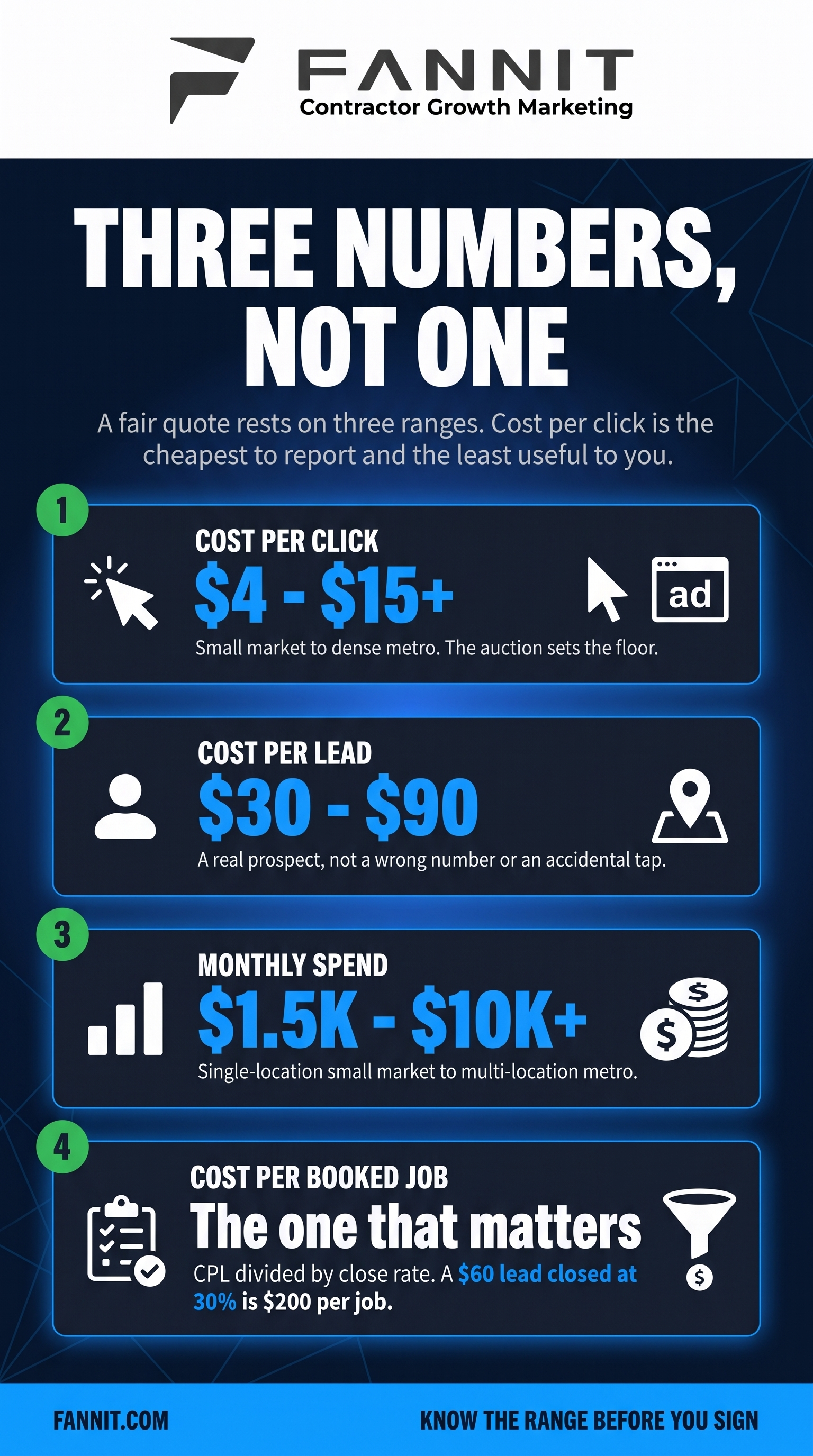
With those variables in mind, here's a realistic range. Cost per click for plumbing keywords typically runs from around $4 in smaller, less competitive markets up to $15 or more in dense metro areas with heavy competition. Cost per lead, meaning a phone call or form submission that's actually a real prospect and not a wrong number or an accidental click, typically lands between $30 and $90, depending on market and how tightly the account is managed. If you want a broader frame on how the platform prices out, our guide to how much Google Ads costs breaks down the levers behind these numbers.
Monthly ad spend for a plumbing company running a serious, always-on campaign usually starts around $1,500 to $2,000 for a single-location business in a smaller market, and climbs toward $5,000 to $10,000 or more for a multi-location company competing in a major metro. Below that floor, most accounts don't get enough data volume for Google's bidding algorithm to optimize well, and you end up paying a premium for inconsistent results.
None of these numbers are guarantees, and any agency who hands you an exact number before looking at your market and your service mix is guessing. What they should be able to do is explain where in these ranges your account is likely to land, and why.
Cost Per Click, Cost Per Lead, and Cost Per Booked Job Are Three Different Numbers
This is the distinction that trips up most plumbing business owners when they're evaluating a quote, and it's the one agencies are least likely to bring up on their own, because the number that makes them look best is usually the number that matters least to you.
Cost per click is what you pay every time someone clicks your ad. It's the easiest number for an agency to report, and the least useful one for you, because a click isn't a customer. A campaign can have a low cost per click and still lose you money if the clicks aren't converting.
Cost per lead is a step closer to reality: what you pay for a call or form fill that's an actual prospect. This is where call tracking with a minimum duration matters. A "lead" that's a ten-second wrong number shouldn't count the same as a two-minute call from someone describing a leaking water heater.
Cost per booked job is the number that actually determines whether the campaign is profitable. It accounts for your close rate on top of your cost per lead. A $60 lead that you close 30 percent of the time costs you $200 per booked job. A $35 lead you only close 10 percent of the time costs you $350 per booked job, even though the lead itself looked cheaper. If your agency only ever talks about cost per click or cost per lead, ask them to walk the number all the way through to cost per booked job. That's the only one that tells you whether the campaign is working.
What Actually Drives Your Cost Up or Down
A handful of factors move these numbers more than anything else, and most of them are within an agency's control, which is exactly why they're worth asking about directly. Before you dig into them, it helps to understand how to run Google Ads as a contractor so you can recognize a well-built account when you see one.
Landing page quality affects your cost per click through Google's Quality Score system. A generic homepage sends a weaker relevance signal than a dedicated page built for the exact service and city someone searched for, and Google charges more per click for lower relevance scores. This is a real, measurable lever, not a vague "best practice." Google's explainer on Quality Score walks through the three components behind the number.
Negative keywords keep your budget from leaking out on searches that will never convert, like "how to fix a running toilet" for a company that only wants paid, professional service calls. An account with a thin or outdated negative keyword list is quietly paying for clicks it should be blocking.
Seasonal budget pacing matters specifically for plumbing, where demand spikes hard around frozen pipes and water heater failures. An agency that pre-loads budget ahead of a cold snap and pulls back once it passes gets more volume out of the same annual spend than one running a flat budget year-round. If you're working with a tighter number, our Google Ads budget guide for small plumbing companies covers how to pace spend through those spikes.
Geographic targeting precision is an easy one to get wrong. Bidding on a 30-mile radius when you only actually service a 12-mile radius means you're paying for clicks from homeowners you'll never book, which drags your average cost per lead up without adding any real volume.
Signs You're Overpaying
A few patterns are worth watching for, independent of the raw dollar figures.
Your agency can't tell you your cost per booked job, only cost per click or cost per lead. If the conversation stops at clicks or leads, ask why, and don't accept "we don't track it that way" as an answer.
Your pricing model is a flat percentage of ad spend, with no other explanation. A pure percentage-of-spend fee means your agency makes more money the more you spend, whether or not that spend is producing results. That's not automatically a red flag on its own, but it should come with a clear answer about how they're also incentivized to lower your cost per lead.
Your cost per click has crept up steadily for months with no explanation and no adjustment to landing pages, negative keywords, or targeting. Costs naturally drift with market competition, but an agency that isn't actively managing against that drift is letting your budget absorb the increase instead of fighting it.
You're being quoted a fixed cost-per-lead guarantee that sounds too good for your market. A guarantee that's dramatically below the benchmarks above usually means the leads are shared with other contractors, poorly qualified, or both.
How to Talk to Your Agency About Cost
Bring the ranges in this guide into the conversation directly. Ask where your account currently sits, or would be expected to sit, within them, and ask what specifically would move you toward the lower end. A good agency will have a real, specific answer involving landing pages, negative keywords, geographic targeting, or seasonal pacing. A weak one will fall back to generalities about "optimizing your campaigns." To see what competent, ongoing management actually looks like month to month, our walkthrough of how Google Ads management works is the frame to hold them to.
Ask to see cost per booked job, not just cost per click or cost per lead, even if that means connecting your CRM or job-close data to their reporting. If they can't or won't do that, you're evaluating the campaign on the wrong number.
The plumbing companies that get the most out of their PPC spend aren't the ones who found the cheapest agency. They're the ones who understood what a fair number actually looks like for their market, and who kept asking about cost per booked job until the answer was a real one. If you want to see how those ads fit into how to market a plumbing business as a whole, that guide covers the full system, and if you'd rather hand the whole thing to a team that runs your plumbing marketing program day in and day out, Fannit does exactly that.
<a href="https://www.fannit.com/blog/how-much-should-plumbing-ppc-actually-cost/" title="Plumbing PPC Cost Benchmarks — Plumbing PPC Cost Guide"><img src="https://www.fannit.com/images/blog/infographic-plumbing-ppc-cost.jpg" alt="Plumbing PPC Cost Benchmarks — Plumbing PPC Cost Guide [Infographic]" width="800" /></a><br /><small><a href="https://www.fannit.com/blog/how-much-should-plumbing-ppc-actually-cost/">Plumbing PPC Cost Benchmarks — Plumbing PPC Cost Guide</a> via <a href="https://www.fannit.com">Fannit | Contractor Growth Marketing</a></small>

Keith Eneix is the Co-Founder and President of Fannit, a digital marketing agency built exclusively for home service contractors. He still owns and operates a multi-seven-figure contracting business in the Pacific Northwest. Since 2010, Fannit has helped 200+ contractors generate $100M+ in documented revenue.
Full Bio