How to Dominate Google Local Service Ads as an HVAC Company
Google Local Service Ads are the most valuable paid advertising channel available to HVAC companies right now. Most contractors are not using them correctly. Here is how the top performers do it.
How to Dominate Google Local Service Ads as an HVAC Company
Google Local Service Ads are the most valuable paid advertising channel available to HVAC companies right now, and most HVAC contractors are not using them correctly. The companies that have figured out how LSAs actually work are generating leads at a cost that makes every other channel look expensive. The companies that have not figured it out are spending money on a program that underperforms and wondering why.
This guide covers how LSAs work specifically for HVAC companies, what drives performance, and the specific actions that separate the top-performing accounts from the ones that waste budget.
What Makes LSAs Different From Regular Google Ads
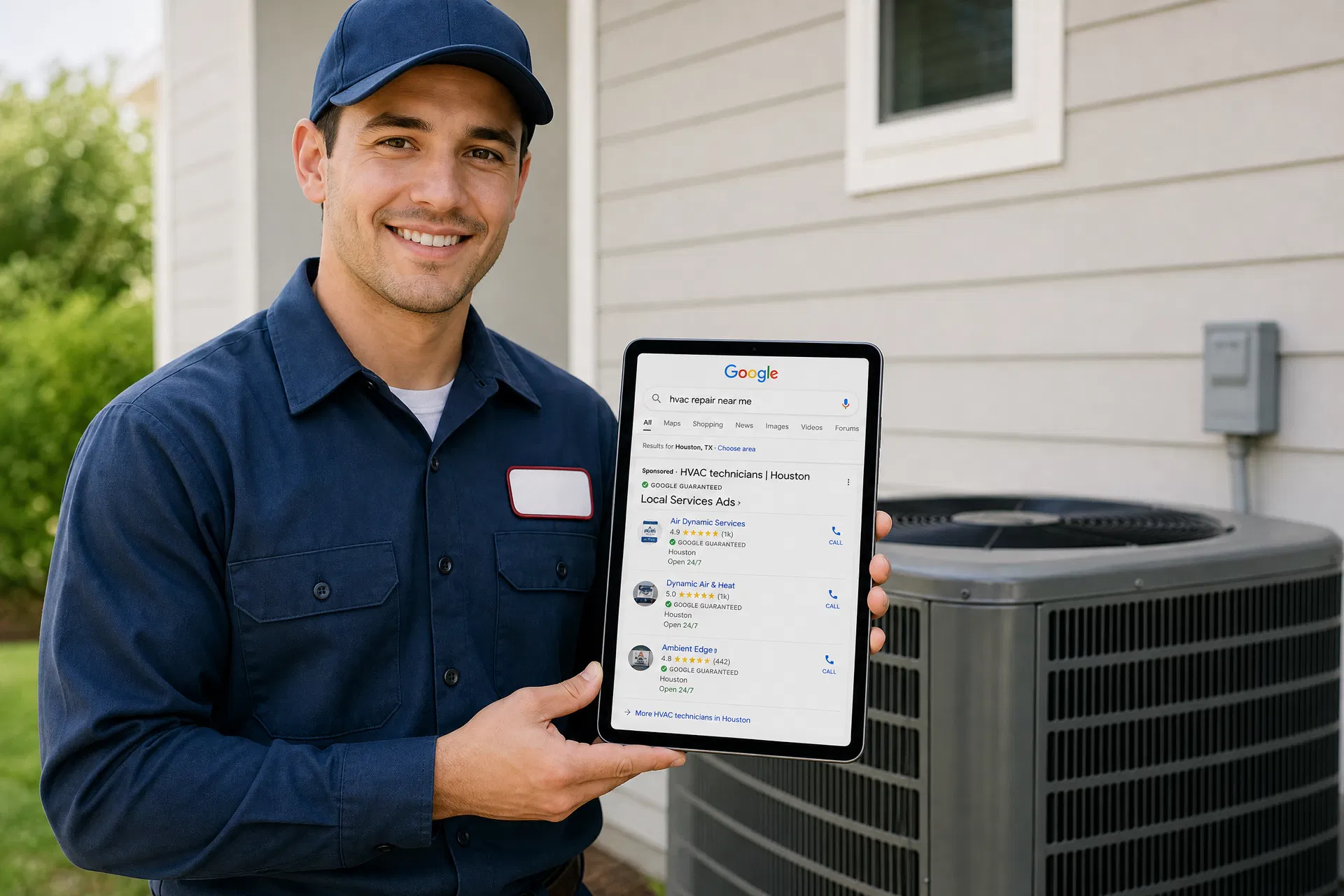
Google Local Service Ads appear at the very top of the search results page, above both paid search ads and organic results. They show your company name, your star rating, your review count, your phone number, and the Google Guaranteed or Google Screened badge. When a homeowner clicks, they see your profile and can call you directly or send a message.
The critical difference between LSAs and regular Google Ads is how you pay. With regular Google Ads, you pay for every click, whether or not that click becomes a lead. With LSAs, you pay per lead, meaning you only pay when a homeowner actually contacts you through the ad. This pay-per-lead model is significantly more efficient for HVAC companies because you are not paying for clicks from homeowners who are just browsing or comparing prices.
The other critical difference is the Google Guaranteed badge. This badge tells homeowners that Google has verified your business, checked your license and insurance, and run background checks on your team. For homeowners who are nervous about letting a stranger into their home, this badge is a meaningful trust signal that increases conversion rates.
The Google Screening Process: What You Need to Pass
Before your LSA ads can run, Google requires you to complete a verification process. For HVAC companies, this includes a business license verification, a general liability insurance verification, a background check on the business owner, and in some markets, background checks on individual technicians.
The verification process can take two to four weeks. If you have not started it, start now. The most common reasons HVAC companies fail verification or get delayed are expired licenses, insurance certificates that do not meet Google's minimum requirements, or background check issues with employees.
Once verified, your Google Guaranteed badge is active and your ads can run. The badge needs to be maintained. If your license or insurance lapses, Google will pause your ads until the issue is resolved.
The Review Profile: The Single Biggest Driver of LSA Performance
If there is one thing that separates high-performing HVAC LSA accounts from low-performing ones, it is the review profile. Google surfaces your star rating and review count prominently in the ad. Homeowners use this information to decide whether to click. A company with 200 reviews at 4.9 stars will get significantly more clicks than a company with 40 reviews at 4.5 stars, even if both companies are running identical budgets.
The math on this is important. If your LSA ad gets 100 impressions and your click-through rate is 8 percent because of a strong review profile, you get 8 leads. If your click-through rate is 4 percent because of a weaker review profile, you get 4 leads from the same 100 impressions. Your cost per lead is twice as high, not because your budget is wrong, but because your review profile is not competitive.
Building your review profile is not optional if you want LSAs to perform. The mechanics are straightforward: after every completed service call, send a text message to the customer with a direct link to your Google review page and a brief, personal request. The HVAC GBP optimization guide covers the full profile build-out that supports LSA performance - because your GBP and your LSA profile share the same review pool. This message, sent within an hour of the service call, converts at a significantly higher rate than a generic follow-up email. A team of five technicians doing three calls per day can generate 15 review requests per day. Even at a 20 percent conversion rate, that is three new reviews per day, or roughly 90 per month.
Budget Setting and Lead Volume
One of the most common mistakes HVAC companies make with LSAs is setting their budget too low. LSAs work on a weekly budget model. If you set a weekly budget of $300 and leads cost $40 each, you will get roughly seven to eight leads per week. If you need 20 leads per week to keep your technicians busy, a $300 weekly budget is not enough.
The right budget depends on your market, your lead goals, and your cost per lead. In competitive markets like major metro areas, HVAC LSA leads typically cost $35 to $80 each. In less competitive markets, they can be as low as $20 to $30. Before setting your budget, estimate the number of leads you need per week to hit your revenue goals, multiply by your expected cost per lead, and set your budget accordingly.
Google will not always spend your full budget. If there are not enough qualifying searches in your area, your budget will underspend. This is more common in smaller markets or during shoulder season. The HVAC shoulder season playbook covers how to adjust your LSA job types and budget during the spring and fall windows to capture tune-up and maintenance demand rather than going dark. If you are consistently underspending, it is a signal that your service area is too narrow or your job types are too restrictive.
Job Type Selection: Match Your Highest-Margin Work
LSAs let you select which job types you want to receive leads for. For HVAC companies, the common options include AC installation, AC repair, furnace installation, furnace repair, heat pump installation, heat pump repair, duct cleaning, and HVAC maintenance.
The temptation is to select all job types to maximize lead volume. The smarter approach is to select the job types that match your highest-margin work and your capacity. If you do not do duct cleaning, do not select it. If you are booked out on AC repairs during peak season and want more installation leads, weight your selection toward installation job types.
You can also adjust job type selection seasonally. In spring, weight toward cooling installation and AC tune-up. In fall, weight toward heating installation and furnace tune-up. This seasonal adjustment keeps your lead mix aligned with your operational capacity and your highest-margin opportunities.
Responding to Leads: Speed Is Everything
LSA performance is heavily influenced by how quickly and consistently you respond to leads. Google tracks your response rate and your response time, and uses this data to determine how often your ads are shown. An HVAC company that responds to every lead within five minutes will get more ad impressions than one that misses calls or responds slowly.
The practical implication is that you need a system for answering LSA leads immediately. During business hours, this means having someone dedicated to answering calls and responding to messages. After hours, this means either having an answering service or setting your ads to only run during hours when you can respond.
When you receive an LSA lead that is not a good fit, do not ignore it. Dispute it through the LSA dashboard. Google allows you to dispute leads that are outside your service area, for job types you do not offer, or that are clearly spam. Disputing invalid leads reduces your cost and signals to Google that you are an engaged advertiser, which can improve your ad ranking.
The LSA Ranking Algorithm: What Google Looks At
Google ranks LSA ads based on several factors: your review score and review count, your proximity to the searcher, your responsiveness, and your budget. Of these, review score and review count are the factors you have the most control over and the most leverage on.
Proximity is fixed. You cannot change where your business is located. But you can expand your service area to cover more zip codes, which increases the number of searches where you are eligible to show.
Responsiveness is within your control. Answer every call. Respond to every message within five minutes. Dispute invalid leads promptly. These behaviors signal to Google that you are a reliable partner, which improves your ranking.
Budget affects how often you show, but it does not directly affect your ranking position. A company with a strong review profile and a modest budget will often outrank a company with a weak review profile and a large budget.
Tracking LSA Performance and Connecting It to Revenue
Most HVAC companies track LSA leads by counting the calls and messages they receive. This is a starting point, but it is not enough. To understand whether your LSA investment is generating a positive return, you need to track leads all the way through to booked jobs and revenue.
The simplest way to do this is to ask every new customer how they found you and record the answer in your CRM. Over time, this data tells you what percentage of your LSA leads convert to booked jobs, what the average ticket is for LSA-sourced jobs, and what your true cost per booked job is from LSAs.
If your LSA leads are converting to booked jobs at a lower rate than your other lead sources, the problem is usually in the follow-up process, not the lead quality. LSA leads are high-intent. A homeowner who contacts you through an LSA ad is actively looking for an HVAC company. If they are not booking, something in your response process, your pricing presentation, or your follow-up sequence is losing them.
What a Mature LSA Program Looks Like
An HVAC company with a mature, well-optimized LSA program typically has the following in place: a review profile with 150 or more reviews at 4.8 stars or above, a response system that answers every lead within five minutes during business hours, a weekly budget that matches their lead volume goals, seasonal job type adjustments that align with operational capacity, and a tracking system that connects LSA leads to booked jobs and revenue.
Building this takes six to twelve months of consistent effort. The companies that invest in it consistently generate leads at a cost that makes every other channel look expensive by comparison.
Fannit manages LSA programs for HVAC companies across the country as part of our HVAC paid search and LSA marketing program. The companies that perform at the top of their markets are the ones who treat LSA as a system - not a campaign they set up once and forget. If you want to understand what that looks like for your market, schedule a free strategy call.
Not every agency tracks LSA performance the way HVAC operators do. The best HVAC marketing agencies for paid search are the ones who report on booked jobs and revenue per lead, not just click-through rate and cost per lead.
Frequently Asked Questions
How much does an HVAC LSA lead cost?
Cost per lead varies significantly by market. In major metro areas, expect $40 to $80 per lead. In smaller markets, $20 to $40 is more common. These are averages. During peak season, costs can be higher due to increased competition. During shoulder season, costs often drop. The ACCA recommends that members maintain active Google profiles as part of their digital marketing foundation, which directly supports LSA performance.
How many reviews do I need before LSAs are worth running?
You can run LSAs with any number of reviews, but performance improves significantly once you have 50 or more reviews at 4.7 stars or above. Below that threshold, your click-through rate will be lower than competitors with stronger profiles, which means higher cost per lead.
Can I run LSAs and regular Google Ads at the same time?
Yes, and most HVAC companies should. LSAs and regular Google Ads serve different functions. LSAs are best for high-intent, local searches where the Google Guaranteed badge drives trust. Regular Google Ads give you more control over targeting, messaging, and landing page experience. Running both maximizes your coverage of the Google search results page.
What happens if I get a bad review on my LSA profile?
A single bad review will not destroy your LSA performance if you have a strong overall profile. The key is to respond professionally to the review, address the issue if possible, and continue generating new positive reviews. Google does not remove negative reviews, but a high volume of positive reviews dilutes the impact of occasional negative ones.

Keith Eneix is the Co-Founder and President of Fannit, a digital marketing agency built exclusively for home service contractors. He still owns and operates a multi-seven-figure contracting business in the Pacific Northwest. Since 2010, Fannit has helped 200+ contractors generate $100M+ in documented revenue.
Full Bio