
The PE Home Service Marketing Playbook: How to Scale a Portfolio Company in 90 Days
You closed on a roofing company with strong operations and a thin digital presence. Here is the 90-day marketing playbook PE operating partners use to protect the investment and build toward exit.
The Problem with Generalist Agencies in Home Services
When a PE firm acquires a home service company, the standard move is to bring in a generalist marketing agency. The agency shows up with a brand audit, a 90-day discovery phase, and a strategy deck. Six months later, the portfolio company is still waiting for leads while competitors who have been running Google Ads for years are picking up the phone.
This is not a knock on generalist agencies. It is a structural problem. Home service marketing is not B2B marketing. It is not e-commerce. It is not SaaS. The customer acquisition model, the search behavior, the trust signals, and the competitive dynamics are completely different from every other vertical a generalist agency serves. An agency that does not live in this world will spend your hold period learning it.
Fannit's private equity contractor marketing program is built for exactly this situation. We have been in the trades since 2010. We do not need a learning curve. We need a kickoff call.
What PE Firms Get Wrong About Home Service Marketing
The most common mistake PE operating partners make is applying B2B marketing logic to a B2C trades business. In B2B, you build awareness over months, nurture leads through a long sales cycle, and close deals through relationships. In home services, a homeowner wakes up with a flooded basement and calls the first credible option they see on Google. The entire sales cycle is 15 minutes.
This means the marketing priorities are completely different. In home services, the highest-leverage investments are:
- Google Business Profile optimization -- the GBP is the most important marketing asset a home service company owns. It drives Local Pack rankings, which appear above organic results for nearly every local service search.
- Google Local Services Ads -- LSAs appear above everything else in search results with a "Google Guaranteed" badge. They are pay-per-lead, not pay-per-click, and they convert at a higher rate than any other paid channel in home services.
- Review velocity -- a steady stream of recent five-star reviews is both a ranking factor and a conversion factor. A company with 200 reviews and a 4.9 average will outrank and out-convert a company with 50 reviews and a 5.0 average.
- Website conversion rate -- most acquired home service websites are digital brochures. A click-to-call button, a service-specific landing page, and a mobile-first design can double lead volume from the same traffic without increasing ad spend.
None of these are complicated. All of them require trades-specific execution. A generalist agency will get them wrong in ways that are not obvious until you look at the data.
The 30-Day Post-Acquisition Sprint
The first 30 days after closing define the trajectory of a portfolio company's marketing. Here is the sprint we run for every PE portfolio company engagement.
Days 1 to 7: Audit and Baseline
Before touching anything, we establish the baseline. This means pulling the current Google Analytics data, auditing the Google Business Profile, reviewing the paid ad account history, checking citation consistency across directories, and scoring the website for conversion rate. We document everything so we can show measurable improvement at 30, 60, and 90 days.
The audit almost always reveals the same three issues: a GBP that is 60 percent complete, a website that sends all traffic to the homepage instead of service-specific landing pages, and a review profile that has not received a new review in 90 days. These are the first things we fix.
Days 8 to 14: GBP and Citation Cleanup
Google Business Profile optimization is the fastest-moving lever in local home service marketing. We complete every field, add service-specific photos, seed the Q&A section with the questions homeowners ask on every estimate call, and set up a weekly posting cadence. We also audit every major citation directory (Yelp, Angi, BBB, HomeAdvisor, and 40 others) and correct any NAP inconsistencies.
This work alone typically produces measurable Local Pack ranking improvements within 30 to 45 days. It is also the foundation for everything else. A GBP that is incomplete or inconsistent undermines every other marketing investment.
Days 15 to 21: Paid Ads Baseline
If the portfolio company has an existing Google Ads account, we audit it for wasted spend, missing negative keywords, and conversion tracking gaps. Most acquired home service companies have Google Ads accounts that are generating clicks but not tracking calls, which means the algorithm has no data to optimize against.
If there is no existing account, we launch one. For a home service company in a competitive market, a well-structured Google Ads campaign with $1,500 to $3,000 per month in ad spend should produce 20 to 40 qualified leads per month within the first 30 days. LSAs are set up in parallel because they are pay-per-lead and typically produce the lowest cost per lead of any paid channel.
Days 22 to 30: Review Generation System
We implement a systematic review generation program. This means a text-to-review link sent to every customer within 24 hours of job completion, a QR code on invoices and truck doors, and a verbal ask script for technicians and crew leads. The goal is ten new five-star reviews in the first 30 days.
Review velocity is a ranking factor. Google rewards businesses that are generating a steady stream of recent reviews. A company that goes from 2 new reviews per month to 10 new reviews per month will see Local Pack ranking improvements within 60 to 90 days.
What Board-Ready Marketing Reporting Looks Like
Most marketing agencies report on impressions, clicks, and sessions. PE operating partners need to report on revenue, EBITDA, and return on invested capital. These are not the same metrics, and bridging the gap requires a reporting structure that most agencies do not build by default.
For PE portfolio companies, we build reporting around four metrics that map directly to investment performance:
Cost per lead by channel -- what does it cost to generate a qualified lead from Google Ads, LSAs, organic search, and direct traffic? This tells you which channels are efficient and which are burning money.
Revenue attributed to marketing -- using call tracking and CRM integration, we attribute revenue to the marketing channels that generated the initial lead. This is the number that matters for EBITDA analysis.
Year-over-year organic traffic growth -- organic search traffic is a proxy for brand authority and local market dominance. A portfolio company that grows organic traffic 40 percent year-over-year is building a durable competitive moat.
Review profile health -- average rating, review velocity, and response rate. These metrics correlate with close rates on estimates and with Local Pack rankings.
These four metrics tell the story of a portfolio company's marketing health in a way that maps to an LP report. We format them for quarterly board decks and can align reporting cadence to your investment committee schedule.
Marketing Due Diligence Before You Close
One of the most underused applications of trades-specialist marketing expertise is pre-acquisition due diligence. Before you close on a home service company, a marketing audit can identify risks and opportunities that do not show up in a standard financial due diligence.
We audit five things:
Website traffic quality -- is the website generating organic traffic, or is it entirely dependent on paid ads? A company that drives 80 percent of its leads from Google Ads has a fragile marketing foundation. A company with strong organic rankings has a durable asset.
GBP health -- is the Google Business Profile complete, accurate, and active? A GBP with incorrect hours, missing service categories, or a stalled review profile is a fixable problem, but it is a problem that will take 60 to 90 days to correct after closing.
Review profile -- what is the review volume, average rating, and recency? A company with 15 reviews and a 4.2 average has a reputation problem that will suppress Local Pack rankings and reduce estimate close rates until it is corrected.
Paid ad account history -- if the company has been running Google Ads, what does the account history look like? A well-structured account with conversion tracking and a clean negative keyword list is a marketing asset. An account with a high impression share but no conversion tracking is a liability.
Citation consistency -- are the company's Name, Address, and Phone number consistent across every major directory? Inconsistent NAP data is one of the most common and most damaging issues in local SEO, and it is invisible in a financial due diligence.
This audit takes 5 to 7 business days and produces a written report with a marketing asset valuation and a prioritized list of risks and opportunities. For a PE firm paying a 6 to 8x EBITDA multiple, understanding the marketing asset value before closing is worth the investment.
Building Exit-Ready Digital Assets
The best marketing agencies for PE-backed home service companies understand that for PE-backed companies, marketing is not just about generating leads during the hold period. It is about building digital assets that increase the company's value at exit.
A strategic buyer or another PE acquirer evaluating a home service company in 2026 will look at the digital marketing infrastructure as part of their due diligence. A company with strong Google rankings, a high-volume review profile, a well-optimized GBP, and a website that converts traffic into leads commands a premium over a comparable company with weak digital assets.
The specific assets that contribute to exit valuation are:
Organic search rankings -- a company that ranks in the top three positions for its primary service keywords in its market has a durable competitive advantage that is difficult and expensive to replicate. These rankings are a defensible asset.
Review profile -- a company with 300 five-star reviews and a 4.9 average has a trust asset that took years to build. A buyer knows that this profile will continue generating leads and suppressing competitors for years after the acquisition.
Website domain authority -- a website with strong backlinks and a long history of organic traffic has a domain authority that compounds over time. A new owner does not have to rebuild this from scratch.
Google Business Profile authority -- a GBP that has been consistently maintained, with regular photo uploads, Q&A responses, and review replies, has an authority score that takes 12 to 24 months to build. A buyer inherits this authority.
Building these assets during the hold period is a direct contribution to exit multiple. The digital marketing guide for contractors covers the full channel mix in detail.
The 90-Day Milestone Framework
For PE operating partners who want a clear framework for evaluating marketing progress, here is the 90-day milestone structure we use:
Day 30 milestones:
- GBP fully optimized and citation cleanup complete
- Google Ads and LSA campaigns live and generating leads
- Review generation system implemented and producing new reviews
- Baseline metrics documented for all four reporting KPIs
Day 60 milestones:
- Local Pack ranking improvements measurable in at least 3 primary keywords
- Cost per lead by channel established with 30 days of data
- 20 to 30 new five-star reviews generated
- Website conversion rate audit complete with recommendations implemented
Day 90 milestones:
- Revenue attributed to marketing measurable in CRM
- Year-over-year organic traffic growth trend established
- Paid ad campaigns optimized based on 60 days of conversion data
- First quarterly board report delivered
These milestones are not guarantees. They are the outcomes a well-executed post-acquisition marketing sprint should produce for a home service company in a competitive market. If a portfolio company is not hitting these milestones at 90 days, the marketing program needs to be reassessed.
Conclusion: Marketing Is a Value Creation Lever, Not a Cost Center
The PE firms that generate the best returns from home service acquisitions treat marketing as a value creation lever, not a cost center. They invest in the digital infrastructure that makes a portfolio company more valuable at exit: stronger rankings, more reviews, better conversion rates, and a brand that homeowners recognize and trust.
The contractor marketing strategy is not complicated. It is consistent execution of the right fundamentals, in the right order, by people who understand the trades. That is what separates a portfolio company that compounds in value from one that generates leads but never builds durable competitive advantages.
If you are evaluating a home service acquisition or managing a portfolio company that needs a marketing reset, the private equity contractor marketing program is the starting point.
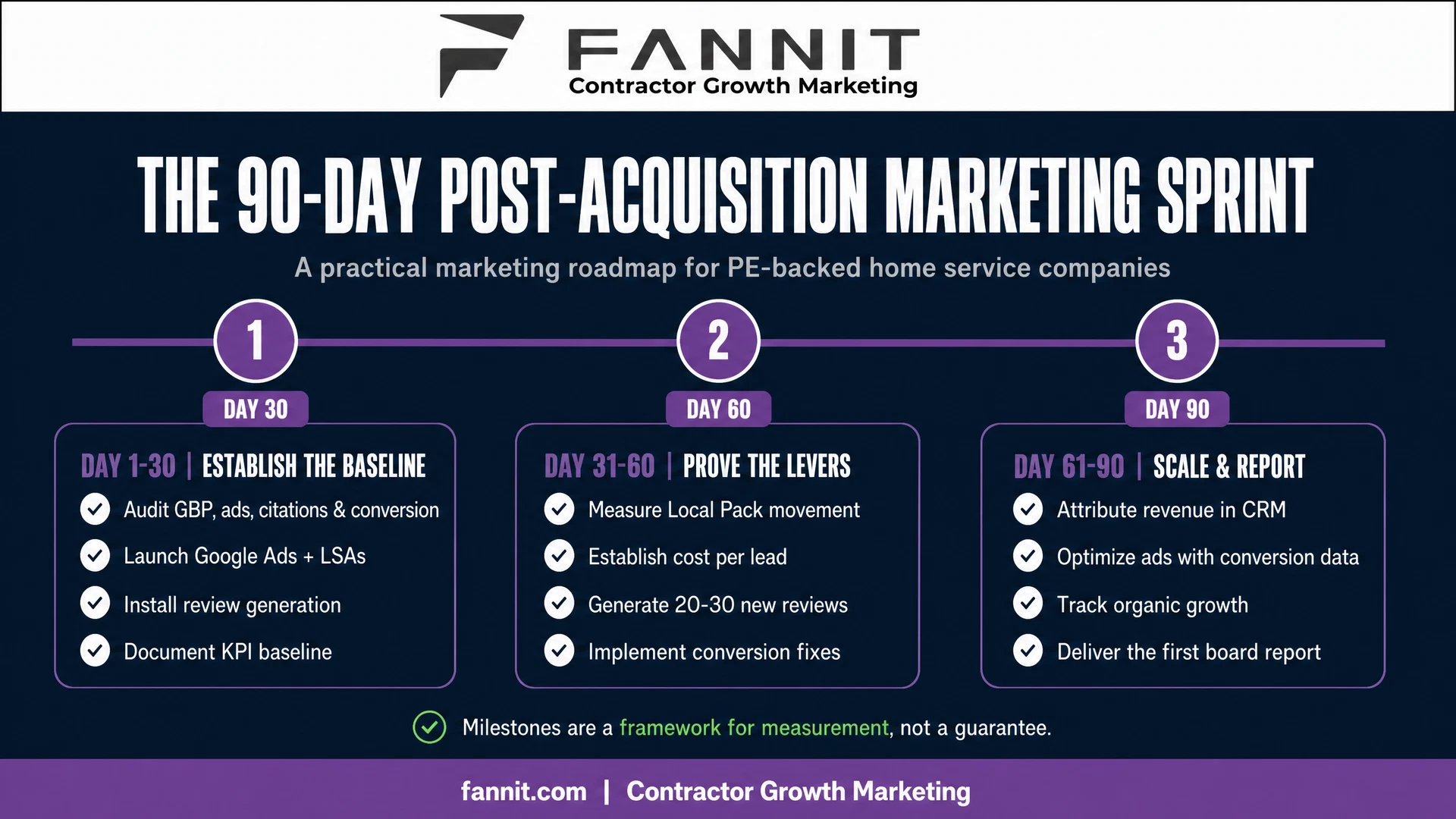
<a href="https://www.fannit.com/blog/private-equity-home-service-marketing-playbook/" title="90-Day Post-Acquisition Marketing Sprint — Private Equity Home Service Marketing"><img src="https://www.fannit.com/manus-storage/infographic-pe-90-day-marketing-sprint_95dcc18a.png" alt="90-Day Post-Acquisition Marketing Sprint — Private Equity Home Service Marketing [Infographic]" width="800" /></a><br /><small><a href="https://www.fannit.com/blog/private-equity-home-service-marketing-playbook/">90-Day Post-Acquisition Marketing Sprint — Private Equity Home Service Marketing</a> via <a href="https://www.fannit.com">Fannit | Contractor Growth Marketing</a></small>

Keith Eneix is the Co-Founder and President of Fannit, a digital marketing agency built exclusively for home service contractors. He still owns and operates a multi-seven-figure contracting business in the Pacific Northwest. Since 2010, Fannit has helped 200+ contractors generate $100M+ in documented revenue.
Full Bio