
Why You're Not Getting Remodeling Leads (And How to Fix It)
Your crew does great work. Your pricing is fair. You have a website. So why is the phone sitting there, silent? This is the remodeling lead problem, and it has a specific set of causes and fixes that most contractors never address.
The phone sits there, silent. You check the ringer. You check the voicemail. Nothing. You just wrapped up a stunning kitchen renovation last month, the kind of project that should have neighbors knocking down your door. Your crew does impeccable work. Your pricing is fair. You even have a website and a Facebook page. So where are the remodeling leads? The silence is not a reflection of your craftsmanship. It is a symptom of a broken lead generation system, one that countless skilled contractors are struggling with right now. The old playbook, the one that says good work speaks for itself, has been quietly retired. Homeowners have changed how they find and hire remodelers, and if your strategy hasn't evolved, you are effectively invisible to the very people who need you most. This guide will walk you through the five hidden reasons your pipeline is dry and give you the exact fixes to start generating local remodeling leads consistently in 2026.
The Hard Truth: Why "Good Work" and Word of Mouth Are No Longer Enough
For decades, the remodeling industry ran on a simple engine. You did a great job, the client was happy, and they told a friend. That friend hired you, and the cycle repeated. This model built thousands of successful businesses. Fannit's remodeling marketing program is built for contractors who are ready to add a second engine alongside referrals. The problem in 2026 is not that referrals have stopped working. The problem is that relying on them exclusively has become a slow-growth trap that leaves you vulnerable to market shifts and aggressive competitors.
The "Field of Dreams" fallacy, the belief that if you build it they will come, is the single biggest killer of remodeling businesses today. Your referral network has a hard ceiling. It is limited by the number of people your past clients know who are actively planning a remodel right now. When you finish a big project and suddenly have a gap in your schedule, that ceiling becomes painfully real. You cannot force a friend of a past client to be ready for a bathroom renovation just because you need the work.
Meanwhile, the homeowner's journey has fundamentally changed. Before they ever ask a neighbor for a recommendation, they are on their phone searching for "kitchen remodeling leads" or "bathroom remodelers near me." A recent look at the search results for "remodeling leads" tells a revealing story. Five of the top ten organic results are community-driven platforms like Reddit, Quora, and ContractorTalk forums. Homeowners are not just looking for a name and a phone number. They are looking for trusted voices, for proof of expertise, and for answers to their specific anxieties. If you are not present in those search results, providing that content, you do not exist to a massive segment of your market. Someone else, perhaps a less skilled competitor with a better digital presence, is answering their questions and winning the job.
There is also the silent killer that plagues every talented tradesperson: you are too busy working in the business to work on the marketing. You spend your days managing crews, ordering materials, and solving on-site problems. Marketing becomes an afterthought, something you will get to when things slow down. But by the time things slow down, it is too late. The pipeline is empty, and you are scrambling. This feast-or-famine cycle is a direct result of treating marketing as a tap you turn on when thirsty, rather than a well you dig continuously. The shift from a referral-only model to a hybrid referral-plus-digital model is no longer a competitive advantage. It is a requirement for survival. Your reputation gets you the interview, but your digital presence gets you into the room.
The Hidden Gaps in Your Digital Foundation
Many contractors believe they have checked the digital box. They have a website. They have a Facebook page. The problem is that these assets are often passive brochures, not active lead-capture machines. A website that simply lists your services and phone number is doing almost nothing for you. It is a digital business card in a world that demands a digital salesperson.
The first gap is a lack of clear conversion paths. Your website needs to aggressively guide a visitor toward a single action. That action is rarely "call us for a quote" as the only option. Homeowners research at midnight, on weekends, and during their lunch breaks. They are not always ready to talk. Your site needs project-specific landing pages for kitchen remodels, bathroom remodels, and additions, each with its own tailored call-to-action and a lead magnet. A lead magnet is something of value you offer in exchange for their contact information. A downloadable guide titled "The Real Cost of a Kitchen Remodel in Phoenix in 2026" is infinitely more compelling than a generic "Contact Us" form.
The second gap is speed to lead. You might actually be generating leads without knowing it because they are dying in your voicemail. A potential client who fills out a form on your site or on a platform like Houzz will often contact multiple contractors simultaneously. The first one to have a real, human conversation with them wins the job a staggering percentage of the time. If you are finishing up a tile job and return the call four hours later, you have already lost to the contractor who picked up on the first ring or called back within five minutes. Speed is the new currency of contractor lead generation.
The third gap is the trust trifecta. Homeowners need to see proof before they will risk their largest asset on you. The forums and Q&A sites are unanimous on this point. You need a powerful combination of before-and-after photos, video testimonials, and written reviews. A single photo of a finished kitchen is nice. A side-by-side slider showing a dated, dysfunctional space transform into a modern, beautiful one is persuasive. A 60-second video of a homeowner saying, "I was terrified of this process, but they made it easy," is a conversion machine. Yet most contractors have these assets buried in an Instagram feed or on a phone's camera roll, not strategically placed on their website where they can influence a buying decision.
This leads to the portfolio paradox. You have dozens of stunning project photos, but they are not optimized for remodeling SEO. Google cannot "see" a photo. It reads the file name and the alt text. A photo named "IMG_4582.jpg" is a wasted opportunity. A photo named "modern-farmhouse-kitchen-remodel-phoenix-az.jpg" with descriptive alt text tells Google exactly what the image is and where you work. This is a foundational element of remodeling contractor SEO that most contractors ignore entirely.
Finally, your digital foundation crumbles without a content strategy. Homeowners are typing questions into Google every single day. Questions like "What is the 30% rule for renovations?" or "How much does a bathroom remodel cost in 2026?" The "People Also Ask" boxes on Google are full of these queries, and they represent direct lines to your ideal client. If you are not creating blog posts, videos, or guides that answer these questions, you are ceding that real estate to competitors and lead generation companies. You are invisible at the exact moment a homeowner is raising their hand and asking for help.
Local SEO for Remodelers: Why Google Doesn't Trust You Yet
You could have the most beautiful website in the world, but if Google does not trust your business, it will not show it to local searchers. Local SEO for remodelers is not about tricking an algorithm — the contractor lead generation guide covers how SEO, paid ads, and referrals work together as a lead system. It is about sending consistent, trustworthy signals that prove you are a legitimate, active, and relevant business in a specific geographic area.
The most common and damaging issue is the consistency trap. Your business's Name, Address, and Phone number, often called NAP, must be identical everywhere it appears online. If your Google Business Profile says "Smith Remodeling LLC" but a Yelp listing says "Smith Remodeling," and an old Angi profile has a former cell phone number, Google's algorithm sees a conflicted entity. This inconsistency creates doubt, and a doubtful algorithm will not risk recommending you to a user. This single issue tanks local rankings for thousands of contractors. A thorough audit of every directory, social profile, and citation is not busywork; it is foundational general contractor marketing.
Your Google Business Profile itself is likely underutilized. This is not a set-it-and-forget-it listing. It is a dynamic, social-like platform that Google prioritizes heavily for local remodeling leads. You need to be adding project-specific photos weekly, not just a logo and a cover image. You need to be using the Q&A feature to seed and answer common questions like "Do you handle permit applications?" or "What cabinet lines do you carry?" You need to be posting regular updates, just like you would on social media, about projects you are starting, completing, or even just a behind-the-scenes look at a tricky structural solution. This activity signals to Google that you are an active business, not a dormant one.
Review velocity is another critical trust signal that many contractors misunderstand. You might be proud of your 4.8-star average from 47 reviews collected over ten years. A competitor with a 4.6-star average from 120 reviews, with three new ones this week, will often outrank you. Google rewards a steady stream of fresh reviews because it indicates ongoing, current customer satisfaction. A five-year-old review is good for social proof, but a review from last Tuesday is rocket fuel for your local ranking. You need a systemized process for requesting reviews immediately upon project completion, when the client's delight is at its peak.
A subtle but powerful mistake is the category selection on your Google Business Profile. Many contractors select "General Contractor" and leave it at that. But Google allows you to select multiple specific categories. If you do kitchen and bath work, your primary category should be "Kitchen Remodeler" or "Bathroom Remodeler," with "General Contractor" as a secondary category. This specificity tells Google exactly which search queries you are most relevant for. When a homeowner searches for a "kitchen remodeler," Google is far more likely to surface a business categorized as one than a generic general contractor.
The final piece of the local SEO puzzle is the local link gap. Backlinks, which are links from other websites to yours, are a core ranking factor. For local businesses, the most powerful links come from other local, trusted organizations. A link from a local lumberyard's supplier directory, a mention on a real estate agent's blog about trusted partners, or a sponsorship page for a local little league team all send powerful "local entity" signals to Google. These links tell Google that you are woven into the fabric of your community. Most remodelers have zero local backlinks, while their more digitally savvy competitors are actively building this moat.
The Paid Lead Generation Trap: Are You Buying Leads or Buying Headaches?
When the phone stops ringing, the instinct to buy leads is powerful and understandable. Platforms like Houzz Pro, Angi, and Service Allies promise a steady stream of exclusive, high-intent remodeling leads. The reality, as many contractors discover after spending thousands of dollars, is far more complicated. The best remodeling marketing agencies guide breaks down what separates the ones who deliver from the ones who don't. You are not necessarily buying clients; you are often buying the right to compete in a race to the bottom.
The lead quality myth is the first thing to understand. A lead from a paid service is rarely exclusive, no matter what the sales pitch says. That same homeowner's information is often sold to two, three, or even five of your competitors. The homeowner, who was likely just browsing for ideas and clicked a "Get a Quote" button out of curiosity, is suddenly bombarded with phone calls. They become defensive, price-sensitive, and difficult to convert. You end up spending your time chasing unqualified leads instead of closing profitable projects. The high-end client disconnect, frequently discussed on contractor forums, is real. Affluent homeowners in markets like Naples, Florida, are not clicking "Get Free Estimates" on a lead gen site. They are asking their network of lawyers, financial advisors, and interior designers for a trusted referral. Paid lead services overwhelmingly attract price-shoppers, not quality-buyers.
Then there is the cost question, which is a major knowledge gap in the industry. How much do remodeling leads cost? The answer varies wildly, but here is the breakdown no one gives you. Google Ads, when managed correctly, can generate leads for $30 to $80+ per click in competitive markets, with a cost-per-lead that can range from $100 to $300 or more depending on the project type. Pay-per-lead services like Angi or Thumbtack charge a fixed fee per lead, often $15 to $50 for a basic contact, but these leads are shared and have low conversion rates. A retainer-based lead generation service might charge $1,000 to $3,000 per month for a promised number of "exclusive" leads. You must compare this cost against your average project value and closing rate. If you close one in ten paid leads and your average project is $15,000, a $200 lead cost is manageable. If you close one in thirty, you are bleeding money. Most contractors do not track this math, and they subsidize the lead platform's profits with their own wasted time.
The smarter alternative is not to abandon paid channels but to own them yourself. Instead of paying a middleman for a lead, invest that same budget in hyper-targeted Facebook and Instagram ads. These platforms allow you to put your stunning portfolio directly in front of homeowners in specific zip codes, within specific income brackets, who have interests like "home renovation" or "interior design." This is the untapped gap in remodeler marketing. You control the creative, the audience, and the follow-up. A well-crafted ad showcasing a gorgeous kitchen transformation, targeted to affluent homeowners within a 15-mile radius of your office, will attract a far higher caliber of client than a blind lead from a shared platform.
The secret weapon that almost no contractor uses is retargeting. A homeowner visits your website, looks at your kitchen portfolio, and leaves. They are not ready to call yet. Without retargeting, they are gone forever. With a simple retargeting pixel installed on your site, you can show your portfolio ads to that exact person as they browse Facebook or other websites over the following days and weeks. You stay top-of-mind, building familiarity and trust passively. When they are finally ready to pull the trigger, your name is the first one they think of. This is how you build a sophisticated remodeling business marketing engine without wasting money on low-intent, shared leads.
The Untapped Goldmine: Niche-Specific Strategies for Kitchen and Bath Leads
A homeowner dreaming of a $80,000 chef's kitchen has a completely different psychology than one who needs to gut a moldy guest bathroom for $15,000. Yet most remodeling websites and marketing speak to them in the exact same generic language. The one-size-fits-all failure is a massive missed opportunity for home remodeling leads.
Your marketing must mirror the homeowner's specific intent. Someone searching for "kitchen remodeling leads" is often in a planning and aspiration phase. They are looking at photos, comparing cabinet styles, and trying to understand the investment required. Someone searching for "bathroom remodeling leads" is often closer to a pain point, a leaky shower or a tub they can no longer step into safely. Your messaging should shift accordingly. Kitchen content should be rich with design inspiration, material comparisons, and layout possibilities. Bathroom content should address functionality, aging-in-place solutions, and rapid timelines.
The core tactical move here is the project-specific landing page. You need a dedicated page on your website optimized for "Kitchen Remodeling in [Your City]" and a separate one for "Bathroom Remodeling in [Your City]." This is the core of remodeling company marketing that converts. These pages should not be thin, 200-word afterthoughts. They should be comprehensive resources that include a gallery of your work specific to that room, a breakdown of your process for that type of project, and a specific lead magnet like a cost guide or a design checklist. When Google sees a deeply relevant page matching a specific search query, your chances of ranking skyrocket.
Visual proof is non-negotiable, especially for kitchens. A kitchen is the emotional and financial heart of a home. If a prospective client cannot quickly find a dedicated, fast-loading gallery of your kitchen projects, they will leave. Each photo should include specific details in the caption: "Shaker-style cabinets, quartz countertops, and a custom island with a walnut butcher block top." This level of detail demonstrates expertise and helps the homeowner visualize their own project. It also provides rich, keyword-relevant content for remodeling SEO.
The cost guide lead magnet is your most powerful tool for capturing kitchen and bathroom remodeling leads. The "People Also Ask" boxes are full of unanswered questions about the 30% rule for renovations, which states you shouldn't spend more than 30% of your home's value on a single room renovation. Create a guide that explains this rule, breaks down real cost ranges for your city, and outlines what factors drive price. Offer it as a free download in exchange for an email address. You have now positioned yourself as a transparent, helpful expert and captured a lead you can nurture over time.
Finally, address the seasonality gap that most marketing content ignores. Remodeling lead volume and cost fluctuate with the seasons. Spring often brings a surge of homeowners ready to start projects, while winter is a planning and dreaming season. Your ad spend and content strategy should reflect this. In January, push your cost guide and planning content heavily. In April, shift to ads showcasing completed projects with a "Book Your Summer Remodel Now" urgency. Aligning your marketing rhythm with the homeowner's decision-making calendar smooths out the feast-or-famine cycle.
The 2026 Action Plan: Building a Predictable Lead Engine
Knowing what is broken is only half the battle. The contractor marketing strategy guide walks through how to build a system that generates leads consistently. The contractors who win in 2026 will be those who execute a systematic plan, not those who dabble in random tactics. This is a 90-day sprint to transform your marketing from a source of anxiety into a predictable lead engine.
Start with a 90-day sprint focused on your local foundation. In the first 30 days, your only job is to audit and optimize your Google Business Profile and fix your NAP consistency. Claim every listing. Correct every phone number and address variation. Add 20 high-quality project photos to your GBP, categorized by project type. Seed the Q&A section with five common questions and answer them thoroughly. Then, implement a review generation system. Identify your last ten completed projects and personally reach out to those clients with a direct link to leave a Google review. Your goal is ten new, detailed reviews in 30 days. This single sprint will do more for your local remodeling leads than any ad campaign you could run.
Next, establish a sustainable content cadence. This does not mean you need to become a professional blogger. It means you need to document your work consistently. Commit to posting one before-and-after project per week on your social media channels and on your Google Business Profile. The caption should tell the story of the project: the client's problem, your solution, and the result. Once a month, write a short blog post answering a specific question you heard from a client that month. "How long does a bathroom remodel really take?" or "What's the difference between quartz and granite?" These posts target long-tail keywords and feed the search engines with fresh, relevant content for remodeling lead generation.
Modernize your referral engine. The old way is to hope a happy client mentions your name. The new way is to create a formalized "Finder's Fee" program. At the conclusion of a successful project, present your client with a stack of your business cards and a clear offer: "For any friend or family member you refer who signs a contract, we will send you a $250 Visa gift card." Extend this program to local real estate agents, interior designers, and even kitchen designers at big-box stores. These professionals talk to homeowners who need remodeling work constantly. Become their go-to, trusted installer by offering a formal referral fee and, more importantly, by making them look like a hero for recommending you.
Actively build your partnership network. Do not just wait for referrals to come in. Contact local real estate agents directly. Send a short, professional email introducing your services and offering to do a walkthrough of a new listing to provide a renovation estimate for potential buyers. This is a powerful value-add for the agent and positions you directly in front of a motivated buyer. Contact the large production builders in your area, like Pulte or DR Horton, and ask about their subcontracting needs for warranty work or small customizations. This can provide a steady baseline of work while you build your consumer-facing pipeline.
Finally, track the metrics that matter. Stop measuring success by how many calls you get. A hundred tire-kicker calls are worthless. Start tracking qualified appointments. Create a simple spreadsheet. For every lead that comes in, log the source (Google, referral, ad, etc.), whether it resulted in an appointment, whether the appointment resulted in an estimate, and whether the estimate closed. At the end of each month, you can calculate your cost-per-lead and cost-per-acquisition by source. This data will tell you with brutal clarity where your profitable remodeling leads are actually coming from, allowing you to cut what doesn't work and double down on what does.
Stop Chasing Leads, Start Building a System
The silent phone is not a judgment on your skill as a craftsman. It is a signal from the market that the old rules no longer apply. The problem is not your workmanship; it is the absence of a deliberate, multi-channel system that makes your expertise visible and trustworthy to the modern homeowner.
There is a vocal contingent of veteran contractors who will tell you that advertising is useless, that they have never gotten a single job from it in fifteen years. They are not entirely wrong. Badly targeted, generic advertising that screams "HIRE US" into the void is indeed useless. It is a waste of money. But that is not what this guide has described. What we have outlined is the opposite of generic advertising. It is precision-targeted, value-first marketing that answers real questions, showcases real proof of your expertise, and builds a digital reputation that mirrors the one you have earned in person.
You do not need to implement everything in this guide tomorrow. That is a recipe for overwhelm and inaction. Pick one thing. Fix your Google Business Profile this week. Create a dedicated kitchen remodeling landing page next week. Start that simple spreadsheet. The contractors who will own their markets in 2026 are not the ones with the biggest ad budgets. They are the ones who build a hybrid engine of digital visibility, a stellar reputation, and a rapid, professional response system. Start building that engine today, one component at a time, and the phone will start ringing again.
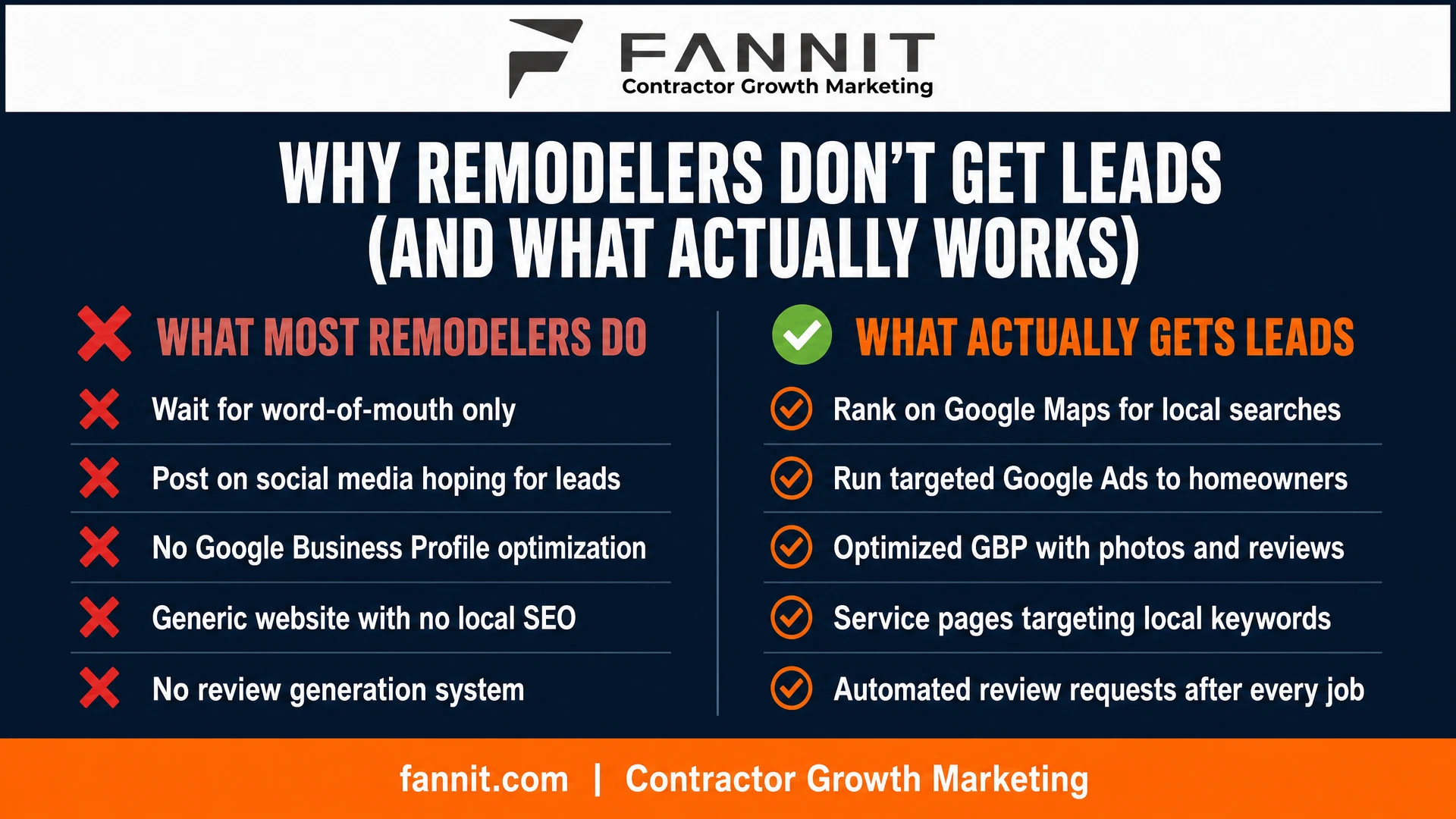
<a href="https://www.fannit.com/blog/remodeling-leads-local-strategy/" title="Why Remodelers Don't Get Leads — Remodeling Marketing Strategy"><img src="https://www.fannit.com/manus-storage/infographic-remodeling-leads-comparison_5a5082bd.png" alt="Why Remodelers Don't Get Leads — Remodeling Marketing Strategy [Infographic]" width="800" /></a><br /><small><a href="https://www.fannit.com/blog/remodeling-leads-local-strategy/">Why Remodelers Don't Get Leads — Remodeling Marketing Strategy</a> via <a href="https://www.fannit.com">Fannit | Contractor Growth Marketing</a></small>

Keith Eneix is the Co-Founder and President of Fannit, a digital marketing agency built exclusively for home service contractors. He still owns and operates a multi-seven-figure contracting business in the Pacific Northwest. Since 2010, Fannit has helped 200+ contractors generate $100M+ in documented revenue.
Full Bio

