
The Right Way to Vet a Plumbing PPC Agency (Ask for This, Not a Case Study Slide)
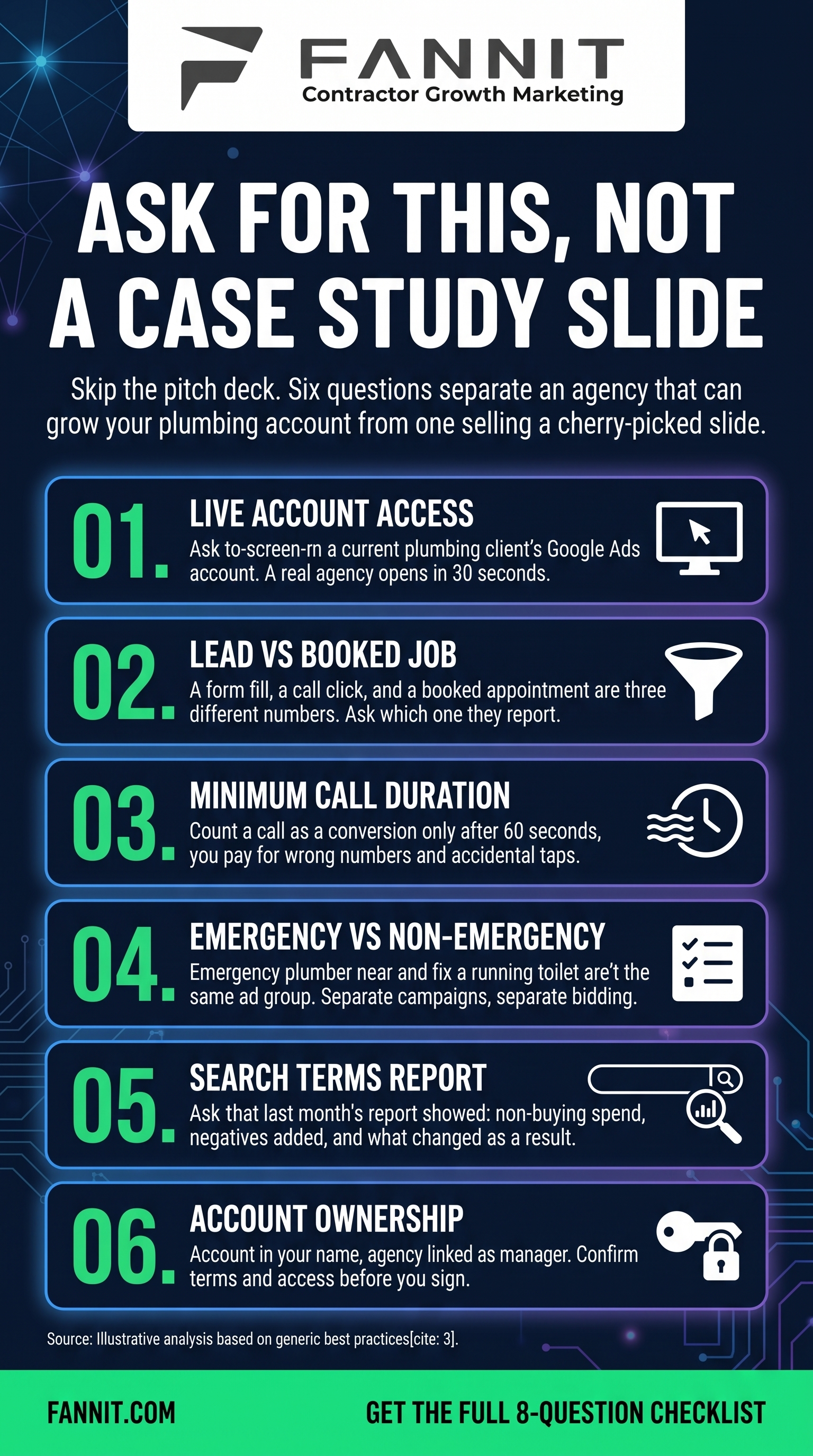
The questions that actually separate a plumbing PPC agency that can grow your account from one selling a case study slide come down to live access, call tracking proof, and ownership terms.
Every plumbing PPC agency pitch ends with the same slide: a case study. A client logo, a big percentage lift, a graph pointing up and to the right. It looks like proof. It isn't.
A case study slide is marketing collateral built to sell you, not evidence that the agency can run your account well. It's cherry-picked, it's dated, and you have no way to check whether the numbers are current, whether that client is still with the agency, or whether the "40 percent more leads" happened because of the agency's work or because the client also raised prices, hired more techs, or had a slow month the year before that made the comparison look better than it was.
If you're about to hire someone to manage Google Ads for your plumbing company, there's a better question to ask than "show me your results." Ask for something the agency can't stage.
Why a Case Study Doesn't Prove Much
A case study answers one question: can this agency write a slide. It doesn't answer the questions that actually determine whether your account will perform. Is this agency doing good work right now, or did they do good work for one client eighteen months ago? Do they understand plumbing specifically, or do they run the same playbook for every home service trade? How do they handle the parts of plumbing PPC that are easy to get wrong: call tracking, seasonality, and the gap between a form fill and a booked job?
None of that shows up on a slide. All of it shows up in a live account.
Ask for Live Account Access or a Screen-Share, Not a Slide
The single most useful thing you can ask a plumbing PPC agency for during a sales call is to see a current client's account, live, on a screen-share. Not a redacted PDF. Not a dashboard export. The actual Google Ads interface, with campaigns, search terms, and conversion tracking visible.
This works as a filter almost by itself. An agency that's doing real, current work can pull this up in thirty seconds, because they're in these accounts every week. An agency that's coasting, or that doesn't have an active plumbing client in a comparable market, will stall, get vague about client confidentiality, or come back to the case study slide instead.
Confidentiality is a fair concern, and a good agency will still find a way to show you something real: a screen-share with the client's name blurred, a walkthrough of a similar account structure, or a call with an actual current client as a reference. What you're testing isn't whether they'll show you everything. It's whether they can show you anything that isn't pre-packaged.
If you want a baseline for what a well-structured account should look like before the call, our guide on how to run Google Ads as a contractor walks through the campaign structure worth expecting.
What "Similar" Actually Means in Plumbing PPC
Agencies love to say they've "worked with plumbers before." That phrase is doing a lot of work, and it's worth pushing on, because plumbing PPC has enough trade-specific nuance that a generalist "we run ads for everyone" agency often gets it wrong in predictable ways.
A few examples of what actually separates plumbing-specific PPC experience from general local-service PPC experience:
Call tracking with a minimum duration. Most plumbing bookings happen over the phone, not through a form. If an agency is counting every call click as a conversion, without a minimum call length (60+ seconds is a common threshold), they're optimizing the account toward accidental taps and wrong numbers, not booked jobs. This is one of the most common mistakes in plumbing accounts, and it's also one of the easiest things to ask about directly: "How do you define a conversion, and does it account for calls that didn't actually connect?" Google's own guide to measuring calls explains the minimum-duration setting and why it matters.
Seasonality. Plumbing demand spikes hard and fast around frozen pipes, water heater failures, and storm season, and CPCs move with it. An agency that manages a flat monthly budget without adjusting for these swings either overspends chasing volume during a spike or sits invisible during it. Ask how they handle budget pacing during a demand surge, and how quickly they can react. If you're running a smaller operation, our Google Ads budget guide for small plumbing companies covers how to pace spend when demand spikes.
Emergency vs. non-emergency intent. "Emergency plumber near me" and "how to fix a running toilet" are both plumbing searches, and they should never live in the same ad group or be treated as the same kind of lead. An agency that understands plumbing will talk about this split without being prompted.
If you want the full picture of how plumbing-specific marketing fits together beyond the ad account, our guide on how to market a plumbing business covers the pieces these agencies should already understand.
Questions to Ask a PPC Agency Before Hiring
Beyond the screen-share, here's a short list worth working through on any vetting call. None of these are gotcha questions. They're just specific enough that a generic answer becomes obvious.
- "Can I see a current plumbing client's account, live?" This is the anchor question. Everything else is a follow-up.
- "How do you define a lead, and how do you define a booked job?" A form fill, a call click, and a connected call that turned into an appointment are three very different numbers. Ask which one they report on.
- "What's your minimum call duration for counting a call as a conversion?" If they don't have an answer, they're probably not filtering out accidental clicks and wrong numbers.
- "How often do you actually touch the account?" Plumbing CPCs move fast enough that a "set and forget" retainer usually means wasted spend within a month or two. Ask for a real cadence, not "we monitor it regularly."
- "What did last month's search terms report look like for a similar client?" This is a harder version of the case study question. A real answer includes specifics: percentage of spend on non-buying-intent terms, what got added to the negative keyword list, what changed as a result.
- "How do you handle emergency vs. non-emergency search intent?" A specific answer here (separate campaigns, separate ad groups, separate bidding) is a strong signal. A vague answer ("we optimize for what converts") is not.
- "What's included in month one versus what's ongoing?" A vague "we'll optimize your campaigns" answer is a red flag on its own, independent of everything else on this list.
- "Who owns the account, and what happens to access if we part ways?" The account should be in your name, with the agency linked as a manager, not owned inside their manager account. If leaving means losing your ad history, your conversion data, and your remarketing audiences, that's a lock-in. Confirm the exit terms before you sign.
Before You Sign: Account Ownership, Access, and Change Log
A screen-share tells you the agency is inside the account. Ownership terms tell you what happens to your account and your data when the relationship ends, and that is a question the case study slide never answers.
Who owns the Google Ads account? The clean setup is an account in your name, with the agency linked from their manager account (MCC) as a manager. If the campaigns live inside the agency's own account or under an MCC you can't see, then the agency owns the ad history, the conversion history, and the data, and you're renting your own record. Ask it directly: "Is the account in my name with me as the owner, and are you linked as a manager?"
Where does the billing run? A setup that bills you directly through Google, with the agency working inside the account, keeps the relationship auditable. Reseller billing, where the agency pays Google and invoices you, can work, but it adds a layer you can't verify and makes the ownership question messier. Confirm who receives the Google invoice before you sign.
Can you show the change history? Google Ads keeps a full change history for every account: who changed what, when, and how it moved performance. Asking to scroll through a few weeks of change history is a faster test of active management than any reporting dashboard. An agency that is actually working the account has nothing to hide there. For a baseline on what competent management looks like, see how Google Ads management works.
What happens if we part ways? Get the answer in writing. Can you keep the account, your remarketing audiences, and your conversion history, or does leaving mean starting from zero? An agency that makes exit painful is betting you'll stay out of inertia rather than because the work is good.
Red Flags on the Call
A few patterns are worth listening for regardless of how the case study or the pitch itself goes.
The agency can't name a specific plumbing client without checking notes. If plumbing is genuinely a specialty, the names and rough account details should be close to top of mind.
Every answer routes back to the case study slide. If a direct question about conversion tracking gets answered with "well, we got Client X a 40 percent lift," that's a redirect, not an answer.
No mention of call tracking at all, unprompted, in a plumbing PPC pitch. This is close to table stakes for the trade, and its absence from the pitch is telling.
A pricing model that's a flat percentage of ad spend, with no explanation of why that aligns their incentives with lowering your cost per lead rather than just increasing your spend.
The account is in the agency's name and you don't hold admin access. Screen-share access isn't ownership. If the campaigns live under the agency's MCC and the contract gives you no path to take the account, data, and conversion history with you, that's a lock-in, not a partnership.
What a Real Answer Sounds Like
The difference is usually obvious once you hear it. A sales-oriented answer to "how do you handle seasonality" sounds like: "We're always monitoring the market and adjusting as needed." A real answer sounds like: "We watch for temperature drops in the forecast and pre-load budget into water heater and frozen pipe campaigns 24 to 48 hours ahead, then pull back once the spike passes. Last winter that meant roughly a 30 percent budget shift over a four-day stretch for one client."
One of those answers could apply to any industry. The other could only come from someone who has actually run a plumbing account through a cold snap.
That's the real test. Not the slide. Whether the agency can talk about your specific business the way someone who's already done the work would.
And if you'd rather start from a vetted shortlist than run every pitch yourself, our roundup of the best plumbing marketing agencies is a good place to begin.
<a href="https://www.fannit.com/blog/the-right-way-to-vet-a-plumbing-ppc-agency/" title="How to Vet a Plumbing PPC Agency — Plumbing PPC Agency Guide"><img src="https://www.fannit.com/images/blog/infographic-plumbing-ppc-agency.jpg" alt="How to Vet a Plumbing PPC Agency — Plumbing PPC Agency Guide [Infographic]" width="800" /></a><br /><small><a href="https://www.fannit.com/blog/the-right-way-to-vet-a-plumbing-ppc-agency/">How to Vet a Plumbing PPC Agency — Plumbing PPC Agency Guide</a> via <a href="https://www.fannit.com">Fannit | Contractor Growth Marketing</a></small>

Keith Eneix is the Co-Founder and President of Fannit, a digital marketing agency built exclusively for home service contractors. He still owns and operates a multi-seven-figure contracting business in the Pacific Northwest. Since 2010, Fannit has helped 200+ contractors generate $100M+ in documented revenue.
Full Bio