Facebook Ads vs. Google Ads for Roofing: Where Each One Actually Works
Google captures demand that already exists. Facebook creates demand in people who were not looking. Here is where each one earns its money for a roofer.
A roofer asked me once which platform to run ads on, as if it were one decision. The answer is both, but not for the same reason. Google Ads and Facebook Ads do opposite jobs, and a roofer who treats them as interchangeable wastes half the budget.
One captures demand that already exists. The other creates demand in people who were not looking. Knowing the difference is the whole strategy.
Demand Capture vs. Demand Creation
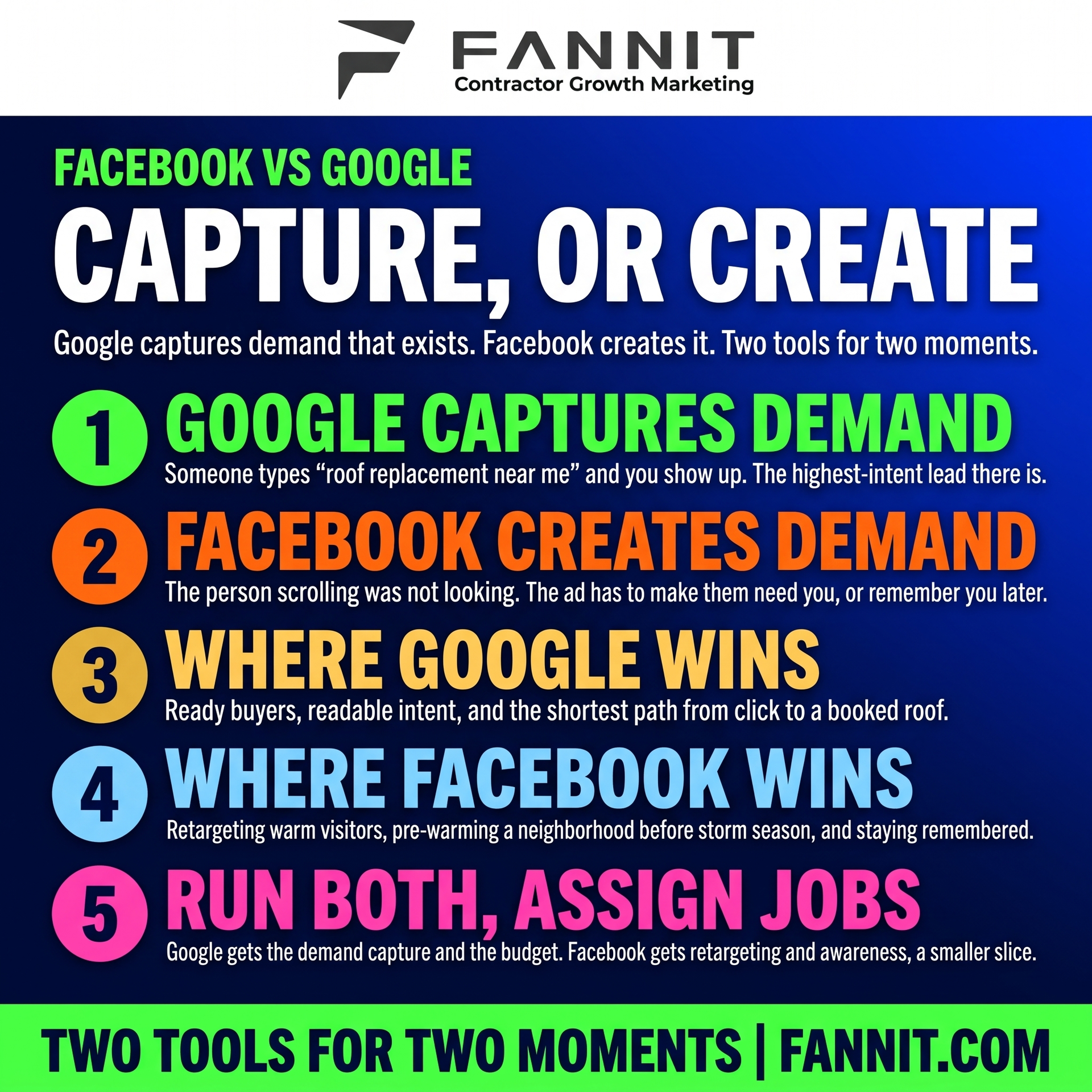
Google Ads captures demand. Someone types "roof replacement near me" and you show up. They already decided they need a roofer, and your ad just wins the moment. That is the highest-intent lead there is, and it is why Google Ads is the foundation of roofing paid search. Our guide to running Google Ads as a contractor shows how that capture works.
Facebook Ads create demand. The person scrolling Facebook was not looking for a roofer. Your ad interrupts them, and it has to make them realize they need one, or remember one when they do. That is a much harder sell, which is why Facebook converts differently, and why it is usually the wrong first dollar for a roofer who needs the phone to ring this week. Meta's advertising guide frames it the same way: it is about reaching people by who they are, not by what they just searched.
Where Google Ads Wins
Ready buyers. A search is a confession of need. "Emergency roof repair" is someone with a leak right now, and nothing beats being the ad at the top of that moment.
Intent you can read. You can see the exact search, bid on it, write for it, and measure it. That is the control that turns clicks into estimates. Our budget guide shows how to size that machine.
Faster path to a job. A search ad to a roofer is a shorter distance from click to booked roof than a Facebook ad, because the person is already moving. For a contractor who needs revenue now, Google is where the money is.
Where Facebook Ads Win
When nobody is searching yet. Roof replacement is a decision people make slowly, and most of them are not searching this week. Facebook lets you put your name in front of them before the need becomes urgent, so you are the one they remember. Our LSA versus ads guide shows how that "be remembered" job fits a wider funnel.
Retargeting the people who almost bought. The visitor who checked your roof replacement page and left is a warm lead. A Facebook retargeting ad brings them back for a fraction of what a new click costs, and it is the highest-return use of the platform for a roofer.
Seasonal awareness. Before storm season, a Facebook campaign can warm a neighborhood to your name, so when the hail hits, the search clicks find someone they already recognize. Our storm season guide shows how that pre-warming compounds when demand spikes.
How to Run Both Without Wasting Either
The mistake is splitting the budget fifty-fifty and hoping. The right way is to assign each platform a job.
Give Google the demand capture job. Put the bulk of the budget on the high-intent searches, the emergency terms, and the specific services. This is where the phone rings. Our Google Ads cost guide shows how to wire the tracking so you can see it.
Give Facebook the awareness and retargeting job. A smaller budget, aimed at warm audiences and past visitors, not at cold strangers who never asked. Its job is to make the Google clicks cheaper and the referrals easier, not to replace Google.
Measure each on its own job. Google on cost per booked roof from search. Facebook on what it does to brand recall and retargeting conversions, not on the same cost per lead. Comparing them head to head is how roofers get talked into wasting the budget on the wrong one.
Google and Facebook are not rivals for the same buyer. They are two tools for two moments, and the roofer who wins runs each at the job it was built for. Start with the account structure that keeps the two jobs separate, and our new roofing PPC account guide shows how to set it up from day one.
<a href="https://www.fannit.com/blog/facebook-ads-vs-google-ads-roofing/" title="Facebook Ads vs Google Ads for Roofing — PPC Guide"><img src="https://www.fannit.com/images/blog/infographic-facebook-ads-vs-google-ads-roofing-1920x1080.png" alt="Facebook Ads vs Google Ads for Roofing — PPC Guide [Infographic]" width="800" /></a><br /><small><a href="https://www.fannit.com/blog/facebook-ads-vs-google-ads-roofing/">Facebook Ads vs Google Ads for Roofing — PPC Guide</a> via <a href="https://www.fannit.com">Fannit | Contractor Growth Marketing</a></small>

Keith Eneix is the Co-Founder and President of Fannit, a digital marketing agency built exclusively for home service contractors. He still owns and operates a multi-seven-figure contracting business in the Pacific Northwest. Since 2010, Fannit has helped 200+ contractors generate $100M+ in documented revenue.
Full Bio