How Hardscape Contractors Use Houzz and Pinterest to Generate High-Ticket Leads
The homeowners who spend $50,000 to $150,000 on outdoor living projects do not find their contractors the same way someone looking for a $3,000 repair does. They research on Houzz and Pinterest. Here is how to be there.
How Hardscape Contractors Use Houzz and Pinterest to Generate High-Ticket Leads
The homeowners who spend $50,000 to $150,000 on outdoor living projects do not find their contractors the same way someone looking for a $3,000 patio repair does. The National Concrete Masonry Association provides design inspiration resources that align with what these homeowners search for on Houzz and Pinterest - and contractors who reference NCMA standards in their project descriptions signal the kind of technical credibility that high-budget homeowners are looking for. They spend months researching. They build inspiration boards. They save photos of projects they love and bring those photos to their first meeting with a contractor.
Houzz and Pinterest are where that research happens.
Most hardscape contractors ignore both platforms. They focus on Google Ads and Facebook, which are excellent for capturing demand but poor for creating it. Houzz and Pinterest sit at the top of the buyer journey, reaching homeowners before they have even decided what they want to build, let alone who they want to build it.
This post covers how to build a presence on both platforms that generates a consistent stream of high-ticket, high-intent leads.
Understanding Where Houzz and Pinterest Fit in the Buyer Journey
Before getting into tactics, it is worth understanding the role each platform plays.
Houzz is a home improvement platform where homeowners browse professional project photos, read reviews, and connect directly with contractors. It functions as a combination of Instagram, Yelp, and a contractor directory. Homeowners on Houzz are actively planning projects. They are not passively scrolling. They are researching contractors, saving photos for inspiration, and in many cases, ready to request quotes.
Pinterest is a visual discovery platform where homeowners save ideas for future projects. The buyer intent on Pinterest is lower than on Houzz, but the audience is larger and the planning horizon is longer. Homeowners who save hardscape inspiration on Pinterest today are often ready to start a project six to eighteen months later. Pinterest is a top-of-funnel platform that builds brand awareness and keeps your company in front of homeowners throughout their research process.
Together, the two platforms cover the full research journey: Pinterest for early-stage inspiration and awareness, Houzz for late-stage contractor evaluation and contact.
Building Your Houzz Profile
A Houzz profile is free to create and maintain. The paid "Pro+" tier adds additional features, but a well-optimized free profile can generate significant lead volume on its own.
Complete every section of your profile. Fill out your business description, service area, license information, and contact details completely. Houzz uses profile completeness as a ranking signal, similar to Google Business Profile. An incomplete profile ranks lower and converts worse than a complete one.
Upload your best project photos. This is the most important element of your Houzz presence. Upload at least 50 photos of completed projects, organized into project collections. Each project should have a title, a description, and photos that show the full scope of the work, from the site before construction through the finished result.
Write detailed project descriptions. Include the project type (patio, outdoor kitchen, fire feature, retaining wall, etc.), the materials used, the approximate square footage, and any design challenges you solved. The same documentation system that produces strong Houzz content also powers your before/after photo marketing - the two channels share the same raw material. These descriptions add keyword-rich content to your profile that helps Houzz surface your work in relevant searches.
Collect Houzz reviews. Houzz reviews are separate from Google reviews and carry significant weight on the platform. Ask every completed project customer to leave a Houzz review. A profile with 20 or more reviews ranks dramatically better than one with fewer than five.
Respond to every review and inquiry promptly. Houzz tracks response time and uses it as a ranking factor. Contractors who respond to inquiries within a few hours rank higher than those who take days to respond. Set up Houzz notifications on your phone and treat Houzz inquiries with the same urgency as a phone call.
Use the "Ideabooks" feature strategically. Houzz allows you to create curated collections of photos called Ideabooks. Create Ideabooks organized by project type (patios, outdoor kitchens, fire features, water features, etc.) and by style (modern, traditional, rustic, etc.). Homeowners browse Ideabooks when planning projects, and your photos in those collections expose your work to a wider audience.
The Houzz Pro+ Decision
Houzz Pro+ is a paid subscription that gives you additional visibility in search results, a featured placement in your service area, and access to lead generation tools. The cost varies by market and service area, typically ranging from $300 to $800 per month.
Whether Pro+ is worth the investment depends on your market and your existing Houzz presence. In competitive markets with high-ticket project averages, Pro+ often generates a strong return. In smaller markets or for companies just starting on Houzz, building a strong free profile first and evaluating paid options after you have established a baseline is the more prudent approach.
If you do invest in Pro+, treat it as a complement to your free profile optimization, not a substitute for it. The companies that get the best results from Pro+ are the ones with strong profiles, great photos, and consistent reviews.
Building Your Pinterest Presence
Pinterest requires a different approach than Houzz. The platform rewards consistency, visual quality, and keyword optimization. The goal is not to generate immediate leads but to build a library of content that drives steady traffic to your website over time.
Create a business account. A Pinterest business account gives you access to analytics, promoted pins, and the ability to claim your website. Set up your account with your company name, logo, and a keyword-rich description of your services and service area.
Create boards organized by project type and style. Create separate boards for each major project category: Patios and Outdoor Living, Outdoor Kitchens, Fire Pits and Fireplaces, Retaining Walls and Landscaping, Water Features, and so on. Also create style-based boards: Modern Outdoor Spaces, Traditional Patio Designs, Rustic Outdoor Living, etc.
Homeowners search Pinterest by project type and style. Having boards that match these search patterns increases the likelihood that your content appears in relevant searches.
Pin your own project photos consistently. Pin photos from your completed projects to the relevant boards. Each pin should have a keyword-rich description that includes the project type, materials, location (city and state), and a brief description of the work. Include a link back to the relevant page on your website.
Pin at least five to ten times per week. Consistency matters on Pinterest. Accounts that pin regularly rank better in Pinterest search and reach more homeowners than accounts that pin in bursts and then go quiet.
Optimize your pin descriptions for search. Pinterest is a search engine as much as it is a social platform. Homeowners search for terms like "backyard patio ideas," "outdoor kitchen with pergola," "fire pit seating area," and "modern hardscape design." Include these types of phrases naturally in your pin descriptions.
Link every pin to a relevant page on your website. Every pin should link back to a project gallery, a service page, or a blog post on your website. This drives traffic from Pinterest to your site and creates a path for interested homeowners to contact you.
Creating Content That Performs on Both Platforms
The content that performs best on Houzz and Pinterest shares several characteristics:
High-quality photography. This is non-negotiable. Blurry, poorly lit, or poorly composed photos will not generate engagement on either platform. Invest in professional photography for your best projects, or at minimum, learn the basics of smartphone photography: good natural light, clean composition, multiple angles, and detail shots.
Before-and-after sequences. Before-and-after content performs exceptionally well on both platforms because it tells a story and demonstrates transformation. Show the site before construction, during key stages, and after completion. This type of content generates significantly more saves and engagement than finished-product-only photos.
Detail shots. Wide-angle photos of the full project are important, but detail shots of specific elements (the pattern of a paver installation, the stonework on a fire feature, the cabinetry in an outdoor kitchen) demonstrate craftsmanship and attract homeowners who care about quality.
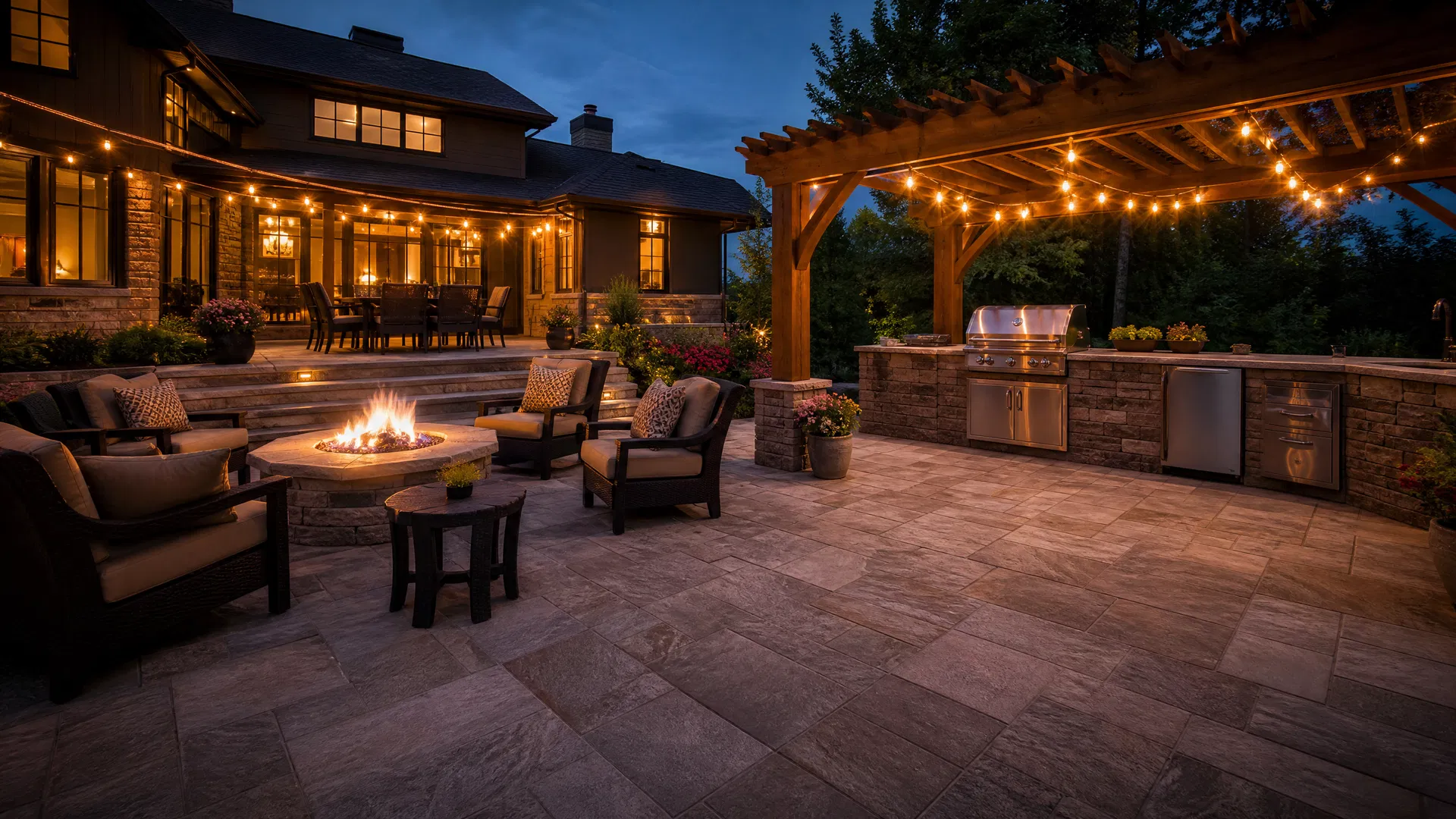
Lifestyle photos. Photos of the finished space being used, with furniture, plants, and lighting, help homeowners visualize themselves in the space. A patio with outdoor furniture, string lights, and a fire pit burning is more compelling than the same patio empty.
Connecting Houzz and Pinterest to Your Lead Generation System
The goal of your Houzz and Pinterest presence is not just to generate saves and views. It is to convert interested homeowners into leads. Every piece of content you publish on these platforms should have a clear path back to your website and your lead capture system.
On Houzz, this means keeping your contact information current, responding to inquiries promptly, and including a call to action in your project descriptions that directs homeowners to your website or contact form.
On Pinterest, this means linking every pin to a relevant page on your website and making sure those pages have clear calls to action (free estimate forms, phone numbers, consultation booking links). Pinterest traffic spikes in January and February as homeowners begin planning spring projects - the spring booking strategy guide covers how to convert that research-phase interest into booked consultations.
Fannit's hardscape visual and full-funnel marketing program connects the top-of-funnel awareness that Houzz and Pinterest generate with the bottom-of-funnel conversion infrastructure - Google Ads, local SEO, and a lead nurture system - that turns that awareness into booked consultations. If you want to talk through what that looks like for your company, schedule a free strategy call.
High-ticket hardscape marketing requires presence at every stage of the buyer journey. The best hardscape marketing agencies that understand this build the visual platform strategy alongside the paid and organic channels, not as a separate initiative.
Frequently Asked Questions
How long does it take to see results from Houzz?
A fully optimized Houzz profile with strong photos and reviews typically generates its first leads within 60 to 90 days. Ongoing lead volume grows as you accumulate more reviews and more project photos. Houzz is a medium-term investment, not an immediate lead source.
Is Pinterest worth the time investment for a hardscape contractor?
Yes, particularly for companies targeting high-ticket projects. Pinterest users who save hardscape inspiration are often planning significant investments. The platform drives long-term brand awareness and website traffic that compounds over time. The time investment is relatively low once you have a system for pinning consistently.
Should I hire a photographer for my project photos?
For your best projects, yes. Professional photography makes a significant difference in engagement on both platforms. For smaller or less photogenic projects, high-quality smartphone photography is sufficient. The key is consistent quality across all your content.
How do I handle negative reviews on Houzz?
The same way you handle them on Google: acknowledge the concern, apologize for the experience, and offer to resolve it offline. Never argue with a reviewer in your public response. The audience for your response is future customers, not the person who left the review.
Can I use the same photos on both Houzz and Pinterest?
Yes. Your project photos should be published on both platforms, your website gallery, Google Business Profile, and social media. Each platform serves a different audience and a different stage of the buyer journey. Publishing the same photos across all platforms maximizes the reach of your photography investment.

Keith Eneix is the Co-Founder and President of Fannit, a digital marketing agency built exclusively for home service contractors. He still owns and operates a multi-seven-figure contracting business in the Pacific Northwest. Since 2010, Fannit has helped 200+ contractors generate $100M+ in documented revenue.
Full Bio